
Bring your strengths. Build a team.
Role of Talent and Core Values
A robotics coach’s conversation with students about talent, teamwork and core values—and why how a team works together matters as much as individual ability.
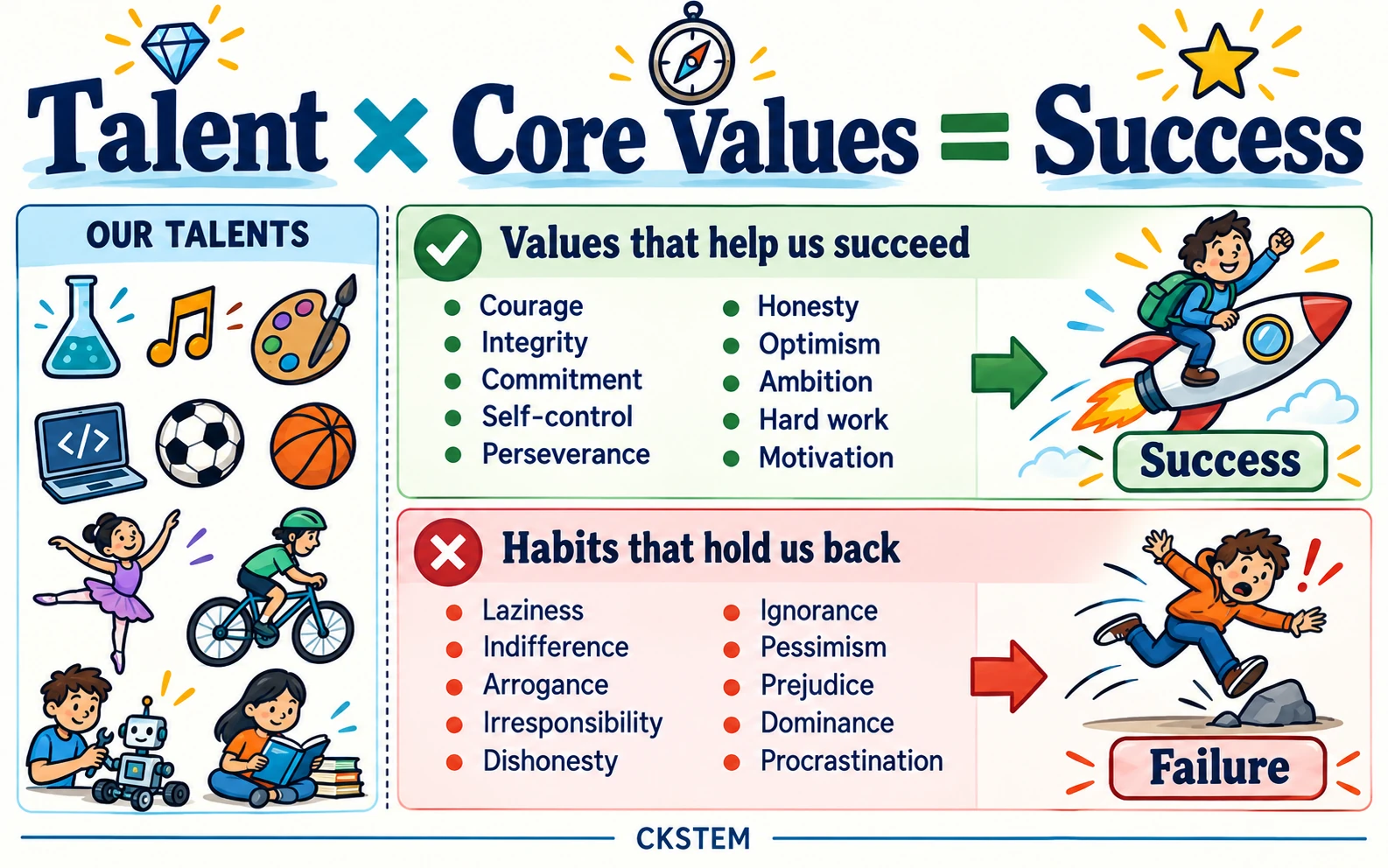
Read the diagram as text
Talent × Core Values = Success. The same talents can be applied with different values and habits. The illustration shows talents in science, music, art, coding, sports, dance, robotics and learning.
Values that help us succeed: Courage, Integrity, Commitment, Self-control, Perseverance, Honesty, Optimism, Ambition, Hard work, Motivation.
Habits that hold us back: Laziness, Indifference, Arrogance, Irresponsibility, Dishonesty, Ignorance, Pessimism, Prejudice, Dominance, Procrastination.
The upper path leads to success; the lower path illustrates failure.
On this page
I had the privilege of coaching an FLL Robotics team in the 2019 City Shaper competitions. It was an amazing experience to work with so many talented kids. I was fortunate to receive the Best Coach award, which encouraged me to share my experiences.
A conversation about talent
I was discussing core values with some of the team members, but the conversation sounded very theoretical to them. With their strong coding and design skills, they thought the team should do very well.
Given their strength in math, I tried to explain the idea in mathematical terms. A team cannot simply choose the talents its members bring. Team members are who they are, just as family members are. A good family figures out how to respect and celebrate the diversity of each person’s talents.
For this discussion, I asked the students to think of the team’s talent as a constant. It is what the team has to work with; it cannot be changed dramatically within the span of a project.
Talent, for the duration of a team’s project, is a constant.
They nodded, then asked, “If team talent is a constant, why don’t talented teams always win?”
Finding the variable
“Now we know the constant in our equation of success,” I said. “Is there a variable that could affect the result?”
They understood the question but could not answer it. So I asked, “Do you like working in a team, or do you feel you can get more done alone?”
Some said that other people slowed them down. They could work much faster if they did everything themselves.
“Do you see a variable here?” I asked.
“Yes,” they said. “The variable is teamwork. We are less efficient as a team, but more effective individually.”
I asked them to hold on to that idea about variables. “If you are so talented, you must be cooking your own food and driving yourself to school!”
They thought I was being silly. They said they were too young to cook and drive.
I asked them to pause and think. “What if your parents started thinking that you were slowing them down? They have to cook more food and spend time taking you to school. They do these things happily every day, don’t they?”
The students agreed. In a family, parents demonstrate teamwork and leadership without constantly weighing up how much each person contributes. Yet in an FLL team, we can become a little selfish. We may fail to appreciate the different skills each member brings. Sometimes we become arrogant, and that affects the team’s performance.
“So what is the variable in our equation of team success?”
By then, they were connecting our conversation to core values: teamwork, inclusion, respect and more. They said the variable must be core values.
Core values are the variables a team can work on and improve.
Putting core values into the equation
I explained that, in our model, success is the product of a constant—talent—and a variable—core values. If the constant is fixed for the project, we improve the team’s chances of success by fine-tuning the variable, just as we adjust a PID controller.
Talent × Core Values = Team Success
The students agreed, but they were still unsure whether this variable could make such a big difference. I asked them to try some simple calculations.
Imagine four teams, each with ten members. Give each member an illustrative talent score from 1 to 10, then add those scores to obtain a total for the team. Keeping each team’s talent total fixed, adjust the core-values multiplier and compare the results:
Move a factor to explore the example. The talent total for each team stays the same.
- Talent100Below averageResult
- Talent90AverageResult
- Talent80Above averageResult
- Talent70BestResult
View the original four-team comparison

After these calculations, the students were amazed to see why talent alone does not guarantee success. In the illustration, the team with the lowest perceived talent could outperform the others by working together more effectively. Talent matters, but core values influence how well a team uses it.
They began to understand why teamwork and collaboration are so important. We need to make good use of each other’s strengths and be patient and supportive, just as we are in a good family.
More than winning a competition
FLL encourages teams to work like extended families by focusing on core values. This learning matters more than winning a competition. Many of these children may one day create amazing robots. But if they do not learn to put core values into practice, they may find that they have few people around them to celebrate their success.
I wish every team the very best for the next round. Have fun, and spread core values by making them part of your everyday life.
The FLL core values
- Discovery: We explore new skills and ideas.
- Innovation: We use creativity and persistence to solve problems.
- Impact: We apply what we learn to improve our world.
- Inclusion: We respect each other and embrace our differences.
- Teamwork: We are stronger when we work together.
- Fun: We enjoy and celebrate what we do!