Mathematical typesetting is unavailable. Reload this page to try again.
A problem-solving strategy
Make an organized list
Every possibility. Exactly once. A reason to trust the answer.
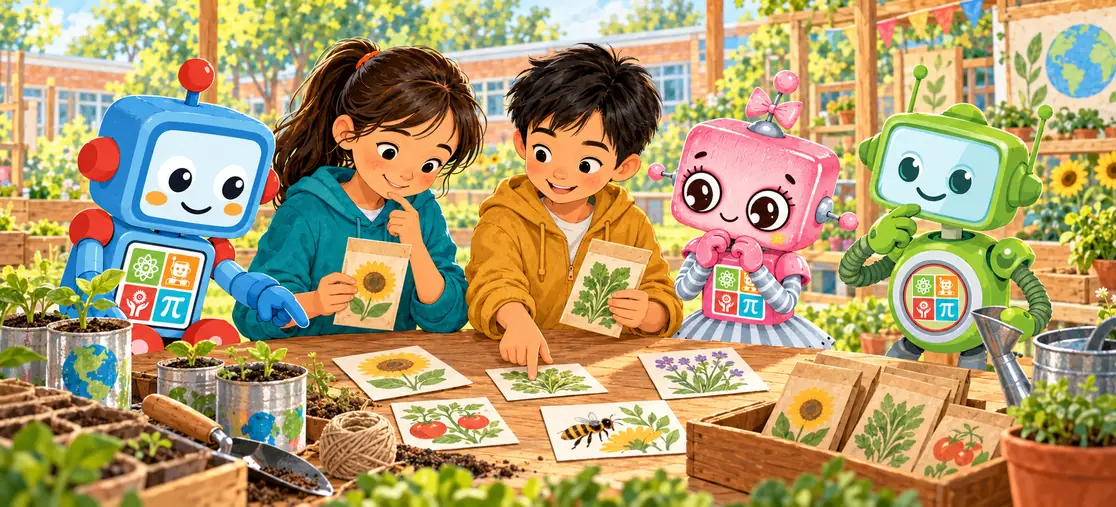
At the garden worktable, the team compares possible seed displays.
Mina and her friend Li Wei are preparing a garden display. Li Wei loves asking whether an idea really works. Their coach, CKSprout—Sprout for short—helps them think through the choices.
Visitors will choose a pair of seed varieties. The children want one picture card for every different pair, so every visitor can see all the choices.
Mina “I’ve made a few cards. But how will we know when we have them all?”
Li Wei “And how will we know we haven’t counted the same choice twice?”
CKSTEM Thinking CompassStuck? Find your next move.
You don’t need the whole route yet. Start with one useful move, then notice what it tells you.
What do you know for certain? What are you trying to find?
After checking your steps against every clue, choose your own check:
Ready to explore.
The direction reflects your self-check. Use the lesson’s answer and reasoning to check further when you are ready.
01
The missing display cards
There are four seed varieties: Basil, Bean, Marigold and Sunflower. Each card shows two different varieties. A pair is the same choice whichever variety is named first: Basil with Bean is the same pair as Bean with Basil.
Which different pairs should the display show—and how can the team be certain none is missing?
Mina’s first cards are a mixed-up start:
1Basil+Bean
2Basil+Sunflower
3Bean+Basil
4Marigold+Sunflower
A first pile of four cards. Which choices are different?
Li Wei “These two cards name the same pair in a different order. Four cards don’t necessarily mean four different choices.”
CKSprout “What would make the missing choices easier to notice?”
A growing pile of guesses is hard to check. The team needs a rule for what comes next.
Try with the CKSTEM Thinking Compass
Interactive checking needs JavaScript. The complete question and worked answer remain available.
Which different pairs should the display show—and how can the team be certain none is missing?
There are four seed varieties: Basil, Bean, Marigold and Sunflower. Each card shows two different varieties. A pair is the same choice whichever variety is named first: Basil with Bean is the same pair as Bean with Basil.
Mina’s first cards are a mixed-up start:
1Basil+Bean
2Basil+Sunflower
3Bean+Basil
4Marigold+Sunflower
A first pile of four cards. Which choices are different?
Li Wei “These two cards name the same pair in a different order. Four cards don’t necessarily mean four different choices.”
CKSprout “What would make the missing choices easier to notice?”
A growing pile of guesses is hard to check. The team needs a rule for what comes next.
Your answer
The Compass checks the numbers. Compare your list and explanation with the complete worked answer when you are ready.
This count fits. Also check your actual choices and the reason your search is complete.
Break it into steps
Step 1 of 2
How many partners can Basil have among the other varieties?
Basil pairs with each of the other 3 varieties. Finish this group before moving to the next variety.
Step 2 of 2
How many different seed pairs are there in all?
The groups have three, two and one new pairs: \(3+2+1=6\). Compare your actual pairs with the complete list; the number alone does not establish coverage.
You have worked through these help steps. Return to Your answer when you are ready, and check every original clue.
Give the search an order
Make an organized list: choose an order and follow it, so you find every allowed choice once.
Use it to find all the ways, test choices against a clue, or check whether there is just one answer.
A neat list of guesses might still miss a choice. Your system should explain why nothing is missed and why nothing is repeated.
02
Finish one group before moving on
Show the answer and reasoning
Answer: There are 6 different pairs, listed below.
Mina “Let’s keep the varieties in this order: Basil, Bean, Marigold, Sunflower.”
Li Wei “For each pair, we’ll name the earlier variety first. Then a reversed pair won’t get another card.”
Start with Basil. Pair it with each later variety: Bean, Marigold and Sunflower.
Move to Bean. Basil–Bean is already included. The new partners are Marigold and Sunflower.
Move to Marigold. Its only later partner is Sunflower.
Stop at Sunflower. It has no later partner. Every earlier partnership has already been considered.
Start with Basil3 new pairs
1Basil+Bean
2Basil+Marigold
3Basil+Sunflower
Start with Bean2 new pairs
4Bean+Marigold
5Bean+Sunflower
Start with Marigold1 new pair
6Marigold+Sunflower
The earlier variety fixes the group; every later partner appears once.
\[3+2+1=6\text{ pairs}\]
The grid shows the same system. A variety cannot pair with itself here. A reversed pair is the same choice, so only one of its two positions is used.
BaBasilBeBeanMMarigoldSSunflower
Use only the numbered cells: one place for every different pair.
With
Ba
Be
M
S
Ba
—
1
2
3
Be
Seen
—
4
5
M
Seen
Seen
—
6
S
Seen
Seen
Seen
—
— same variety, not allowed. “Seen” marks a reversed pair already counted. Numbers match the six cards above.
Why can we trust this list?
Every allowed pair has one variety earlier in the fixed order. Its card belongs to that variety’s group, so every pair has a place. We included every later partner in that group. No pair can belong to two different earlier-variety groups, so no pair is counted twice.
CKSprout “What did the system reveal about the first pile?”
Mina “It repeated Basil–Bean. It missed Basil–Marigold, Bean–Marigold and Bean–Sunflower.”
The six cards are the answer. The grouping rule is the reason we know the answer is complete.
Systematic counting
Split the possibilities into groups that cover every allowed choice and do not overlap. Then add the group counts.
Another way to check the count
The plant groups contain three, two and one new pairs. We can also count two-position choices first: four choices for the first variety and three different choices for the second.
\[4\times3=12\]
That counts Basil–Bean and Bean–Basil separately. For these seed pairs, every pair has been counted exactly twice, so:
\[12\div2=6\]
The division is justified by the two counted orders. It is not a rule to apply to every choice problem.
Change the question: does order matter?
Li Wei now designs a display with a left pot and a right pot. For each pot he can choose Basil, Bean, Marigold or Sunflower, but the two pots must contain different varieties. Two displays count as different if either pot contains a different variety.
How many different left-and-right displays can he make?
Mina “Can we count these the same way as the seed pairs?”
CKSprout “What makes two displays different here?”
Try with the CKSTEM Thinking Compass
Interactive checking needs JavaScript. The complete question and worked answer remain available.
How many different left-and-right displays can he make?
Change the question: does order matter?
Li Wei now designs a display with a left pot and a right pot. For each pot he can choose Basil, Bean, Marigold or Sunflower, but the two pots must contain different varieties. Two displays count as different if either pot contains a different variety.
Mina “Can we count these the same way as the seed pairs?”
CKSprout “What makes two displays different here?”
Your answer
The Compass checks the numbers. Compare your list and explanation with the complete worked answer when you are ready.
This count fits. Also check your actual choices and the reason your search is complete.
Break it into steps
Step 1 of 2
For one fixed left-hand variety, how many right-hand choices are allowed?
With Basil fixed on the left, Bean, Marigold or Sunflower can be on the right: three choices.
Step 2 of 2
How many left-and-right displays are there altogether?
Four left varieties each allow three right varieties: \(4\times 3=12\). Left and right have different jobs, so keep both orders.
You have worked through these help steps. Return to Your answer when you are ready, and check every original clue.
Show the answer and reasoning
Answer: There are 12 different left-and-right displays.
Left potBasil
Right potBean
Left potBean
Right potBasil
Two different displays: left and right are distinct positions.
Li Wei “We can still choose each left-hand variety in turn. This time, all three other varieties are allowed on the right.”
Mina “So Basil on the left and Bean on the right stays different from Bean on the left and Basil on the right. The two positions do different jobs.”
\[4\times3=12\text{ displays}\]
Before listing or counting, ask “What makes two choices different in this problem?” The objects stayed the same; the question changed.
03
A gift bag with more moving parts
The team makes gift bags holding six seed packets. Only Basil, Bean and Sunflower packets are used, and every bag must contain at least one of each. Two bags are the same mix when their three packet counts match; moving packets around inside a bag does not create a new mix.
How many different mixes are possible?
Try with the CKSTEM Thinking Compass
Interactive checking needs JavaScript. The complete question and worked answer remain available.
How many different mixes are possible?
The team makes gift bags holding six seed packets. Only Basil, Bean and Sunflower packets are used, and every bag must contain at least one of each. Two bags are the same mix when their three packet counts match; moving packets around inside a bag does not create a new mix.
Your answer
The Compass checks the numbers. Compare your list and explanation with the complete worked answer when you are ready.
This count fits. Also check your actual choices and the reason your search is complete.
Break it into steps
Step 1 of 2
With one Basil packet fixed, how many positive Bean/Sunflower splits are possible?
Five packets remain. Bean can be 1,2,3 or 4, leaving 4,3,2 or 1 Sunflower packets. These are four different mixes.
Step 2 of 2
How many six-packet mixes satisfy every rule?
The four Basil groups contain \(4+3+2+1=10\) mixes. Each full triple has one position in the system.
You have worked through these help steps. Return to Your answer when you are ready, and check every original clue.
A question to help me begin
Could you keep one packet count fixed while you change another?
Show the answer and reasoning
Answer: There are 10 different packet mixes.
Mina “If we change all three counts at once, it will be easy to skip a mix.”
Li Wei “Let’s fix the Basil count first. For each Basil count, increase Bean one at a time. Sunflower gets the packets left.”
There can be at most four Basil packets: one Bean and one Sunflower must still fit. With one Basil packet, Bean can be one, two, three or four. With two Basil packets, Bean can be one, two or three—and so on.
BasilBeanSunflower
Fix Basil at 14 mixes
1 Basil, 1 Bean, 4 Sunflower
1 Basil, 2 Bean, 3 Sunflower
1 Basil, 3 Bean, 2 Sunflower
1 Basil, 4 Bean, 1 Sunflower
Fix Basil at 23 mixes
2 Basil, 1 Bean, 3 Sunflower
2 Basil, 2 Bean, 2 Sunflower
2 Basil, 3 Bean, 1 Sunflower
Fix Basil at 32 mixes
3 Basil, 1 Bean, 2 Sunflower
3 Basil, 2 Bean, 1 Sunflower
Fix Basil at 41 mix
4 Basil, 1 Bean, 1 Sunflower
Every strip has six packets. Read the named counts as well as the colours.
\[4+3+2+1=10\]
Every allowed bag has exactly one Basil count, then exactly one Bean count. Those two counts force its Sunflower count. Every permitted first count and second count is included, so every mix appears once.
Check a row against every rule.
For example, two Basil, one Bean and three Sunflower packets give \(2+1+3=6\). All three counts are positive. Reordering those six packets produces the same mix.
A list is only as good as its rules
The first cards needed two different varieties. The bags could repeat a variety, but needed all three types. When the rules change, check what counts as one choice again.
Sorting your first guesses can help you find a system. Then ask: does my system reach every allowed choice?
If your list gets very long, look for a rule that lets you skip steps safely. You still need a reason that the skipped cases follow your rule.
A small change to think through
The team can stamp a label with two symbols chosen from Leaf, Sun, Drop and Star. The same symbol may be used twice. Swapping the two symbols counts as the same label design.
How many different label designs are there?
Try with the CKSTEM Thinking Compass
Interactive checking needs JavaScript. The complete question and worked answer remain available.
How many different label designs are there?
A small change to think through
The team can stamp a label with two symbols chosen from Leaf, Sun, Drop and Star. The same symbol may be used twice. Swapping the two symbols counts as the same label design.
Your answer
The Compass checks the numbers. Compare your list and explanation with the complete worked answer when you are ready.
This count fits. Also check your actual choices and the reason your search is complete.
Break it into steps
Step 1 of 2
How many labels use the same symbol twice?
Leaf–Leaf, Sun–Sun, Drop–Drop and Star–Star give four same-symbol designs. Each has only one order.
Step 2 of 2
How many different label designs are there?
The groups have \(4+3+2+1=10\) designs. Do not halve sixteen: equal-symbol choices were counted only once.
You have worked through these help steps. Return to Your answer when you are ready, and check every original clue.
A question to help me begin
Use the fixed symbol order. When starting a group, should its first symbol be allowed to pair with itself?
Show the answer and reasoning
Answer: There are 10 different label designs.
The Leaf group has four partners, including Leaf. The Sun group has three new partners, the Drop group two, and the Star group one.
Leaf + Leaf
Leaf + Sun
Leaf + Drop
Leaf + Star
Sun + Sun
Sun + Drop
Sun + Star
Drop + Drop
Drop + Star
Star + Star
Equal symbols are allowed; reversed versions of different symbols are not repeated.
\[4+3+2+1=10\]
Each pair is recorded with its earlier symbol first, allowing equality. That includes every permitted pair without recording its reversal again.
Why not count all sixteen ordered choices and divide by two? A pair such as Leaf–Leaf has only one order, while Leaf–Sun has two. Not every design was counted twice.
04
The missing packing note
The packing note for a seedling delivery is missing. Every tray was either small or large and was full on arrival: a small tray held 3 seedlings and a large tray held 5 seedlings. There was at least one tray of each size.
The team first donated half the original seedlings to another class. Then they planted 7 seedlings in their display. They had 14 seedlings left.
Donation and planting moved individual seedlings, not necessarily full trays. All seedlings stayed whole, and no others were added or removed.
Find every possible mix of small and large trays that could have arrived. Do the clues tell us which mix actually arrived?
Try with the CKSTEM Thinking Compass
Interactive checking needs JavaScript. The complete question and worked answer remain available.
Find every possible mix of small and large trays that could have arrived. Do the clues tell us which mix actually arrived?
The packing note for a seedling delivery is missing. Every tray was either small or large and was full on arrival: a small tray held 3 seedlings and a large tray held 5 seedlings. There was at least one tray of each size.
The team first donated half the original seedlings to another class. Then they planted 7 seedlings in their display. They had 14 seedlings left.
Donation and planting moved individual seedlings, not necessarily full trays. All seedlings stayed whole, and no others were added or removed.
Your answer
Add a row for each possible tray mix. Keep its small and large tray counts together. Decide separately whether the clues identify which delivery actually arrived.
Your complete set of tray mixes fits. Explain why there are no others and why the actual arrival cannot be identified.
Break it into steps
Help step 1
How many seedlings were there before planting seven?
\(14+7=21\) seedlings remained just after the donation.
Help step 2
How many seedlings arrived originally?
\(21\times 2=42\) seedlings arrived. This fixes a total, not the tray mix.
Help step 3
What is the last large-tray count that needs testing before capacity alone becomes too large?
Seven is an upper bound for trials, not a confirmed delivery. Eight large plus one small would need \(8\times 5+3=43\) seedlings, more than 42.
You have worked through these help steps. Return to Your answer when you are ready, and check every original clue.
A question to help me begin
Which facts describe the start, and which describe the finish? What must a complete delivery explain?
Show the answer and reasoning
Answer: There are two possible mixes: 9 small trays and 3 large trays, or 4 small trays and 6 large trays. The clues do not tell us which of these actually arrived.
Mina “Planting seven happened last. Before that, there were twenty-one seedlings.”
CKSprout “Which moment does that twenty-one describe?”
Li Wei “After the donation. Half remained, so the original delivery had twice as many: forty-two.”
Work backwards
Start with the known finish and recover earlier stages in reverse order. Put back the planted seedlings before undoing the earlier half-donation:
Follow the arrows from the known finish back to arrival. Undo the last event before the earlier donation.
The original total is now known. It still does not tell us how that total was divided between the two tray sizes.
Li Wei “I’ll increase the large-tray count one at a time. Each count leaves a fixed number of seedlings for small trays.”
CKSprout “How will you know where to stop?”
Mina “Both sizes were there. Eight large trays and even one small tray would already hold forty-three. I only need to try one through seven large trays.”
\[8\times5+3=43>42\]
Mina “One large tray leaves thirty-seven seedlings for small trays. Thirty-seven cannot fill whole trays of three.”
CKSprout “What has that trial told you?”
Li Wei “It rules out that large count, not every mix. I’ll continue through seven.”
Check every allowed large-tray count, from 1 to 7.
Large trays
Seedlings in them
Seedlings for small trays
Does the remainder fit?
1
5
37
Cannot fill whole small trays
2
10
32
Cannot fill whole small trays
3
15
27
9 whole small trays
4
20
22
Cannot fill whole small trays
5
25
17
Cannot fill whole small trays
6
30
12
4 whole small trays
7
35
7
Cannot fill whole small trays
Every matching row describes a complete mix. The two matching rows both need to be retained.
Mina “Three large trays leave \(42-15=27\) seedlings. Those fill \(27\div3=9\) small trays.”
Li Wei “Six large trays leave \(42-30=12\). Those fill \(12\div3=4\) small trays. We have two matching rows.”
CKSprout “What shows that your list is complete?”
Mina “We checked every allowed large count. Each fixes one small count, so no mix is missed or repeated. Finding the first matching row would have missed the second one.”
For either mix, donate half: \(42-21=21\). Plant seven: \(21-7=14\). Both use full trays of both sizes, and every seedling count is whole.
CKSprout “What can the clues tell us about which mix actually arrived?”
Li Wei “Both deliveries end with fourteen seedlings. We cannot choose between them without another clue.”
How the strategies shared the work
Work backwards recovered the original delivery once. Make an organized list then found the complete set of tray mixes. Knowing a total did not force one packing.
05
A bigger CIC delivery
For their Canadian Innovation Contests (CIC) garden display, the team receives a separate delivery of 40 full trays, all either small or large. Small trays hold 3 seedlings, large trays hold 5, and there is at least one tray of each size.
First, they donate one quarter of the original seedlings to the school garden.
Then they plant 18 seedlings in their CIC display.
They have 108 seedlings left.
Donation and planting use individual seedlings, not necessarily whole trays. All seedlings stay whole, and no others are added or removed.
How many small trays and how many large trays arrived? Could a different mix fit every clue?
Try with the CKSTEM Thinking Compass
Interactive checking needs JavaScript. The complete question and worked answer remain available.
How many small trays and how many large trays arrived? Could a different mix fit every clue?
For their Canadian Innovation Contests (CIC) garden display, the team receives a separate delivery of 40 full trays, all either small or large. Small trays hold 3 seedlings, large trays hold 5, and there is at least one tray of each size.
First, they donate one quarter of the original seedlings to the school garden.
Then they plant 18 seedlings in their CIC display.
They have 108 seedlings left.
Donation and planting use individual seedlings, not necessarily whole trays. All seedlings stay whole, and no others are added or removed.
Your answer
The Compass checks the numbers. Compare your list and explanation with the complete worked answer when you are ready.
The two counts fit. Also explain why no other mix can satisfy every clue.
Break it into steps
Step 1 of 6
Before planting, how many seedlings remained after the donation?
\(108+18=126\) seedlings represent three remaining quarters.
Step 2 of 6
How many seedlings were in the full original delivery?
\(126\div 3=42\), then \(42\times 4=168\) seedlings.
Step 3 of 6
How many seedlings are in the first legal mix: one large tray and 39 small trays?
\(39\times 3+5=122\) seedlings. This is the first legal row, not an all-small delivery.
Step 4 of 6
How many tray-replacement steps take the first legal row to 168 seedlings?
Each replacement adds \(5-3=2\) seedlings. The extra \(168-122=46\) needs \(46\div 2=23\) steps.
Step 5 of 6
How many small trays arrived?
There are \(1+23=24\) large trays, leaving \(40-24=16\) small trays.
Step 6 of 6
How many large trays arrived?
\(40-16=24\) large trays. Check the original donation and planting, then justify why a different row cannot give the same total.
You have worked through these help steps. Return to Your answer when you are ready, and check every original clue.
A question to help me begin
What can you settle before choosing a tray mix? How could you keep track of all the allowed choices?
Show the answer and reasoning
Answer: There were 16 small trays and 24 large trays. No different mix fits every clue.
Recover the total before choosing a tray mix
Mina “I’ll put back the eighteen planted seedlings first. That makes one hundred and twenty-six after donation.”
CKSprout “How is that amount connected to the original delivery?”
Li Wei “It is the three quarters left. One quarter is forty-two, so four quarters make one hundred and sixty-eight.”
Follow the arrows from the known finish back to arrival. Undo the last event before the earlier donation.
Begin a complete search in a fixed order
Li Wei “Both sizes must be there. I’ll start with one large and thirty-nine small, then increase the large count one at a time. The last possible large count is thirty-nine.”
CKSprout “What fixes the small count in each row?”
Mina “There are forty trays altogether. One large leaves thirty-nine small; two large leave thirty-eight small; and so on.”
Every allowed large count from 1 to 39 has exactly one partner. That gives a complete order without missing or repeating a mix.
Mina “The first three totals are one hundred and twenty-two, one hundred and twenty-four, and one hundred and twenty-six. The total rises by two.”
CKSprout “What would show that the change keeps working?”
Li Wei “Each step replaces one tray of three with one tray of five. There are still forty trays, and every replacement adds two seedlings.”
Check the first rows, then explain the change before skipping rows.
Large trays
Small trays
Total seedlings
1
39
122
2
38
124
3
37
126
4
36
128
The intervening large counts are 5 through 38. We will explain the rule that covers them.
39
1
198
The tray counts always add to forty. Each permitted large count appears once in the complete order.
Look for a pattern
Notice a relationship, explain why it continues, then use it to reach a case you have not calculated yet. Here the replacement explains the change in every permitted row, not just the first few.
Small: 3 seedlings
→Replace one tray+2 seedlings
Large: 5 seedlings
One tray replaces one tray. The extra two seedlings explain every step, not just the first few.
\[5-3=2\]
Mina “Our legal rows run from one hundred and twenty-two to one hundred and ninety-eight seedlings, so one hundred and sixty-eight lies between them. The first row has one large tray. We need forty-six more seedlings from there.”
CKSprout “Where does that put you in your order?”
Li Wei “Each step adds two, so it takes twenty-three more steps. I started at one large tray: one plus twenty-three is twenty-four large trays.”
\[\begin{aligned}168-122&=46\\46\div2&=23\text{ more steps}\\1+23&=24\text{ large trays}\\40-24&=16\text{ small trays}\end{aligned}\]
Twenty-four is within the allowed large counts. Every step strictly increases the total by two, so no other row can give the same 168 seedlings. The explained rule lets us jump within a complete list instead of calculating all 39 totals.
Check every original clue.
There are \(16+24=40\) full trays, including both sizes. The small trays hold \(16\times3=48\) seedlings; the large trays hold \(24\times5=120\). Together:
Every seedling count is whole, and the finish is exactly right.
How the strategies shared the work
Make an organized list gave every permitted tray mix one position, with a clear first legal row.
Work backwards recovered the delivery total from the finish, reversing the last event first.
Look for a pattern justified the constant change and reached the needed row without calculating every intervening total.
A complete order can reveal a useful relationship. Explain why it continues before using it to skip rows.
Your turn
Try a new setting. Decide what counts as different and choose your own system before opening an answer.
A small museum donation
You want to put exactly 25 cents in a donation box, using only 5-cent and 10-cent coins. You have enough of both types. You may use none of one type. Swapping coins of the same value, or changing their order, does not make a new way.
What are all the different coin-count mixes, and how many are there?
Try with the CKSTEM Thinking Compass
Interactive checking needs JavaScript. The complete question and worked answer remain available.
What are all the different coin-count mixes, and how many are there?
A small museum donation
You want to put exactly 25 cents in a donation box, using only 5-cent and 10-cent coins. You have enough of both types. You may use none of one type. Swapping coins of the same value, or changing their order, does not make a new way.
Your answer
Add a row for every possible coin-count mix, including a zero count when allowed, then give the number of mixes. Explain how you know none is missing.
These counts fit. Also check your actual choices and the reason your search is complete.
Break it into steps
Help step 1
What is the largest 10-cent coin count that does not exceed 25 cents?
Two 10-cent coins use 20 cents. Three would use 30 cents and exceed the target.
Help step 2
How many different coin-count mixes give exactly 25 cents?
For zero, one or two 10-cent coins, the 5-cent counts are five, three or one. There are three mixes. Compare your actual mixes and completeness argument with the answer.
You have worked through these help steps. Return to Your answer when you are ready, and check every original clue.
Show the answer and reasoning
Answer: There are 3 mixes: five 5-cent coins; three 5-cent coins and one 10-cent coin; or one 5-cent coin and two 10-cent coins.
List the 10-cent count in order: zero, one, two. Three would already be 30 cents, too much. The money still needed is 25, 15 or 5 cents, which fixes the 5-cent count at five, three or one. Every allowed 10-cent count is included once.
Check all three.
\(5\times5=25\), \(3\times5+10=25\), and \(5+2\times10=25\). Zero of a type is allowed; different coin orders were not counted again.
Two-scoop choices
An ice-cream shop has mango, vanilla, chocolate and strawberry. Every serving has exactly two scoops. Both scoops may have the same flavour.
How many cup choices and how many cone choices are there?
In a cup, only the flavours matter. Mango–vanilla and vanilla–mango count as the same choice. How many cup choices are there?
On a cone, the top and bottom flavours matter. Mango on top with vanilla below is different from vanilla on top with mango below. How many cone choices are there?
Try with the CKSTEM Thinking Compass
Interactive checking needs JavaScript. The complete question and worked answer remain available.
How many cup choices and how many cone choices are there?
Two-scoop choices
An ice-cream shop has mango, vanilla, chocolate and strawberry. Every serving has exactly two scoops. Both scoops may have the same flavour.
In a cup, only the flavours matter. Mango–vanilla and vanilla–mango count as the same choice. How many cup choices are there?
On a cone, the top and bottom flavours matter. Mango on top with vanilla below is different from vanilla on top with mango below. How many cone choices are there?
Your answer
The Compass checks the numbers. Compare your list and explanation with the complete worked answer when you are ready.
These counts fit. Also check your actual choices and the reason your search is complete.
Break it into steps
Step 1 of 3
How many cup choices have both scoops the same flavour?
Each of the four flavours gives one same-flavour cup, so there are four.
Step 2 of 3
How many cup choices are possible?
\(4+3+2+1=10\) cup choices. Grouping gives each outcome one place.
Step 3 of 3
How many cone choices are possible?
\(4\times 4=16\) cone choices. Different flavours can change places; equal-flavour cones keep one order.
You have worked through these help steps. Return to Your answer when you are ready, and check every original clue.
Show the answers and reasoning
Answer: There are 10 cup choices and 16 cone choices.
For cups, keep the flavour order above. Start with mango and use it with mango, vanilla, chocolate or strawberry: four choices. Then vanilla with vanilla, chocolate or strawberry: three new choices. Then chocolate with chocolate or strawberry: two. Finally strawberry with itself: one.
\[4+3+2+1=10\]
Every cup has exactly one place in this order. For cones, fix each top flavour in turn. Every top has four bottom choices, so \(4\times4=16\).
Check what changed.
The six cup choices with two different flavours each give two cone orders. The four same-flavour cups each give one: \(6\times2+4=16\). This also explains why \(16\div2\) would not count the cups correctly.
The music club’s boxes
A music club packs 10 full boxes of egg shakers. Small boxes hold 4 shakers; large boxes hold 7. There are 52 shakers altogether, with at least one box of each size.
How many small boxes and how many large boxes are there? Is there another mix that fits?
Try with the CKSTEM Thinking Compass
Interactive checking needs JavaScript. The complete question and worked answer remain available.
How many small boxes and how many large boxes are there? Is there another mix that fits?
The music club’s boxes
A music club packs 10 full boxes of egg shakers. Small boxes hold 4 shakers; large boxes hold 7. There are 52 shakers altogether, with at least one box of each size.
Your answer
The Compass checks the numbers. Compare your list and explanation with the complete worked answer when you are ready.
These counts fit. Also check your actual choices and the reason your search is complete.
Break it into steps
Step 1 of 3
How many shakers would ten small boxes hold as a reference count?
\(10\times 4=40\) shakers. The real delivery includes both sizes.
Step 2 of 3
How many small boxes are in the actual delivery?
There are \(52-40=12\) extra shakers. A large-box replacement adds 3, so four boxes are large and \(10-4=6\) are small.
Step 3 of 3
How many large boxes are there?
\(10-6=4\) large boxes; \(6\times 4+4\times 7=52\). Explain why every further replacement changes the total.
You have worked through these help steps. Return to Your answer when you are ready, and check every original clue.
Show the answer and reasoning
Answer: There is just one mix: 6 small boxes and 4 large boxes.
For a reference count, imagine all ten boxes are small (this is not an allowed final mix): \(10\times4=40\) shakers. Each swap to a large box adds \(7-4=3\). The club has \(52-40=12\) extra shakers, so it needs \(12\div3=4\) large boxes. The other six are small.
Check both totals.
\(6+4=10\) boxes and \(6\times4+4\times7=52\) shakers. Both sizes are present. Each extra large box changes the total by three, so a second mix cannot give the same total.
Look back
Mina and Li Wei began with a messy pile of cards. A fixed order revealed both a repeated pair and missing choices. Later, the same habit helped them compare packet mixes. Their complete tray list showed two possible deliveries; more clues would be needed to identify which one actually arrived. In a larger delivery mystery, an explained pattern let them extend the list and jump to the right row.
What counts as different? What rule tells me what comes next? Why does every allowed choice appear exactly once? Do the clues identify one answer, or leave several possible?
Keep those questions with you when choosing teams, arranging objects, finding number combinations or checking possible explanations. The aim is not the longest list. It is a search you can explain and trust.
Continue with Look for a pattern, where a rule can take you beyond a short list.
Another person may choose a different order. Compare the reasons their method is complete; different routes can reach the same reliable answer.


 Mina “I’ve made a few cards. But how will we know when we have them all?”
 Li Wei “And how will we know we haven’t counted the same choice twice?”
 CKSprout “What would make the missing choices easier to notice?”