
Mina
Organises · questions
Mathematical typesetting is unavailable. Reload this page to try again.
Choose a strategy when you are stuck.
Problem-solving strategies
that guide your next move.
Notice what is holding you up. Choose a strategy that fits. Use what it reveals to decide what to try next.
CKSTEM Thinking Compass
helps you find and check your way.

Curiosity has many faces.
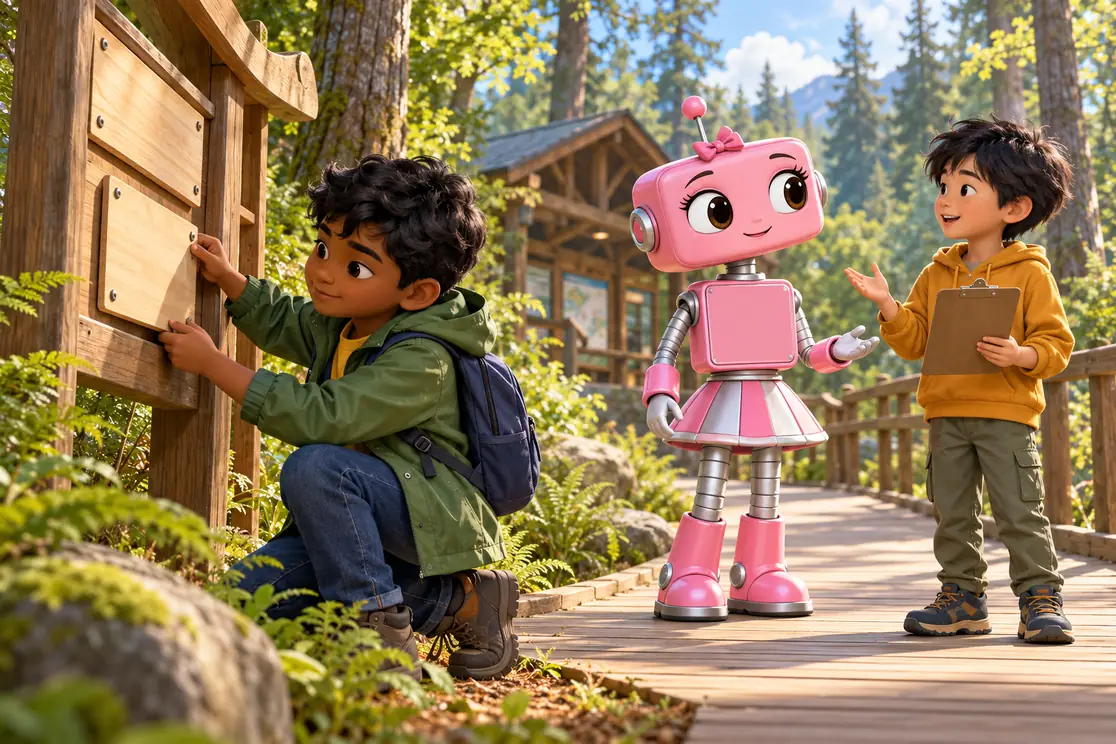
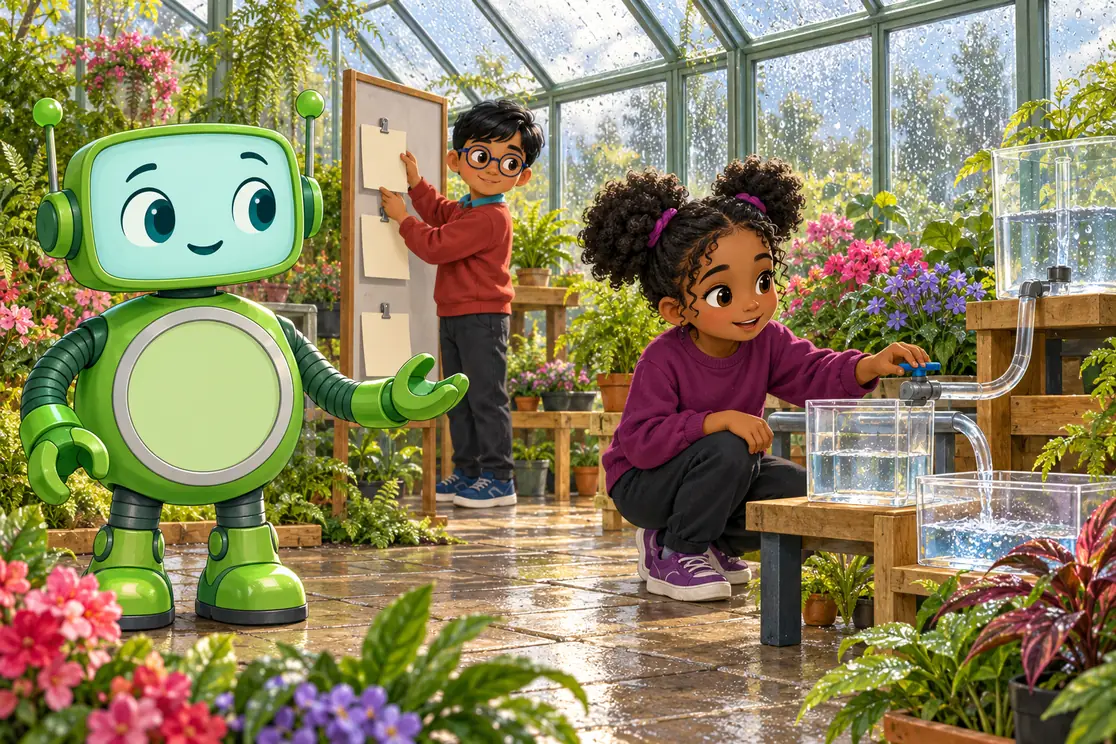
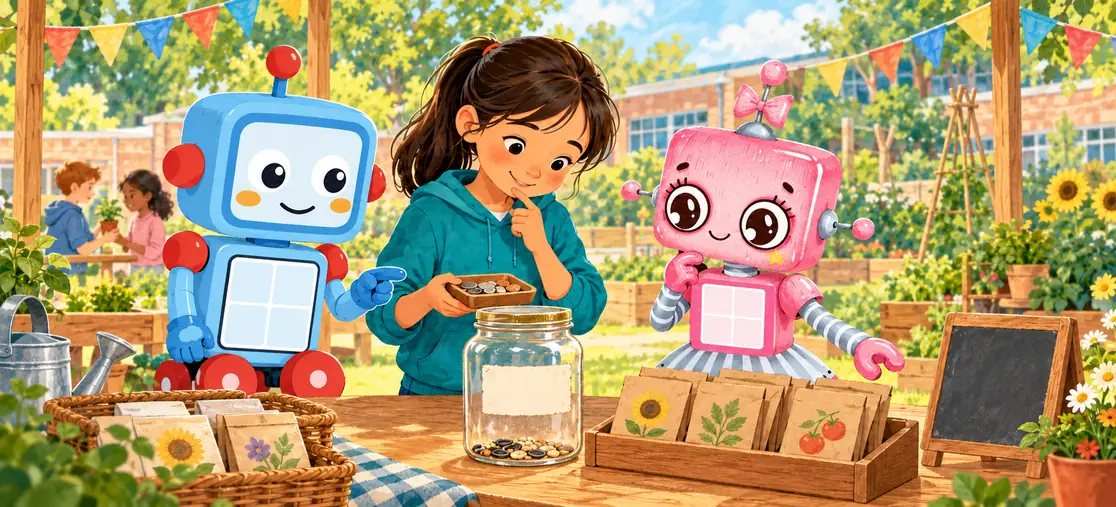
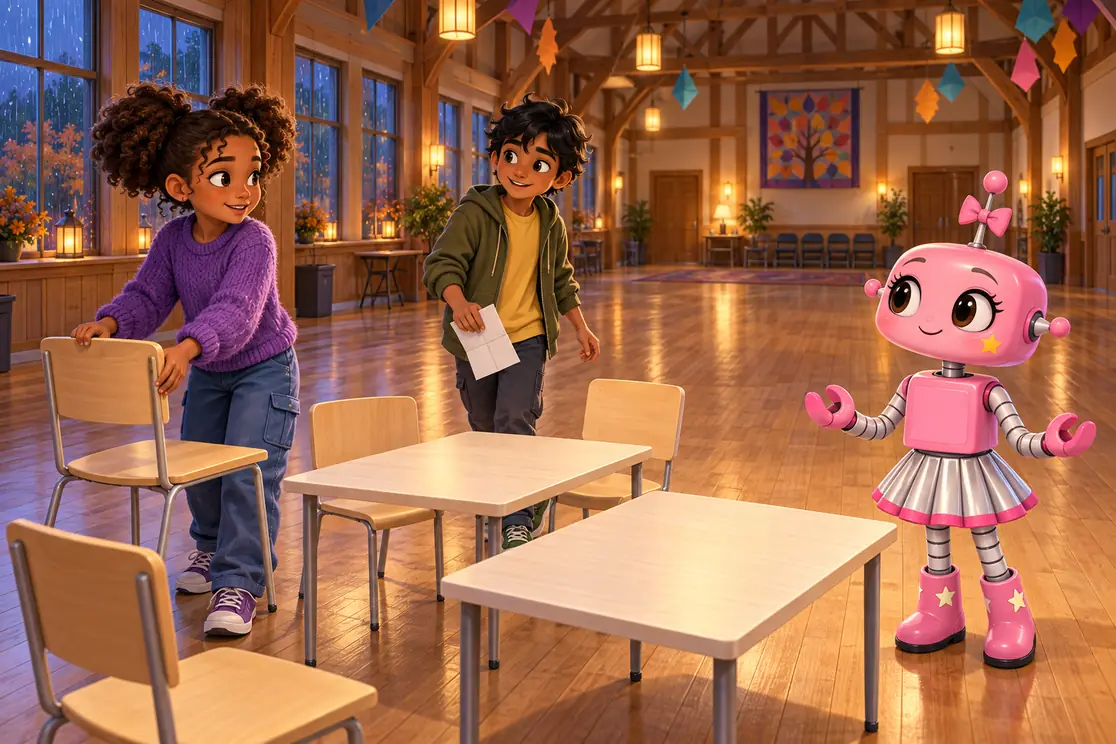
The children try, explain and change their minds. The Robos coach with questions. Each story brings together the teammates who fit its adventure.
Organises · questions

Builds · tests

Designs · explores

Experiments · maps

Sketches · compares

Coaches the next move

Coaches explanations

Coaches careful checks
Choose by the difficulty you face.
A strategy earns its place because it helps with this problem. These six connected groups show what a move can reveal, how to recognise progress and when another approach may help. Enter wherever the difficulty lies; there is no fixed route.
Keep the goal in view. Let evidence change the route.
“I cannot keep the relationships in view.”
Turn the words into a model you can inspect.
A sign of progress You can point to the unknown and show how the givens connect.
Drawing every feather will not settle the time. Show what matters: the front, the rear and the walkway ends.
A possible handover Once a relationship is visible, follow what it tells you. Explore: Follow the information
“I have facts, but I cannot see a route.”
Start from a fact and follow only justified steps.
A sign of progress A new fact follows from the clues, rather than from a guess.
Undo the last change first. Subtracting 6 before halving gives 7, but (7 + 6) × 2 = 26, not 20.
A possible handover If more than one choice survives, organise the possibilities. Explore: Explore the possibilities
“Several choices could work.”
List the choices in a system, then test each against the rules.
A sign of progress You can explain which choices remain and what your search covers.
Red–blue and blue–red are the same pair here. Listing both counts one choice twice.
A possible handover If the search gets huge, look for structure that reduces the work. Explore: Find the structure
“This is large, repeated or tangled.”
Find a relationship, a smaller version or useful parts.
A sign of progress You can explain what stays valid when you reuse the idea.
A few matching numbers suggest a pattern. The construction explains why it continues.
A possible handover A convincing rule may still need a guarantee or a limit. Explore: Prove what is possible
“Could this always happen? Is it the best?”
Use a property or a limit that covers every allowed case.
A sign of progress Your reason applies beyond the examples you happened to try.
A bound rules out going further. To prove a best result, also build a design that reaches it.
A possible handover Check that the proof answers the exact claim you were asked to settle. Explore: Check and learn
“I have a result. Have I finished?”
Return to the question and challenge your own reasoning.
A sign of progress The result fits every clue and answers the whole request.
One working example proves it can happen. It does not prove always, only or best.
A possible handover A failed check helps you choose which approach to revisit. Choose another approach
CKRobi “What could you do with the information you already have?”
Mina “I can draw one relationship, try a small legal case, or work out a quantity we already know. Then I can see what that reveals.”
Not sure where to begin? Try Start with what you know or Draw a diagram. A useful attempt gives you information, even before you have the full solution.
A worked example.
Try this idea · Draw a diagram
Imagine a paper bird 4 m long travelling through a covered walkway 10 m long. It moves at half a metre per second, without stopping. Start with its front at the entrance. How long until the whole bird is through?
CKRobo “Which part has to reach the exit before the whole bird is through?”
Mina “Its rear. The front must travel the length of the walkway, and then the length of the bird.”
\(10+4=14\text{ m}\)
\(14\div0.5=28\text{ s}\)
The whole bird clears in 28 seconds. At 20 seconds only its front has reached the exit.
The two-position diagram shows the difference. When the rear reaches the exit, the front has travelled 14 m. Each metre takes two seconds.
Try a different bird journey in the lesson →An entry point, with room to grow.
A suggested starting grade marks an entry point, not the whole lesson. Each story grows towards deeper ideas, including examples suited to older learners. “Any grade” means begin with a small, suitable example; it does not mean every challenge suits every child.
Grade suggestions are provisional teaching guidance, not ability judgements or access restrictions. Choose the example by the learner’s experience.
Turn the words into a model you can inspect. Revisit the visual guide ↑
Any grade · start small
The positions, movement or overlaps are hard to follow in words.
Draw the relationships the question needs. Keep the important parts and leave out decoration.
Later: choose useful diagrams for space, time and linked quantities.
Any grade · start small
It is hard to see what a move changes.
Use simple objects to follow complete states. Record what each allowed move does.
Later: keep a complete record and reason beyond the objects you used.
Suggested start · Grade 3
Two missing quantities are linked. How can I keep them clear?
Give one quantity a letter and use the story to describe the others.
Later: link several missing quantities and explain what each letter means.
Start from a fact and follow only justified steps. Revisit the visual guide ↑
Any grade · start small
The whole problem feels stuck. Is there one thing I can already work out?
Find a fact the clues fix, then ask what it helps you find next.
Later: combine several clues while keeping unfinished choices open.
Any grade · start small
I know the start. What happens next?
Follow each change, keeping the information needed for the next step.
Later: follow branches that split and join, checking every needed fact.
Any grade · start small
I know the finish, but the start is missing.
Undo the last change first. If an undo leaves several possible starts, keep them all for now.
Later: undo mixed operations and fractions, keeping every possible beginning.
Any grade · start small
Several clues limit the same choices. What follows?
Combine the clues. Rule out a choice only when it breaks a rule.
Later: explain the difference between what must happen and what might happen.
List the choices in a system, then test each against the rules. Revisit the visual guide ↑
Any grade · start small
I might miss a choice or count it twice.
Fix one feature and change the others in a clear order. Explain when the search is complete.
Later: track several linked choices and explain why none are missed.
Suggested start · Grade 3
A few different choices remain. What if I try each one?
Separate the cases and follow each until it works or breaks a clue.
Later: explain why the cases cover all choices, including cases that fail.
Any grade · start small
I can test a possible answer. What will the result tell me?
Choose a trial, check it and use the difference to improve the next trial.
Later: use how far a trial misses to choose the next trial.
Any grade · start small
Several moves are allowed. What would each let me do next?
Explore the next consequences before choosing a move.
Later: compare paths several moves ahead.
Suggested start · Grade 4
The choices I want are hard to count. Are the choices I do not want easier?
Count all the choices, count each unwanted one once, then subtract.
Later: handle overlapping unwanted choices without subtracting any twice.
Find a relationship, a smaller version or useful parts. Revisit the visual guide ↑
Any grade · start small
The work repeats or grows. What rule is doing it?
Find the rule in how it is built, test it and explain why it continues.
Later: explain why a growing rule continues or a whole situation repeats.
Any grade · start small
Some parts seem to play the same role. Are their rules really the same?
Test the turn, flip or exchange against all the rules before treating cases as the same.
Later: prove that a turn, flip or exchange keeps the rules that matter.
Any grade · start small
The whole task looks awkward. Can useful parts help?
Solve manageable parts, then put them together without missing gaps or counting overlaps twice.
Later: handle overlaps and work shared by several parts.
Any grade · start small
The full problem hides the idea. What smaller version keeps its rule?
Solve the smaller case, then check which parts of the method still work in the full problem.
Later: explain which conclusions still hold in the full problem.
Any grade · start small
This looks new, but does it share a relationship with something I solved?
Match the useful parts. Adapt the old method only where the new rules still allow it.
Later: adapt a method when some of the conditions change.
Suggested start · Grade 7
I need a place in a repeating group, rather than the whole count.
Keep the useful remainder and interpret what it means in the story, including a remainder of zero.
Later: interpret zero remainders and combine several repeating programs.
Any grade · start small
Two records share the same part. What changes when I compare them?
Match the equal parts. Remove an equal added part, or divide by an equal nonzero factor.
Later: distinguish an equal added part from an equal nonzero factor.
Use a property or a limit that covers every allowed case. Revisit the visual guide ↑
Suggested start · Grade 3
Pairs or changes in twos seem important. Could even and odd help?
Track evenness and oddness through every allowed move before trying lots of paths.
Later: prove what every allowed move does to evenness and oddness.
Suggested start · Grade 4
Many moves are possible. Is there something that none of them changes?
Find a property no allowed move changes. A goal with a different value from the start is impossible; a matching value still needs more checking.
Later: explain why a matching property alone does not prove the goal can be reached.
Suggested start · Grade 3
What must happen, even before I know how things are spread out?
Put each object in one useful group. Count the most objects that could still avoid the result you need. One more than that forces the result.
Later: invent useful groups and prove the smallest count that guarantees the goal.
Suggested start · Grade 3
An exact answer is hard. Would a limit settle the question?
Work out what the answer cannot go above or below. See whether that is already enough.
Later: combine upper and lower limits to settle a question.
Suggested start · Grade 4
One design looks best. How can I be sure?
Prove a limit for every allowed design. Then build one that reaches the limit.
Later: prove no design can do better, then build one that reaches the limit.
Return to the question and challenge your own reasoning. Revisit the visual guide ↑
Any grade · start small
I have a result. Does it answer everything?
Check every clue and the whole request. If you claim only or best, check that too.
Later: check claims such as the only answer, every possibility or the best design.
Connected strategies.
Near the end of a story, a problem often needs its main tool plus one or two others. Here are two examples: each tool contributes something the others leave unresolved.

A rule can tell the team how many lights one doorway needs. It cannot, by itself, tell them every pair of heights that fits their budget.
CKRobo “How will you search without missing a height pair?”
Li Wei “Fix the side doorway at one row, then two, then three. Subtract its lights and see whether the rest makes a taller main doorway.”
Amara “We can stop before side height seven. Even the smallest taller main doorway, height eight, would take us over budget.”
Explain how the construction connects height and light count.
Fix one height at a time, test the remaining budget and justify a complete search.
Why switch strategies? Knowing one doorway’s light count does not find every pair of heights that fits the budget.
Explore the full doorway problem →Recover the sales money, then undo the stock changes in reverse order.
Use the sales totals to find how many packets of each type were sold.
Test each display card against the original supply rules.
Why switch strategies? The sales records give the sold mix. Which starting display fits every clue?
Explore the full display problem →These are useful routes through those stories, not prerequisites or the only valid methods. Choose the next tool because the remaining problem calls for it.
Using the lessons.
Read the complete question and its clues. The situation gives you a reason to find out, before it names a method.
Enter a numerical answer and tap the Compass to check it. For a proof or a plan, open the question’s Compass coach. Keep the clues beside your work and request a step when you need one.
Open the full answer when you are ready. Check why each move helps and whether the result fits every original rule.
Explore connected challenges and fresh self-review questions. Notice what changes when a familiar tool meets a new situation.
The CKSTEM Thinking Compass is your companion inside the framework. In a numeric check it turns north for a value that fits, or south when the value needs another look. Words and arrows explain the result too.
A correct number does not certify a proof or an explanation. Compare those with the worked reasoning. Motion can be stopped or switched off.
You do not need the whole route.
You need a useful next move.