Mathematical typesetting is unavailable. Reload this page to try again.
Kites for the wind gallery
Use a variable
Keep the relationships, even when the numbers are missing.
The wind gallery is getting ready for a community workshop. There are designs to finish and missing measurements to recover.
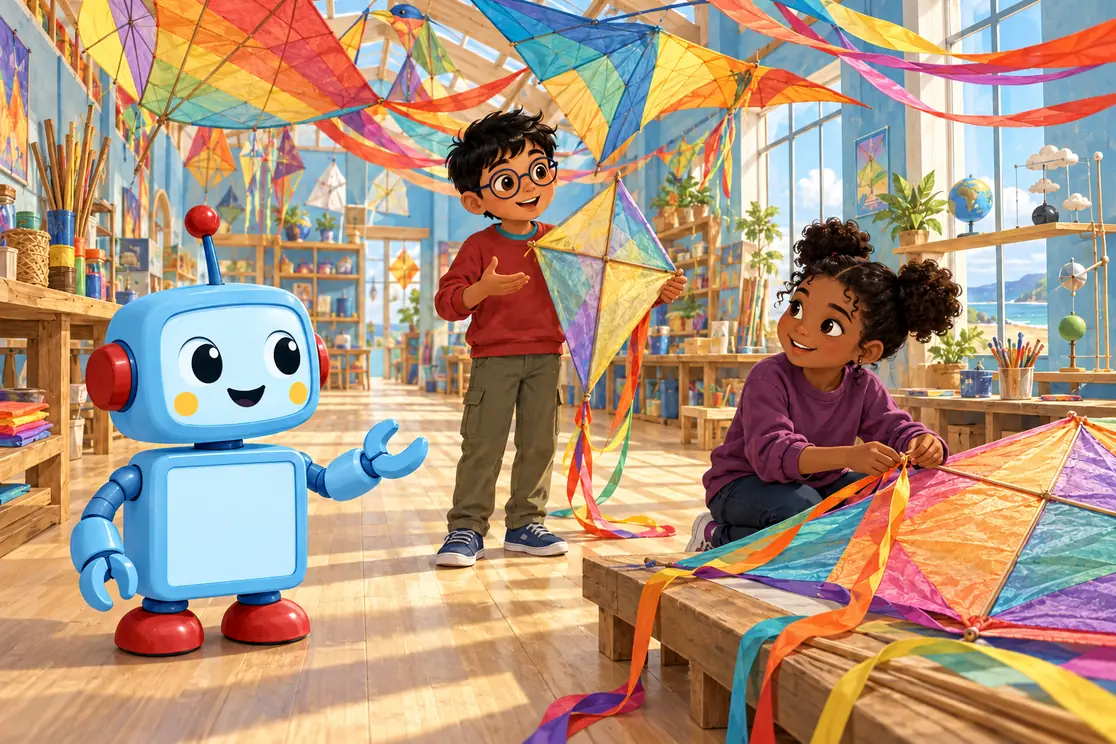
Amara gathers the ribbons. Rowan lifts a kite frame towards the light. CKRobo is their coach. Their workshop uses invented design rules, so each puzzle can be checked exactly.
Amara “I know how these measurements fit together, but I don’t know the measurements themselves.”
CKRobo “What could help you keep track of what you know?”
Rowan “We could give a missing quantity a name, then describe the others using it.”
CKSTEM Thinking CompassStuck? Find your next move.
You don’t need the whole route yet. Start with one useful move, then notice what it tells you.
What do you know for certain? What are you trying to find?
After checking your steps against every clue, choose your own check:
Ready to explore.
The direction reflects your self-check. Use the lesson’s answer and reasoning to check further when you are ready.
Three missing ribbon lengths
A kite needs a blue, a gold and a red ribbon tail. Every length is a positive whole number of centimetres.
The gold tail is 15 cm longer than the blue tail.
The red tail is 5 cm less than twice the blue tail’s length.
The three lengths total 150 cm.
Find the length of each tail. Explain why there is only one possible set of lengths.
Blue tail
Length unknown
Gold tail
Blue length + 15 cm
Red tail
Twice blue length − 5 cm
Three lengths total 150 cm
These cards record the given relationships. Their widths do not show the unknown lengths.A question to help me begin
Which quantity could you name first? What could you then say about the other two?
Try with the CKSTEM Thinking Compass
Interactive checking needs JavaScript. The complete question and worked answer remain available.
Find the length of each tail. Explain why there is only one possible set of lengths.
Three missing ribbon lengths
A kite needs a blue, a gold and a red ribbon tail. Every length is a positive whole number of centimetres.
The gold tail is 15 cm longer than the blue tail.
The red tail is 5 cm less than twice the blue tail’s length.
The three lengths total 150 cm.
Blue tail
Length unknown
Gold tail
Blue length + 15 cm
Red tail
Twice blue length − 5 cm
Three lengths total 150 cm
These cards record the given relationships. Their widths do not show the unknown lengths.
Your answer
Enter all three lengths. Define the unknown, preserve each relationship and explain uniqueness.
These quantities fit. Check all three lengths. Define the unknown, preserve each relationship and explain uniqueness.
Break it into steps
Step 1 of 4
How many extra centimetres remain besides four copies of the blue length?
Fifteen extra centimetres minus five is ten. The four blue-length copies therefore total 140 cm.
Step 2 of 4
What is your answer for Blue (cm)?
Blue (cm): 35. Compare this quantity with the complete worked reasoning; the number alone does not check your argument.
Step 3 of 4
What is your answer for Gold (cm)?
Gold (cm): 50. Compare this quantity with the complete worked reasoning; the number alone does not check your argument.
Step 4 of 4
What is your answer for Red (cm)?
Red (cm): 65. Compare this quantity with the complete worked reasoning; the number alone does not check your argument.
You have worked through these help steps. Return to Your answer when you are ready, and check every original clue.
Show the answer and reasoning: the tails
Answer:Blue 35 cm, gold 50 cm and red 65 cm. No other set fits all three relationships.
Write it with a variable
Let \(t\) be the blue tail’s length in centimetres. We do not have to guess it yet. Gold has length \(t+15\); red has length \(2t-5\). Each expression describes a length, not a different kind of letter.
Blue
\(t\)length in centimetres
Gold
\(t+15\)length in centimetres
Red
\(2t-5\)length in centimetres
The same blue-length quantity occurs in all three expressions. Subtract five after doubling for the red tail.
Amara “The red tail is twice the blue length, with five centimetres taken away.”
CKRobo “What does each part of your expression mean?”
Rowan “Two copies of the blue length make two-t. Then subtract five once. It isn’t twice a length that was already shortened.”
All three measured lengths use the same scale. The gold tail is fifteen centimetres longer than blue; red is five less than twice blue.
Check: gold is \(35+15=50\), red is \(2(35)-5=65\), and \(35+50+65=150\). All lengths are positive whole centimetres. Increasing the blue length by 1 increases the total by 4, so a different blue length cannot give the same total.
You could also draw four equal blue-length parts and account for the extra 10 cm. The letter keeps that same relationship available while the length is unknown.
Use a variable
Name a quantity you do not yet know. Say what it measures or counts, including its unit. Then write the relationships the problem gives you.
Name. What does this symbol stand for?
Connect. How can I express another quantity using it?
Return. Does my result satisfy the original situation?
A box or question mark can begin the idea. A letter becomes useful when you need to use the same unknown several times. An expression describes a quantity; an equation says two quantities are equal.
The symbol helps you reason. It does not create information that the problem never supplied.
Does the record tell us enough?
A rectangular display frame has perimeter 100 cm. Its width and length are positive whole numbers of centimetres. No other relationship between the sides is given.
Does this determine one exact width-and-length pair? Give two different rectangles that fit the record. Could the width and length be equal?
CKSTEM Thinking CompassPlan and check your reasoning.
Does this determine one exact width-and-length pair? Give two different rectangles that fit the record. Could the width and length be equal?
Does the record tell us enough?
A rectangular display frame has perimeter 100 cm. Its width and length are positive whole numbers of centimetres. No other relationship between the sides is given.
The side lengths are not given. This sketch records the question, rather than a measured shape.
You don’t need the whole route yet. Start with one useful move, then notice what it tells you.
What do you know for certain? What are you trying to find?
After checking your steps against every clue, choose your own check:
Ready to explore.
The direction reflects your self-check. Use the lesson’s answer and reasoning to check further when you are ready.
The side lengths are not given. This sketch records the question, rather than a measured shape.Show the answer and reasoning: the frame
Answer:No, the side lengths are not uniquely determined. Width 20 cm with length 30 cm, and width 10 cm with length 40 cm, both fit. Yes, equal sides are possible: 25 cm by 25 cm.
Let \(a\) be the width in centimetres and \(b\) the length in centimetres. The perimeter gives \(2a+2b=100\), or \(a+b=50\). That relation allows many pairs.
20 cm by 30 cm
10 cm by 40 cm
25 cm by 25 cm
Every rectangle has perimeter one hundred centimetres. The common centimetre scale shows that the same perimeter need not fix the side lengths.
Check: each pictured rectangle has two copies of each side and perimeter 100 cm. All its sides are positive whole lengths. Two different fitting rectangles already disprove uniqueness. The square shows why different letters do not have to stand for different values.
A second independent measurement or relationship could select one rectangle. Introducing two letters cannot replace that missing clue.
Two records that must agree
Every short rod has the same unknown length, and every long rod has the same unknown length. Lengths are positive whole centimetres; a short rod is shorter than a long rod.
Placed end to end without gaps or overlaps, 2 short rods and 1 long rod measure 180 cm. A separate bundle of 1 short rod and 2 long rods measures 210 cm.
Find both rod lengths. Explain why those lengths fit both records and why there is no other pair.
Record 1 · 180 cm
ShortShortLong
Record 2 · 210 cm
ShortLongLong
Each labelled tile stands for one rod. These tiles show rod counts, not a length scale; rods of a kind have the same length in both records.Try with the CKSTEM Thinking Compass
Interactive checking needs JavaScript. The complete question and worked answer remain available.
Find both rod lengths. Explain why those lengths fit both records and why there is no other pair.
Two records that must agree
Every short rod has the same unknown length, and every long rod has the same unknown length. Lengths are positive whole centimetres; a short rod is shorter than a long rod.
Placed end to end without gaps or overlaps, 2 short rods and 1 long rod measure 180 cm. A separate bundle of 1 short rod and 2 long rods measures 210 cm.
Record 1 · 180 cm
ShortShortLong
Record 2 · 210 cm
ShortLongLong
Each labelled tile stands for one rod. These tiles show rod counts, not a length scale; rods of a kind have the same length in both records.
Your answer
Enter both lengths. Explain substitution or another valid route, and check both original records and the length order.
These quantities fit. Check both lengths. Explain substitution or another valid route, and check both original records and the length order.
Break it into steps
Step 1 of 3
Adding both records gives three short-plus-long pairs. What is one pair’s length?
Their combined 390 cm contains three of each rod. One short-plus-long pair is 130 cm. This is another valid route beside substitution.
Step 2 of 3
What is your answer for Short rod (cm)?
Short rod (cm): 50. Compare this quantity with the complete worked reasoning; the number alone does not check your argument.
Step 3 of 3
What is your answer for Long rod (cm)?
Long rod (cm): 80. Compare this quantity with the complete worked reasoning; the number alone does not check your argument.
You have worked through these help steps. Return to Your answer when you are ready, and check every original clue.
Show the answer and reasoning: the rods
Answer: A short rod is 50 cm; a long rod is 80 cm. This is the only pair that fits both records.
Let \(s\) be a short rod’s length and \(\ell\) a long rod’s length, both in centimetres. The first record gives \(2s+\ell=180\), so \(\ell=180-2s\). The second gives \(s+2\ell=210\).
Substitute
The long length and \(180-2s\) are equal. Replace each complete long-rod length in the second record with that expression. The parentheses keep the whole replacement together.
One long length
\(\ell=180-2s\)
Record 2 · replace both equal long lengths
\(s\)+\((180-2s)\)+\((180-2s)\)= 210
Both long rods receive the complete equal expression. Keeping the parentheses prevents changing only part of a length.
Rowan “One long rod has the same length as one-hundred-and-eighty minus two short lengths.”
CKRobo “What could that tell you about the other record?”
Amara “It has two long rods. We can replace both of them by the same complete expression.”
Now the rod lengths are measured on the same scale. Both original bundle totals must agree.
Check both: \(2(50)+80=180\), and \(50+2(80)=210\). Both lengths are positive whole centimetres and \(50<80\). Any fitting pair must satisfy the substituted equation, which forces \(s=50\); the first record then forces \(\ell=80\).
Adding or comparing the original records offers another valid route. Substitution works because replacing a quantity by an equal expression preserves the relationship.
Which kit plans can travel?
Prepare exactly 24 kite kits. Each mini kit uses 2 sheets; each wide kit uses 5 sheets. All kits and sheets are whole.
Make at least 2 mini kits and at least 3 wide kits. There are 84 sheets; leftovers are allowed.
Mini and wide kits travel in separate crates. A crate holds up to 3 mini kits or up to 2 wide kits, never a mixture. A partly filled crate is allowed, and at most 10 crates can travel.
Find every allowed pair of kit counts, its unused sheets and the number of crates it needs. Which allowed plan gives the most wide kits?
Mini kit
2 sheets each
Up to 3 per mini crate
Wide kit
5 sheets each
Up to 2 per wide crate
Whole workshop
Exactly 24 kits
At most 84 sheets and 10 crates
Both kit types have positive minimum counts. Separate partly filled crates are permitted; all constraints in the question apply.A question to help me begin
If you choose the wide-kit count, what else becomes determined? Remember that a partly filled last crate still counts as a crate.
Try with the CKSTEM Thinking Compass
Interactive checking needs JavaScript. The complete question and worked answer remain available.
Find every allowed pair of kit counts, its unused sheets and the number of crates it needs. Which allowed plan gives the most wide kits?
Which kit plans can travel?
Prepare exactly 24 kite kits. Each mini kit uses 2 sheets; each wide kit uses 5 sheets. All kits and sheets are whole.
Make at least 2 mini kits and at least 3 wide kits. There are 84 sheets; leftovers are allowed.
Mini and wide kits travel in separate crates. A crate holds up to 3 mini kits or up to 2 wide kits, never a mixture. A partly filled crate is allowed, and at most 10 crates can travel.
Mini kit
2 sheets each
Up to 3 per mini crate
Wide kit
5 sheets each
Up to 2 per wide crate
Whole workshop
Exactly 24 kits
At most 84 sheets and 10 crates
Both kit types have positive minimum counts. Separate partly filled crates are permitted; all constraints in the question apply.
Your answer
Build every allowed plan: kit counts, unused sheets and total separate crates. Add or remove rows as needed. Then identify the greatest-wide plan. Explain completeness separately.
The complete plan table and greatest-wide pair fit. Check separate crate capacities as well as the sheet limit.
Break it into steps
Help step 1
How many crates does the thirteen-mini, eleven-wide plan require?
Thirteen mini kits need five crates and eleven wide kits need six. Eleven crates fail the limit, even though the sheets fit. Test every sheet-feasible count.
You have worked through these help steps. Return to Your answer when you are ready, and check every original clue.
Show the answer and reasoning: the kit plans
Answer: There are nine allowed plans. Mini/wide counts are 21/3, 20/4, 19/5, 18/6, 17/7, 16/8, 15/9, 14/10 and 12/12. Their unused sheets are 27, 24, 21, 18, 15, 12, 9, 6 and 0; they need 9, 9, 10, 9, 10, 10, 10, 10 and 10 crates, respectively. The greatest allowed wide count is 12, with 12 mini kits.
Amara “I thought fewer wide kits would always need fewer crates.”
CKRobo “What does a complete plan still have to satisfy?”
Rowan “Both types need their own crates. Leftover space in a mini crate cannot carry a wide kit.”
Use a variable: let \(k\) count wide kits. Then \(24-k\) counts mini kits. The sheet total is \(2(24-k)+5k=48+3k\). The count and sheet rules reduce the possible whole values to \(3\le k\le12\).
Make an organized list
The crate rule does not increase smoothly: filling the last spare place in one crate may add no new crate. List each remaining whole value once, round up each type’s crate count separately, then add them. Checking just the largest sheet-feasible count would miss smaller working plans.
Every sheet-feasible count, then its separate crates
Mini / wide
Unused sheets
Mini + wide crates
Decision
21 / 3
27
7 + 2 = 9
Fits
20 / 4
24
7 + 2 = 9
Fits
19 / 5
21
7 + 3 = 10
Fits
18 / 6
18
6 + 3 = 9
Fits
17 / 7
15
6 + 4 = 10
Fits
16 / 8
12
6 + 4 = 10
Fits
15 / 9
9
5 + 5 = 10
Fits
14 / 10
6
5 + 5 = 10
Fits
13 / 11
3
5 + 6 = 11
Too many crates
12 / 12
0
4 + 6 = 10
Fits
Eleven wide kits require eleven crates, but twelve wide kits fit ten. Smaller counts do not automatically use fewer crates: each type must be packed separately.
Check: every kept row totals twenty-four kits, meets both minimum counts and uses at most eighty-four sheets and ten crates. Rejected rows exceed the crate limit. All whole values from three through twelve were tested, so no allowed plan is missing. The largest surviving wide count is twelve; the list supplies its complete working witness.
The welcome-light curtain
The final record describes a much larger installation. The team needs its dimensions before planning the frame.
A rectangular light curtain has exactly 15,621 lights, in complete rows and columns. There are 4 more columns than rows. Both counts are positive whole numbers. Every row has one light per column, with no gaps or extra lights.
How many rows and columns does it have? Explain why no other allowed pair works.
This is a labelled schematic, not a measured grid. Both whole dimensions remain unknown.A question to help me begin
How can one symbol keep the two dimensions connected? What could rule out whole groups of row counts before you multiply them?
Try with the CKSTEM Thinking Compass
Interactive checking needs JavaScript. The complete question and worked answer remain available.
How many rows and columns does it have? Explain why no other allowed pair works.
The welcome-light curtain
The final record describes a much larger installation. The team needs its dimensions before planning the frame.
A rectangular light curtain has exactly 15,621 lights, in complete rows and columns. There are 4 more columns than rows. Both counts are positive whole numbers. Every row has one light per column, with no gaps or extra lights.
This is a labelled schematic, not a measured grid. Both whole dimensions remain unknown.
Your answer
Enter both dimensions. Explain the safe bounds, remainder filter and complete product checks proving uniqueness.
These quantities fit. Check both dimensions. Explain the safe bounds, remainder filter and complete product checks proving uniqueness.
Break it into steps
Step 1 of 3
Within the coarse interval 101 through 149 inclusive, how many row counts end in three?
For this coarse interval, the candidates are 103, 113, 123, 133 and 143: five. If you chose tighter valid bounds for the original problem, you may have fewer candidates; that is a valid different route. Each retained count still needs the complete product check.
Step 2 of 3
What is your answer for Rows?
Rows: 123. Compare this quantity with the complete worked reasoning; the number alone does not check your argument.
Step 3 of 3
What is your answer for Columns?
Columns: 127. Compare this quantity with the complete worked reasoning; the number alone does not check your argument.
You have worked through these help steps. Return to Your answer when you are ready, and check every original clue.
Show the answer and reasoning: the curtain
Answer:123 rows and 127 columns. This is the only allowed pair.
Use a variable: let \(r\) count rows. Then \(r+4\) counts columns and \(r(r+4)=15621\). This retains the four-column difference through every candidate check.
Bound the size
At one hundred rows or fewer, there are at most one hundred and four columns, giving at most \(100\times104=10400\) lights. At one hundred and fifty rows or more, the product is at least \(150\times154=23100\). Neither range can give 15,621. Only the forty-nine whole row counts from 101 through 149 remain.
Rowan “Forty-nine full multiplications are possible, but the total gives us another clue.”
CKRobo “Which part of that clue could test many candidates together?”
Amara “The remainder after complete tens. The total has one extra light after all its tens.”
Modular reduction
Remove complete tens from each factor. Any discarded ten multiplied by a whole number still gives complete tens, so the extra ones determine the product’s units digit. We are keeping remainders by ten, not claiming that the original factors equal their endings.
Check the units digit
The row ending fixes the column ending because the columns are four more. Check all ten endings:
Remainders by ten of both dimensions and their product
Rows
Columns
Product
0
4
0
1
5
5
2
6
2
3
7
1
4
8
2
5
9
5
6
0
0
7
1
7
8
2
6
9
3
7
The columns are four more, including a carry into a new ten. Only a row remainder of three gives a product remainder of one.
Only a row count ending in three can produce a product ending in one. Combine that necessary condition with the bound: the candidates are 103, 113, 123, 133 and 143. The ending does not choose among those five.
All five survivors need a full product check
Rows
Columns
Lights
Decision
103
107
11,021
Not 15,621
113
117
13,221
Not 15,621
123
127
15,621
Fits
133
137
18,221
Not 15,621
143
147
21,021
Not 15,621
A matching ending is necessary, not sufficient. Only the 123-by-127 candidate has the complete required total.
Full check: \(127-123=4\) and \(123\times127=15621\). Both counts are positive and fill a complete rectangle. The bounds excluded every row count outside 101–149; the remainder test excluded all but five inside; full products test all five, of which only 123 works.
Listing factor pairs is a valid alternative. The coarse hundreds-based bounds and the ten-ending table give one accessible route: they leave five exact checks without needing a close square estimate. They are not the shortest possible route. If you notice that 15,621 is four below 125 squared, the relationship \(r(r+4)=(r+2)^2-4\) immediately gives \(r+2=125\), so \(r=123\). Tighter bounds from \(120\times124=14880\) and \(125\times129=16125\) also leave just four row counts. Use a useful relation you can justify; do not insist on a remainder test when a stronger observation has already settled the problem. A correct ending alone would not prove the answer.
Kites that carried observations
Scientists once used observation kites to lift instruments above the ground. The instruments recorded conditions in the air; the observers recovered the records after bringing the kites back.
Our workshop makes models and decorations. It shares one useful habit with that history: preserve what a record actually tells you, and notice what you still need to find out.
Your turn
Try these before opening the answers. Define the quantity, preserve its relationships and check the original request.
Does the equation tell the same story?
A ribbon reel has unknown length \(x\) centimetres. First, 12 cm is reserved. The remaining ribbon makes 3 equal tails of 48 cm each, with no other waste.
Two proposed equations are \((x-12)/3=48\) and \(x/3-12=48\).
Which equation represents the stated order? What was the original reel length? Explain why the other equation does not solve this story.
Try with the CKSTEM Thinking Compass
Interactive checking needs JavaScript. The complete question and worked answer remain available.
Which equation represents the stated order? What was the original reel length? Explain why the other equation does not solve this story.
Does the equation tell the same story?
A ribbon reel has unknown length \(x\) centimetres. First, 12 cm is reserved. The remaining ribbon makes 3 equal tails of 48 cm each, with no other waste.
Two proposed equations are \((x-12)/3=48\) and \(x/3-12=48\).
Your answer
Enter the original length. Also choose the correct equation and explain the different operation order in the other equation.
These quantities fit. Check the original length. Also choose the correct equation and explain the different operation order in the other equation.
Break it into steps
Step 1 of 2
How much ribbon do the three finished tails use?
Three tails of forty-eight centimetres use 144 cm. Restore the reserved twelve once to find the original length.
Step 2 of 2
What is your answer for Original length (cm)?
Original length (cm): 156. Compare this quantity with the complete worked reasoning; the number alone does not check your argument.
You have worked through these help steps. Return to Your answer when you are ready, and check every original clue.
Show the answer and reasoning: the reel
Answer:\((x-12)/3=48\); the reel was 156 cm long. The other equation reserves 12 cm from each already-divided share, which is a different operation order.
Reserve 12 first, then divide what remains by three. This gives \(x-12=144\), so \(x=156\).
Check: \(12+3(48)=156\). The other equation gives \(x=180\), but following the actual story with that length would give \((180-12)/3=56\) cm per tail, not 48. Correct algebra on the wrong model is not an answer to the original problem.
Keep the time with the quantity
One cousin is twice the other cousin’s age now. Both present ages are positive whole years. Six years from now, their ages will total 48 years.
How old is each cousin now? Check the present relationship and their combined future age.
Try with the CKSTEM Thinking Compass
Interactive checking needs JavaScript. The complete question and worked answer remain available.
How old is each cousin now? Check the present relationship and their combined future age.
Keep the time with the quantity
One cousin is twice the other cousin’s age now. Both present ages are positive whole years. Six years from now, their ages will total 48 years.
Your answer
Enter both present ages. Check the present doubling and their combined age six years later.
These quantities fit. Check both present ages. Check the present doubling and their combined age six years later.
Break it into steps
Step 1 of 3
What is the cousins’ combined present age?
The future total includes twelve extra years: forty-eight minus twelve is thirty-six now.
Step 2 of 3
What is your answer for Younger now?
Younger now: 12. Compare this quantity with the complete worked reasoning; the number alone does not check your argument.
Step 3 of 3
What is your answer for Older now?
Older now: 24. Compare this quantity with the complete worked reasoning; the number alone does not check your argument.
You have worked through these help steps. Return to Your answer when you are ready, and check every original clue.
Show the answer and reasoning: the ages
Answer: The cousins are 12 and 24 years old now. In six years they will be 18 and 30, totalling 48.
Let \(y\) be the younger cousin’s age now. The older cousin is \(2y\) now. Six years later the ages are \(y+6\) and \(2y+6\), so \(3y+12=48\) and \(y=12\).
Check: 24 is twice 12; \(18+30=48\). Do not double \(y+6\): the “twice” relationship was given for now. The equation forces 12, so there is no other present-age pair.
What can an ending really prove?
A separate rectangular curtain has \(r\) rows and \(r+4\) columns, with positive whole counts and no gaps. Its total is not known; only that the product’s units digit is 1 is known. There is no size bound.
Does this force 13 rows? If not, give two different allowed row-and-column pairs and their totals.
CKSTEM Thinking CompassPlan and check your reasoning.
Does this force 13 rows? If not, give two different allowed row-and-column pairs and their totals.
What can an ending really prove?
A separate rectangular curtain has \(r\) rows and \(r+4\) columns, with positive whole counts and no gaps. Its total is not known; only that the product’s units digit is 1 is known. There is no size bound.
You don’t need the whole route yet. Start with one useful move, then notice what it tells you.
What do you know for certain? What are you trying to find?
After checking your steps against every clue, choose your own check:
Ready to explore.
The direction reflects your self-check. Use the lesson’s answer and reasoning to check further when you are ready.
Show the answer and reasoning: the ending alone
Answer:No. For example, 3 rows and 7 columns give 21; 13 rows and 17 columns give 221.
Check: both pairs have four more columns than rows, positive whole counts and a product ending in 1. Two fitting pairs disprove uniqueness. The units-digit test is a necessary condition; the full total and size bound did additional work in the workshop problem.
What does your variable represent?
The workshop records are ready. Amara and Rowan can explain what their letters count, how each expression follows from a clue, and which results the clues do—or do not—force.
When a quantity is missing, you can still do something useful: name it and preserve one relationship. Then choose another tool if that relationship leaves a difficult search or more than one possibility.
The next connection develops Check the units digit into reasoning with complete groups and remainders. It begins with understanding why the ending works, rather than memorising a trick.


 Amara “I know how these measurements fit together, but I don’t know the measurements themselves.”
 CKRobo “What could help you keep track of what you know?”
 Rowan “We could give a missing quantity a name, then describe the others using it.”