Mathematical typesetting is unavailable. Reload this page to try again.
The lighthouse’s last test
Use even and odd
Before searching for a way, ask whether the rules allow one.
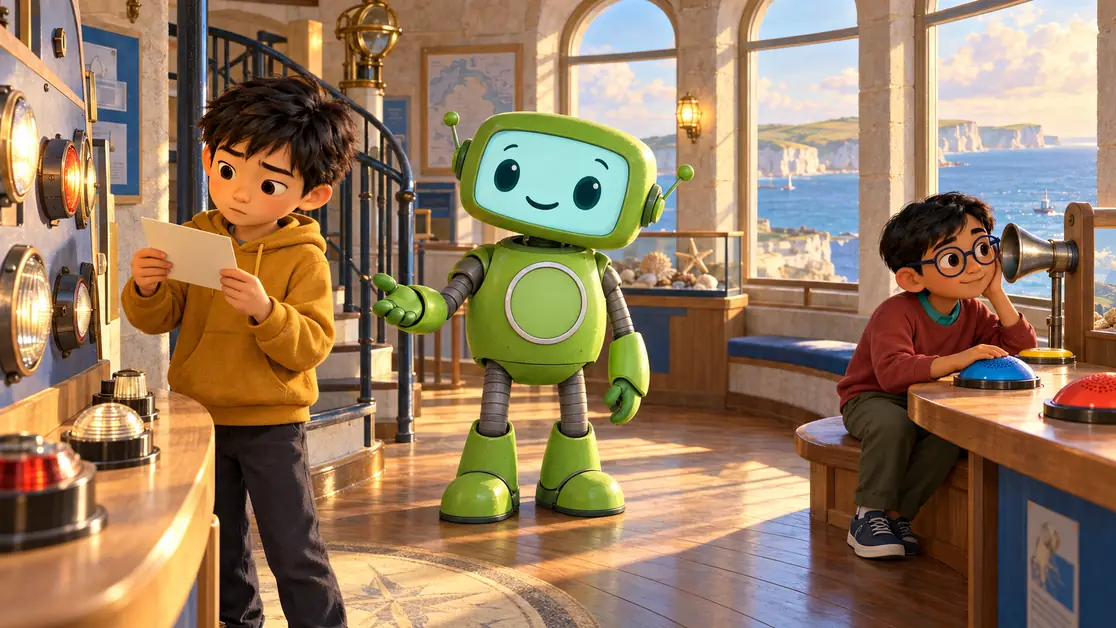
Li Wei checks a challenge card, Rowan tests the sound station, and CKSprout coaches.
The lighthouse discovery centre is getting its model exhibits ready for visitors. Li Wei has tried the lamp challenge several times. Rowan is preparing the sound station nearby.
Li Wei “Maybe I’m missing a better way.”
CKSprout “What could we learn from one legal press?”
CKSTEM Thinking CompassStuck? Find your next move.
You don’t need the whole route yet. Start with one useful move, then notice what it tells you.
What do you know for certain? What are you trying to find?
After checking your steps against every clue, choose your own check:
Ready to explore.
The direction reflects your self-check. Use the lesson’s answer and reasoning to check further when you are ready.
A promise on the card
Nine lamps, A to I, are all on. One press toggles any two distinct lamps: on becomes off, and off becomes on. No other lamp changes. There is no limit on the number of presses.
Can a finite sequence of legal presses switch all nine off together? How can you be sure your answer covers every possible sequence?
CKSTEM Thinking CompassPlan and check your reasoning.
Can a finite sequence of legal presses switch all nine off together? How can you be sure your answer covers every possible sequence?
A promise on the card
Nine lamps, A to I, are all on. One press toggles any two distinct lamps: on becomes off, and off becomes on. No other lamp changes. There is no limit on the number of presses.
AonBonConDonEonFonGonHonIon
All nine begin on. One press chooses two different lamps.
You don’t need the whole route yet. Start with one useful move, then notice what it tells you.
What do you know for certain? What are you trying to find?
After checking your steps against every clue, choose your own check:
Ready to explore.
The direction reflects your self-check. Use the lesson’s answer and reasoning to check further when you are ready.
AonBonConDonEonFonGonHonIon
All nine begin on. One press chooses two different lamps.A question to help me begin
Try one allowed press and notice what changes. What other kinds of pair could a later press choose?
Show the answer and reasoning: the lamp challenge
Answer:No. The number of lit lamps always stays odd. All off would mean zero lit lamps, which is even.
Li Wei “Switching two lit lamps off leaves seven.”
CKSprout “What could a later press do, once some lamps are off?”
Rowan “Two lit lamps go off. One lit and one dark just trade places. Two dark lamps both come on.”
AonBon
→
AoffBoff
Lit count changes by -2
AonBoff
→
AoffBon
Lit count changes by 0
AoffBoff
→
AonBon
Lit count changes by +2
A–B represents one chosen pair. These three cases cover every permitted press, including later presses after some lamps are off.
Every press changes the lit count by \( -2,\ 0,\ \text{or }+2\). None changes an odd count into an even one. Starting from nine, every later lit count is odd. Which lamps are lit can change; their count still stays odd.
AonBonConDonEonFonGonHonIon
Four pairs use eight lamps. One lamp is left over.
An odd collection leaves one lamp unpaired. Zero is even: an empty collection has no unpaired lamp.
\[
9=2\times4+1,\qquad 0=2\times0.
\]
This checks every legal kind of press, so it covers any finite sequence. A few failed attempts would not prove impossibility. The problem is the card’s promise, not Li Wei’s effort.
Use even and odd
Sometimes you need only a number’s parity—whether it is even or odd—to make a useful decision. Ask what the rules force before calculating every value or trying every route.
Even and odd numbers
An even whole-number count can be paired completely. An odd count leaves one over. Adding or removing a complete pair keeps that distinction. The lit count changed, but its parity did not.
This tool can rule out a target or reject a mistaken total. Passing the test leaves a question: can we actually make the required result?
Choose a replacement
The centre can install either replacement below. Every lamp starts on. Panel P has 3 rows of 7 lamps; panel Q has 4 rows of 7. One press toggles any two distinct lamps: on becomes off, and off becomes on. No other lamp changes.
Which panels can be switched completely off? For every panel that can, find the fewest presses and give a plan.
Panel P
3 rows of 7
Panel Q
4 rows of 7
Every lamp starts on in both replacement panels.Try with the CKSTEM Thinking Compass
Interactive checking needs JavaScript. The complete question and worked answer remain available.
Which panels can be switched completely off? For every panel that can, find the fewest presses and give a plan.
Choose a replacement
The centre can install either replacement below. Every lamp starts on. Panel P has 3 rows of 7 lamps; panel Q has 4 rows of 7. One press toggles any two distinct lamps: on becomes off, and off becomes on. No other lamp changes.
Panel P
3 rows of 7
Panel Q
4 rows of 7
Every lamp starts on in both replacement panels.
Your answer
If you find a panel that can be cleared, enter its minimum presses. Identify and justify the possibilities for both panels and give a shortest legal plan; those parts remain unscored.
These quantities fit. Compare your method and every unscored part with the complete answer and reasoning.
Break it into steps
Step 1 of 3
How many lamps does panel P contain?
\(3\times7=21\) lamps. This is odd, so P cannot reach zero under the two-lamp rule.
Step 2 of 3
How many lamps does panel Q contain?
\(4\times7=28\) lamps. Evenness passes the necessary test; still construct a legal clearing plan.
Step 3 of 3
If a panel can be cleared, what is the minimum number of presses for your legal plan?
Q can be cleared in \(28\div2=14\) disjoint-pair presses. Give the pairs and explain why fewer presses cannot suffice.
You have worked through these help steps. Return to Your answer when you are ready, and check every original clue.
Show the answer and reasoning: the replacement panels
Answer: P cannot be cleared. Q can, in a minimum of 14 presses.
Li Wei “P has twenty-one lamps. That is another odd start.”
CKSprout “What would establish your claim for Q?”
Rowan “I can pair its first two rows, then its last two rows, column by column. Each press clears one pair.”
For Q, select one pair in each column across rows 1–2, then across rows 3–4. Press each selected pair once.
P has \(3\times7=21\) lamps and cannot reach zero. Q has \(4\times7=28\). An even number of rows lets every lamp match one above or below, so no lamp is left over.
\[
28\div2=14.
\]
One press can turn off at most two lit lamps. Clearing 28 therefore needs at least 14 presses. The 14 disjoint pair presses attain that bound, so the plan is shortest. It is legal because any pair is allowed; evenness alone is not the plan.
The same count, different controls
A separate panel has four lamps. A and C start on; B and D are off. One button toggles A and B together. The other toggles C and D together. These are the only permitted presses; either button may be pressed any number of times.
Can all four lamps ever be off together, even though two are lit at the start?
CKSTEM Thinking CompassPlan and check your reasoning.
Can all four lamps ever be off together, even though two are lit at the start?
The same count, different controls
A separate panel has four lamps. A and C start on; B and D are off. One button toggles A and B together. The other toggles C and D together. These are the only permitted presses; either button may be pressed any number of times.
Only the A–B button
AonBoff
Only the C–D button
ConDoff
Each button affects only its own two lamps. There is no cross-pair control.
You don’t need the whole route yet. Start with one useful move, then notice what it tells you.
What do you know for certain? What are you trying to find?
After checking your steps against every clue, choose your own check:
Ready to explore.
The direction reflects your self-check. Use the lesson’s answer and reasoning to check further when you are ready.
Only the A–B button
AonBoff
Only the C–D button
ConDoff
Each button affects only its own two lamps. There is no cross-pair control.Show the answer and reasoning: the restricted panel
Answer:No. There will always be one lit lamp in A–B and one in C–D.
Rowan “The total is even. That test doesn’t rule out zero.”
CKSprout “What do these particular controls let you change?”
Li Wei “Each button only swaps which lamp is lit in its own pair. Neither pair can become empty.”
Lit: A, C
AonBoffConDoff
Lit: B, C
AoffBonConDoff
Lit: A, D
AonBoffCoffDon
Lit: B, D
AoffBonCoffDon
These four states cover both choices for each controlled pair. None has all lamps off.
The four shown states are all the possibilities. Each controlled pair keeps its odd lit count—exactly one—so the total stays two. If A and B had started on instead, the A–B button would clear them in one press. The actual start and the actual controls both matter.
Passing one necessary test does not prove that a route exists.
A quick check for a visitor report
While Li Wei checks the replacement panel, Rowan compares the centre’s visitor counters.
Seven counters record 124, 87, 132, 95, 208, 173 and 64 visits. Each visit is counted in exactly one counter. Two draft reports give totals of 882 and 883.
Without adding every count, which report can even and odd rule out? Does the other report’s parity prove it is correct? Then add the counts to check the actual total.
Counter 1124
Counter 287
Counter 3132
Counter 495
Counter 5208
Counter 6173
Counter 764
Each visit belongs to exactly one of the seven counters.Try with the CKSTEM Thinking Compass
Interactive checking needs JavaScript. The complete question and worked answer remain available.
Without adding every count, which report can even and odd rule out? Does the other report’s parity prove it is correct? Then add the counts to check the actual total.
A quick check for a visitor report
While Li Wei checks the replacement panel, Rowan compares the centre’s visitor counters.
Seven counters record 124, 87, 132, 95, 208, 173 and 64 visits. Each visit is counted in exactly one counter. Two draft reports give totals of 882 and 883.
Counter 1124
Counter 287
Counter 3132
Counter 495
Counter 5208
Counter 6173
Counter 764
Each visit belongs to exactly one of the seven counters.
Your answer
Enter the actual total. Also identify the report that parity rules out and explain why passing that test does not prove an exact total; those parts remain unscored.
These quantities fit. Compare your method and every unscored part with the complete answer and reasoning.
Break it into steps
Step 1 of 4
How many of the seven visit counts are odd?
87, 95 and 173 are the three odd counts. Their three leftovers make the sum odd.
Step 2 of 4
What do the even visit counts add to?
\(124+132+208+64=528\).
Step 3 of 4
What do the odd visit counts add to?
\(87+95+173=355\). Parity alone would not determine this exact subtotal.
Step 4 of 4
What is the exact total?
\(528+355=883\) visits. Also explain why matching parity alone would not certify that total.
You have worked through these help steps. Return to Your answer when you are ready, and check every original clue.
Show the answer and reasoning: the visitor total
Answer:882 is wrong. Parity alone does not prove 883 correct; exact addition does. The actual total is 883 visits.
Rowan “There are three odd counts. Each contributes one leftover after pairing.”
CKSprout “What does that establish—and what does it leave undecided?”
Rowan “The sum must be odd, so 882 fails. But an odd total could still be wrong. We need the exact sum.”
87one leftover
95one leftover
173one leftover
After pairing each count, these three leftovers remain. They make one more pair and one extra.
The even counts contribute complete pairs. The three odd leftovers make another pair and one extra, so the whole sum is odd. Counting odd addends matters, not counting how many addends there are.
For example, 885 is also odd, but it is not this sum. The quick test rejects an error; the addition establishes the exact answer.
Build the sound programme
Rowan’s sound station combines short recorded phrases into one loop.
The loop must have exactly 7 complete phrases and exactly 37 beats. A Ripple phrase has 4 beats, an Echo has 5 and a Sweep has 6. Use at least one of each type. We count mixes of phrase types, not different orders.
Find all allowed mixes as counts of Ripple, Echo and Sweep. Which mix uses the fewest Sweeps?
Ripple · 4 beats
Echo · 5 beats
Sweep · 6 beats
Each square is one beat. Every phrase must stay complete.Try with the CKSTEM Thinking Compass
Interactive checking needs JavaScript. The complete question and worked answer remain available.
Find all allowed mixes as counts of Ripple, Echo and Sweep. Which mix uses the fewest Sweeps?
Build the sound programme
Rowan’s sound station combines short recorded phrases into one loop.
The loop must have exactly 7 complete phrases and exactly 37 beats. A Ripple phrase has 4 beats, an Echo has 5 and a Sweep has 6. Use at least one of each type. We count mixes of phrase types, not different orders.
Ripple · 4 beats
Echo · 5 beats
Sweep · 6 beats
Each square is one beat. Every phrase must stay complete.
Your answer
Add a row for every allowed Ripple/Echo/Sweep mix, then give the fewest Sweeps. Phrase order is not counted. Explain why your complete search leaves no other mix.
These quantities fit. Compare your method and every unscored part with the complete answer and reasoning.
Break it into steps
Help step 1
What is the largest possible Echo count if every type must appear?
Two of the seven phrase spaces are needed for Ripple and Sweep, so at most five Echoes remain. Only 1, 3 and 5 of those counts are odd.
Help step 2
With one Echo and every other space a Ripple, how many beats are there?
\(5+6\times4=29\) beats. Replacing a Ripple with a Sweep adds two beats.
Help step 3
How many Sweep replacements reach 37 beats in that one-Echo case?
\((37-29)\div2=4\) Sweeps replace four Ripples. Two Ripples remain: mix (2,1,4).
Help step 4
With three Echoes and every other space a Ripple, how many beats are there?
\(3\times5+4\times4=31\) beats. Again each Sweep replacement adds two beats.
Help step 5
How many Sweep replacements reach 37 beats in that three-Echo case?
\((37-31)\div2=3\) Sweeps replace three Ripples. One Ripple remains: mix (1,3,3).
Help step 6
If there are five Echoes and two Sweeps, how many Ripples remain?
Zero Ripples remain. Although \(5\times5+2\times6=37\), this case fails the requirement that every type appear.
You have worked through these help steps. Return to Your answer when you are ready, and check every original clue.
A question to help me begin
Which feature of the phrase lengths could help you organise a complete search?
Show the answer and reasoning: every sound mix
Answer: The only mixes, in the order (Ripple, Echo, Sweep), are (2, 1, 4) and (1, 3, 3). The second uses the fewest Sweeps: 3.
Use even and odd
Rowan “Only Echo has an odd number of beats. To make an odd total, I need an odd number of Echo phrases.”
CKSprout “How will you turn that observation into a complete search?”
Rowan “I’ll fix the Echo count. Then I can check the remaining phrases without repeating a mix.”
Make an organized list
At least one Ripple and one Sweep need two of the seven phrase spaces, so there can be at most five Echoes. The surviving odd Echo counts are 1, 3 and 5. Test each once: begin by making every remaining phrase a Ripple, then replace enough Ripples with Sweeps to reach 37 beats. Each replacement adds two beats.
1 Echo
6 other phrase spaces.
Starting those as Ripples falls 8 beats short: 4 Sweeps.
2 Ripples, 1 Echo, 4 Sweeps. All rules met.
3 Echoes
4 other phrase spaces.
Starting those as Ripples falls 6 beats short: 3 Sweeps.
1 Ripple, 3 Echoes, 3 Sweeps. All rules met.
5 Echoes
2 other phrase spaces.
Starting those as Ripples falls 4 beats short: 2 Sweeps.
No Ripples remain. Fails at least one of each type.
The two other types limit Echoes to at most five. Test every surviving odd count and check all original rules.
The list covers every possible odd Echo count; even counts cannot make 37 beats. Check both accepted rows against every rule:
Both allowed mixes meet every original condition. Their Sweep counts are four and three.
Both have seven phrases, 37 beats and all three types. Their Sweep counts are four and three, so three is the minimum. Parity narrowed the search; the organized list settled the exact possibilities and the minimum.
Another valid route
Start with seven 4-beat Ripples: \(7\times4=28\) beats. The loop needs nine extra beats. Replacing a Ripple with an Echo adds one; replacing it with a Sweep adds two. Try one, two, three or four Sweeps: the remaining extras need seven, five, three or one Echoes respectively. The first choice needs more than seven phrases; the second leaves no room for a Ripple; the last two give the same allowed mixes. Five Sweeps would already add ten beats, which is too many. This direct extra-beats method is valid too. Parity is a useful first filter, not a compulsory route.
Choose the opening card
Two model exhibits must finish together for the opening display. The children may choose one of three target cards.
Lamps: all nine A–I start on. A lamp action toggles any two distinct lamps: on becomes off, and off becomes on. No other lamp changes.
Tokens: the tray starts with 18 shells and 4 waves. One token action trades exactly 3 shells for 2 waves, or exactly 2 waves for 3 shells. Either direction is allowed whenever there are enough tokens. No borrowing or other additions/removals.
A lamp action leaves the tokens alone; a token action leaves the lamps alone. One action operates on only one part. It cannot change lamps and tokens together.
Each card gives the complete required finish:
Card A
All lamps off
12 shells8 waves
Card B
Only lamp E on
12 shells6 waves
Card C
Only lamp E on
12 shells8 waves
A card succeeds only when its complete lamp and token targets are both met.
Which cards are reachable? Give a legal plan for each reachable card. What is the smallest total number of actions needed to complete a reachable card?
Lamp start
AonBonConDonEonFonGonHonIon
Token start
18 shells4 waves
Trade 3 shells ↔ 2 waves.
One action works on one part.
Use these complete starting states and the stated controls. Each card requires both targets.Try with the CKSTEM Thinking Compass
Interactive checking needs JavaScript. The complete question and worked answer remain available.
Which cards are reachable? Give a legal plan for each reachable card. What is the smallest total number of actions needed to complete a reachable card?
Choose the opening card
Two model exhibits must finish together for the opening display. The children may choose one of three target cards.
Lamps: all nine A–I start on. A lamp action toggles any two distinct lamps: on becomes off, and off becomes on. No other lamp changes.
Tokens: the tray starts with 18 shells and 4 waves. One token action trades exactly 3 shells for 2 waves, or exactly 2 waves for 3 shells. Either direction is allowed whenever there are enough tokens. No borrowing or other additions/removals.
A lamp action leaves the tokens alone; a token action leaves the lamps alone. One action operates on only one part. It cannot change lamps and tokens together.
Each card gives the complete required finish:
Card A
All lamps off
12 shells8 waves
Card B
Only lamp E on
12 shells6 waves
Card C
Only lamp E on
12 shells8 waves
A card succeeds only when its complete lamp and token targets are both met.
Lamp start
AonBonConDonEonFonGonHonIon
Token start
18 shells4 waves
Trade 3 shells ↔ 2 waves.
One action works on one part.
Use these complete starting states and the stated controls. Each card requires both targets.
Your answer
Enter the minimum action count. Also name all reachable cards, justify the rejected cards and show a complete shortest legal plan; those parts remain unscored.
These quantities fit. Compare your method and every unscored part with the complete answer and reasoning.
Break it into steps
Step 1 of 5
For this worked method, give a shell 2 marks and a wave 3 marks. What is the starting token value?
\(18\times2+4\times3=48\). This value is preserved in both trade directions.
Step 2 of 5
What token value does Card B require?
\(12\times2+6\times3=42\), different from 48. Passing lamp parity cannot repair that obstruction.
Step 3 of 5
How many lamp presses are needed at least to leave only E on?
At least four presses are needed. A–B, C–D, F–G and H–I give a permitted construction.
Step 4 of 5
How many token trades are needed at least for the reachable card?
At least two trades are needed, attained by \((18,4)\to(15,6)\to(12,8)\).
Step 5 of 5
What is the smallest total number of actions for a reachable card?
Four lamp presses and two trades give \(4+2=6\). Also name Card C, reject A and B and check the entire legal plan.
You have worked through these help steps. Return to Your answer when you are ready, and check every original clue.
A question to help me begin
What can the rules rule out before you try complete plans?
Show the answer and full reasoning: the opening card
Answer:Only Card C is reachable. Its shortest plan needs 6 actions: four lamp presses and two token trades. A is impossible by lamp parity; B is impossible by a value kept by every trade.
Divide and conquer
Rowan “Trying full plans feels like too much at once. I’ll check the lamps and the tray separately.”
Li Wei “Both checks must work on the same card. We can’t take the lamp finish from one card and the tokens from another.”
Use even and odd
Rowan “A asks for zero lit lamps. Our count stays odd, so A cannot work.”
Li Wei “B and C each leave one lamp on. That test doesn’t choose between them.”
Li Wei “The token count changes when three become two. Could I give the tokens scores so a trade keeps the same total?”
CKSprout “How would you test your proposed scores against every allowed trade?”
Li Wei “Three shells need to tie two waves. Two marks per shell and three per wave make six on each side. Reversing the trade keeps that score too.”
Find an invariant
An invariant is something the allowed moves never change. Here we choose useful scores; they are not extra rules or money.
3 shells
2 marks each
\(3\times2=6\) marks
↔
2 waves
3 marks each
\(2\times3=6\) marks
The chosen value is unchanged in either direction of the permitted trade.
The tray’s starting value is \(18\times2+4\times3=48\). B asks for \(12\times2+6\times3=42\), so no legal trade sequence reaches B. C asks for \(12\times2+8\times3=48\). Both 42 and 48 are even: parity alone would miss this difference.
C passes that test, but still needs a legal route.
Rowan “Leave E alone and pair the other eight lamps: A–B, C–D, F–G and H–I. Four presses.”
Li Wei “Then I’ll trade three shells for two waves twice. There are enough shells at both steps.”
Four lamp actions
Press A–BPress C–DPress F–GPress H–I
Only E is left on.
Two token actions
18 shells4 waves
Trade 3 shells for 2 waves ↓
15 shells6 waves
Trade 3 shells for 2 waves ↓
12 shells8 waves
Four disjoint pair presses and two legal trades meet Card C exactly.
The four disjoint pair presses leave only E on. The two token trades give:
Every trade has enough tokens, and the lamp and token actions leave the other part alone.
CKSprout “How could you check that a shorter plan cannot work?”
Rowan “Eight lamps must go off. A press turns off at most two, so we need at least four presses.”
Li Wei “We also need six fewer shells. A trade removes at most three, so we need at least two trades. One action can’t do both jobs.”
Both bounds apply to the same complete Card C finish:
\[
4+2=6.
\]
The six-action construction attains both bounds and meets Card C exactly. Thus A and B are impossible, C is possible, and six is the smallest total for any card.
How the ideas shared the work
Divide and conquer separated independent checks and recombined the whole target.
Use even and odd ruled out A before searching for presses.
Find an invariant supplied a different preserved value to rule out B. A matching value still needed the actual plan for C.
A different valid token check is to count net trades: six fewer shells requires two more forward trades than reverse trades, giving four more waves. The conserved score packages that same restriction into one test for any target card; it is not the only valid method.
Rowan puts the new challenge card beside the model. Li Wei tests their six-action plan once more. The first visitors will have a fair challenge—and a chance to discover their own explanation.
Choose what helps. Think through each task before opening its answer.
A numbered trail
A trail has positions 0 through 20. Start at 2. Each move goes forward 4 positions or backward 2; a move may not leave the trail.
Can you reach 11? Can you reach 10? Give a legal route for any target you can reach.
CKSTEM Thinking CompassPlan and check your reasoning.
Can you reach 11? Can you reach 10? Give a legal route for any target you can reach.
A numbered trail
A trail has positions 0 through 20. Start at 2. Each move goes forward 4 positions or backward 2; a move may not leave the trail.
You don’t need the whole route yet. Start with one useful move, then notice what it tells you.
What do you know for certain? What are you trying to find?
After checking your steps against every clue, choose your own check:
Ready to explore.
The direction reflects your self-check. Use the lesson’s answer and reasoning to check further when you are ready.
Show the answer and reasoning: the trail
Answer:11 cannot be reached; 10 can. One legal route is \(2\to6\to10\).
Each move changes the position by an even number, so an even starting position stays even. That rules out 11. The two forward moves check the claim for 10 and stay inside 0–20.
A new lamp rectangle
A full rectangle contains exactly 35 lamps, with at least two rows and two columns.
Could it have four rows? Give one possible rectangle.
Try with the CKSTEM Thinking Compass
Interactive checking needs JavaScript. The complete question and worked answer remain available.
Could it have four rows? Give one possible rectangle.
A new lamp rectangle
A full rectangle contains exactly 35 lamps, with at least two rows and two columns.
Your answer
Give one possible rectangle as rows and columns. Either orientation is accepted. Also answer the four-row question and explain it; that reasoning is not graded here.
These quantities fit. Compare your method and every unscored part with the complete answer and reasoning.
Break it into steps
Step 1 of 2
For this worked route, what is the smallest allowed row count dividing 35 exactly?
Two, three and four do not divide 35. Five does, so use five rows in this worked route. Your original answer also accepts the turned 7-by-5 rectangle.
Step 2 of 2
How many columns go with five rows?
\(35\div5=7\) columns. Also explain why four rows are impossible; these dimensions do not grade that explanation.
You have worked through these help steps. Return to Your answer when you are ready, and check every original clue.
Show the answer and reasoning: the rectangle
Answer:No four-row rectangle. One possible layout has 5 rows of 7.
Four rows could be paired, making an even total, but 35 is odd. A \(5\times7\) layout has all 35 lamps and meets the minimum row/column conditions. One valid layout is all the question requests.
Postcards for the shop
Sealed packs contain either 6 or 10 postcards. You may buy any nonnegative whole number of each pack. Packs cannot be opened, and no postcards may be left over.
Can you make exactly 14 postcards? Can you make exactly 26? Check each answer.
Try with the CKSTEM Thinking Compass
Interactive checking needs JavaScript. The complete question and worked answer remain available.
Can you make exactly 14 postcards? Can you make exactly 26? Check each answer.
Postcards for the shop
Sealed packs contain either 6 or 10 postcards. You may buy any nonnegative whole number of each pack. Packs cannot be opened, and no postcards may be left over.
Your answer
If you find a 26-card mix, enter its pack counts. Decide whether each requested total is possible and justify your conclusions; those parts remain unscored.
These quantities fit. Compare your method and every unscored part with the complete answer and reasoning.
Break it into steps
Step 1 of 4
For twenty-six cards, what remains after two ten-card packs?
\(26-2\times10=6\) cards, exactly one six-card pack.
Step 2 of 4
For a total of fourteen, at most how many ten-card packs can be used?
Zero or one ten-card pack are the only cases. They leave 14 or 4 cards, neither obtainable from six-card packs.
Step 3 of 4
How many six-card packs make this twenty-six-card construction?
One six-card pack is used.
Step 4 of 4
How many ten-card packs belong with it?
\(1\times6+2\times10=26\). Also give and justify the impossibility answer for fourteen.
You have worked through these help steps. Return to Your answer when you are ready, and check every original clue.
Show the answer and reasoning: the packs
Answer:14 is impossible; 26 is possible. For 26, buy one 6-pack and two 10-packs.
Both targets are even, so parity alone settles neither. For 14, there can be zero or one 10-pack: two already exceed the target. The remaining 14 or 4 cannot be made from 6-packs. Those are all cases. For 26, check \(6+10+10=26\), with whole packs and no leftovers.
Look back
The children did not need a longer string of guesses. They asked what the rules could change and used a small property to make a decision. They also learned where that decision stopped: a matching parity, score or partial result still needed an exact check or a legal plan.
When a new problem looks large, ask: Would even and odd already rule something out? If the test passes, what remains to be proved?


 Li Wei “Maybe I’m missing a better way.”
 CKSprout “What could we learn from one legal press?”
 Rowan “Two lit lamps go off. One lit and one dark just trade places. Two dark lamps both come on.”