Mathematical typesetting is unavailable. Reload this page to try again.
Before the curtain rises
Act it out
When a plan is hard to hold in your head, make a small model that remembers the important things.
A rehearsal gives the team time to test an idea and change a plan.
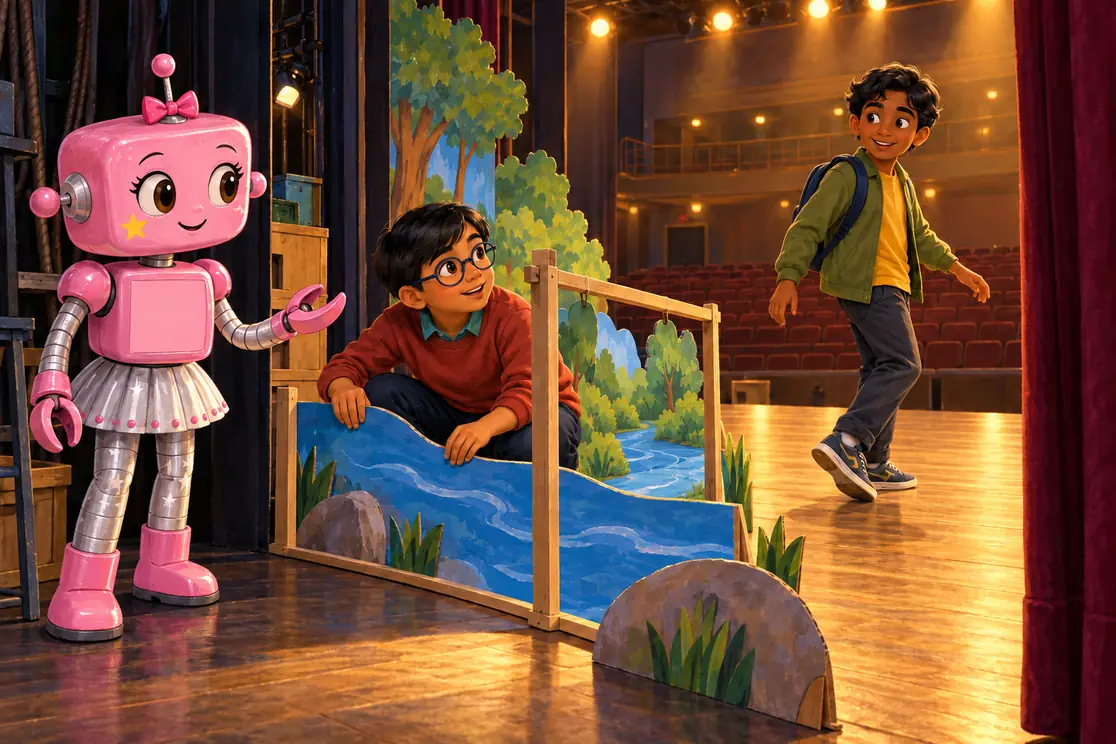
Rowan and Arjun are preparing a community puppet show. Before the curtain rises, they need to check the movements on stage—and a tricky journey inside their story. CKRobi is their coach.
Arjun “I can imagine the first move. Then I lose track of where everything is.”
CKRobi “What could you use to keep the important parts visible?”
Rowan “Paper pieces. We can move one thing, see what changed and keep the rest where it belongs.”
CKSTEM Thinking CompassStuck? Find your next move.
You don’t need the whole route yet. Start with one useful move, then notice what it tells you.
What do you know for certain? What are you trying to find?
After checking your steps against every clue, choose your own check:
Ready to explore.
The direction reflects your self-check. Use the lesson’s answer and reasoning to check further when you are ready.
Rehearse the stage route
The floor has four columns, A to D, and three rows, 1 to 3. Row 1 is nearest the audience; row 3 is nearest the back wall. Arjun starts on A1, facing the back wall.
His instructions are: forward 2 squares; turn right a quarter-turn; forward 1 square; turn right a quarter-turn; forward 2 squares. A turn happens in place. Forward follows the direction he is facing at that moment.
Which square does he finish on, and which way is he facing? Explain why the word “right” cannot always mean the right edge of the page.
CKSTEM Thinking CompassPlan and check your reasoning.
Which square does he finish on, and which way is he facing? Explain why the word “right” cannot always mean the right edge of the page.
Rehearse the stage route
The floor has four columns, A to D, and three rows, 1 to 3. Row 1 is nearest the audience; row 3 is nearest the back wall. Arjun starts on A1, facing the back wall.
His instructions are: forward 2 squares; turn right a quarter-turn; forward 1 square; turn right a quarter-turn; forward 2 squares. A turn happens in place. Forward follows the direction he is facing at that moment.
The arrow shows the starting place and heading. Row 1 is nearest the audience; a turn changes heading without changing squares.
You don’t need the whole route yet. Start with one useful move, then notice what it tells you.
What do you know for certain? What are you trying to find?
After checking your steps against every clue, choose your own check:
Ready to explore.
The direction reflects your self-check. Use the lesson’s answer and reasoning to check further when you are ready.
The arrow shows the starting place and heading. Row 1 is nearest the audience; a turn changes heading without changing squares.A question to help me begin
What must your model remember after each instruction, besides the square?
Show the answer and reasoning: the stage route
Answer: Arjun finishes on B1, facing the audience. A right turn is relative to his current facing direction.
Use an arrow-shaped piece for Arjun. Move it forward without changing its heading; rotate it in place for a turn. A plain dot would record his place but lose the direction he faces.
Action
Square
Facing
Start
A1
back wall ↑
Forward 2
A3
back wall ↑
Right turn
A3
column D →
Forward 1
B3
column D →
Right turn
B3
audience ↓
Forward 2
B1
audience ↓
Read the route and the complete pose after each instruction. The two turns happen on A3 and B3; the finish is B1 facing the audience.
Rowan “The first right turn points him across the stage. The next right turn points him towards the audience.”
CKRobi “What made those two right turns lead in different directions?”
Arjun “I was facing a different way before the second one. Our arrow kept that information.”
Check: the forward parts visit A3, then B3, then B1. Both turns stay on their squares. The last arrow points towards row 1 and the audience.
Act it out
Choose objects that stand for the important parts of a problem. Keep the rules, relevant differences and complete situation. Try one legal move, notice what it reveals, then decide what to try next.
You can use paper pieces, counters, your hands or a careful imagined rehearsal. The model need not look real. It must behave in the ways that matter.
A route that works proves that something is possible. One route that fails does not prove that every route fails. And a successful route is not automatically the shortest.
Three travellers, one boat
Inside the puppet story, three travellers must cross a river. Rowan makes two paper banks and a paper boat to rehearse it.
Puppets A and B each use 1 load unit; puppet C uses 2. The boat carries at most 2 load units. All three puppets and the boat start on the left bank.
In this story, every puppet can operate the boat, including alone. Each crossing must carry at least one puppet: the boat cannot travel empty. Only puppets on the boat's bank can board. After a crossing, all passengers unload on the other bank. There are no other routes or transfers halfway across. Each one-way journey counts as one crossing.
Can all three puppets and the boat finish on the right bank? Give a legal sequence and keep track of the boat as well as the puppets. A working route is enough for this question.
CKSTEM Thinking CompassPlan and check your reasoning.
Can all three puppets and the boat finish on the right bank? Give a legal sequence and keep track of the boat as well as the puppets. A working route is enough for this question.
Three travellers, one boat
Inside the puppet story, three travellers must cross a river. Rowan makes two paper banks and a paper boat to rehearse it.
Puppets A and B each use 1 load unit; puppet C uses 2. The boat carries at most 2 load units. All three puppets and the boat start on the left bank.
In this story, every puppet can operate the boat, including alone. Each crossing must carry at least one puppet: the boat cannot travel empty. Only puppets on the boat's bank can board. After a crossing, all passengers unload on the other bank. There are no other routes or transfers halfway across. Each one-way journey counts as one crossing.
Each label shows puppet · load units. Boat capacity: 2. Someone must ride every trip.
Start
Left
A · 1B · 1C · 2
Boat here
Right
No puppets
Required finish
Left
No puppets
Right
A · 1B · 1C · 2
Boat here
The load labels and the boat are part of the model. The finish is given; no route has been chosen yet.
You don’t need the whole route yet. Start with one useful move, then notice what it tells you.
What do you know for certain? What are you trying to find?
After checking your steps against every clue, choose your own check:
Ready to explore.
The direction reflects your self-check. Use the lesson’s answer and reasoning to check further when you are ready.
Each label shows puppet · load units. Boat capacity: 2. Someone must ride every trip.
Start
Left
A · 1B · 1C · 2
Boat here
Right
No puppets
Required finish
Left
No puppets
Right
A · 1B · 1C · 2
Boat here
The load labels and the boat are part of the model. The finish is given; no route has been chosen yet.Show the answer and reasoning: the three travellers
Answer:Yes. One legal route uses 5 crossings: A and B across, A back, C across, B back, then A and B across.
Give each puppet a labelled piece showing its load. Keep a separate boat piece. A and C are only two pieces, but together they use three load units and cannot share this boat.
Arjun “If C goes first, the boat ends up beside C. I can’t just put the boat back on the left.”
CKRobi “What different legal departure could you test?”
Rowan “A and B can go together. One can bring the boat back while the other stays ready to return it later.”
Start
Left
A · 1B · 1C · 2
Boat here
Right
No puppets
Crossing 1
A + B · left → right Load 2 of 2
Left
C · 2
Right
A · 1B · 1
Boat here
Crossing 2
A · right → left Load 1 of 2
Left
A · 1C · 2
Boat here
Right
B · 1
Crossing 3
C · left → right Load 2 of 2
Left
A · 1
Right
B · 1C · 2
Boat here
Crossing 4
B · right → left Load 1 of 2
Left
A · 1B · 1
Boat here
Right
C · 2
Crossing 5
A + B · left → right Load 2 of 2
Left
No puppets
Right
A · 1B · 1C · 2
Boat here
Each card is the complete situation after unloading. The boat travels with its passengers and stays on its arrival bank until the next crossing.
Check: every load is 2, 1, 2, 1 or 2 units. Every passenger begins beside the boat, and someone operates every trip. After the fifth crossing, all three and the boat are right. The model has supplied a possible route; we have not used that alone to claim it is best.
What if one helper is missing?
This version has only A, using 1 load unit, and C, using 2. The boat carries at most 2. Both puppets and the boat start left; the goal is both puppets and the boat right.
Either puppet can operate the boat. Each trip must carry at least one puppet from its current bank, and everyone aboard unloads on arrival. Empty trips, other routes and halfway transfers are forbidden.
Can this crossing be completed? Give a legal route if it can, or explain why every attempt must fail.
CKSTEM Thinking CompassPlan and check your reasoning.
Can this crossing be completed? Give a legal route if it can, or explain why every attempt must fail.
What if one helper is missing?
This version has only A, using 1 load unit, and C, using 2. The boat carries at most 2. Both puppets and the boat start left; the goal is both puppets and the boat right.
Either puppet can operate the boat. Each trip must carry at least one puppet from its current bank, and everyone aboard unloads on arrival. Empty trips, other routes and halfway transfers are forbidden.
Each label shows puppet · load units. Boat capacity: 2. Someone must ride every trip.
Start
Left
A · 1C · 2
Boat here
Right
No puppets
Required finish
Left
No puppets
Right
A · 1C · 2
Boat here
Removing B changes the puzzle. The remaining pieces must still retain their different load units and the boat must still be operated.
You don’t need the whole route yet. Start with one useful move, then notice what it tells you.
What do you know for certain? What are you trying to find?
After checking your steps against every clue, choose your own check:
Ready to explore.
The direction reflects your self-check. Use the lesson’s answer and reasoning to check further when you are ready.
Each label shows puppet · load units. Boat capacity: 2. Someone must ride every trip.
Start
Left
A · 1C · 2
Boat here
Right
No puppets
Required finish
Left
No puppets
Right
A · 1C · 2
Boat here
Removing B changes the puzzle. The remaining pieces must still retain their different load units and the boat must still be operated.Show the answer and reasoning: one helper
Answer:No. This version is impossible.
A and C cannot travel together: their total load is 3. The only first moves send A alone or C alone. In either case, that same puppet is the only one who can bring the boat back. We return to the complete starting situation, with no progress.
Start
Left
A · 1C · 2
Boat here
Right
No puppets
A across; only A can return
A · left → right Load 1 of 2
Left
C · 2
Right
A · 1
Boat here
C across; only C can return
C · left → right Load 2 of 2
Left
A · 1
Right
C · 2
Boat here
These three situations are the complete reachable set. Each departure has only its undo as the next trip; the required finish is absent.
Check: these are all the reachable situations, not just a few failed guesses. Repeating either loop or waiting cannot create a new one. An empty return would solve a different problem because it breaks this version's rule.
Does one failed trial settle it?
Again, A and B each use 1 load unit, C uses 2, and the boat carries at most 2. All three and the boat start left. Every puppet can operate it. A trip must carry at least one puppet from the boat's current bank; all passengers unload on arrival. No empty trips, other route or halfway transfer is allowed.
Which first loads allow a next crossing that does not restore the complete starting situation? Explain what happens after every other possible first load, so your conclusion does not depend on one failed trial.
CKSTEM Thinking CompassPlan and check your reasoning.
Which first loads allow a next crossing that does not restore the complete starting situation? Explain what happens after every other possible first load, so your conclusion does not depend on one failed trial.
Does one failed trial settle it?
Again, A and B each use 1 load unit, C uses 2, and the boat carries at most 2. All three and the boat start left. Every puppet can operate it. A trip must carry at least one puppet from the boat's current bank; all passengers unload on arrival. No empty trips, other route or halfway transfer is allowed.
Before the first crossing
Left
A · 1B · 1C · 2
Boat here
Right
No puppets
All three start beside the boat. A and B use one load unit each, while C uses two; capacity is two.
You don’t need the whole route yet. Start with one useful move, then notice what it tells you.
What do you know for certain? What are you trying to find?
After checking your steps against every clue, choose your own check:
Ready to explore.
The direction reflects your self-check. Use the lesson’s answer and reasoning to check further when you are ready.
Before the first crossing
Left
A · 1B · 1C · 2
Boat here
Right
No puppets
All three start beside the boat. A and B use one load unit each, while C uses two; capacity is two.Show the answer and reasoning: every first load
Answer: The legal first loads are A, B, C, and A with B. Only A with B allows a next crossing that does not immediately undo the start.
Make an organized list
List the loads with one puppet, then two, then three. This covers every nonempty selection from A, B and C. Test the load units, not just the number of paper pieces.
One failed departure is only one trial. Cover the one-puppet, two-puppet and three-puppet loads before judging all starts.
The list covers every opening load; the model then tests what each legal departure leaves beside the boat.
First load
Units
Result
A
1
Fits; next trip must undo
B
1
Fits; next trip must undo
C
2
Fits; next trip must undo
A + B
2
Fits; next trip need not undo
A + C
3
Exceeds capacity
B + C
3
Exceeds capacity
A + B + C
4
Exceeds capacity
One-puppet loads, then two-puppet loads, then all three cover every nonempty selection. Fitting the boat and allowing a non-undo next move are different tests.
Act it out to check what each legal start leaves behind. If A goes alone, only A is beside the boat on the right. Someone must bring it back, so A must undo that crossing. The same happens when B or C goes alone.
A alone
After going across
A · left → right Load 1 of 2
Left
B · 1C · 2
Right
A · 1
Boat here
Forced return
A · right → left Load 1 of 2
Left
A · 1B · 1C · 2
Boat here
Right
No puppets
B alone
After going across
B · left → right Load 1 of 2
Left
A · 1C · 2
Right
B · 1
Boat here
Forced return
B · right → left Load 1 of 2
Left
A · 1B · 1C · 2
Boat here
Right
No puppets
C alone
After going across
C · left → right Load 2 of 2
Left
A · 1B · 1
Right
C · 2
Boat here
Forced return
C · right → left Load 2 of 2
Left
A · 1B · 1C · 2
Boat here
Right
No puppets
With a single puppet across, that puppet is the only return passenger. Every such two-trip attempt restores the whole starting situation.
Rowan “Sending C first didn’t work. But that was only one of our choices.”
CKRobi “What lets you make a claim about all the choices now?”
Arjun “Our list includes every load. Three legal starts force an undo, and A with B offers a next move that does not return us to the beginning.”
Check: the larger pairs and the three-puppet load exceed capacity. Waiting changes nothing about who can return the boat. A single-puppet first trip can still be part of an eventual success: undo it, then try A with B. It simply wastes two crossings. Starting with A and B also does not mean that every later choice will work.
The show grows. Arjun wants to adapt the rehearsal instead of forgetting everything they have learned.
There are now five puppets: A and B each use 1 load unit; C, D and E each use 2. The boat carries at most 2 load units. Everyone and the boat start left and must finish right.
Every puppet can operate the boat, including alone. Each one-way crossing must carry at least one puppet from the boat's current bank; all passengers unload on arrival. No empty trips, other routes or halfway transfers are allowed.
What is the fewest possible crossings? Give a legal sequence reaching it and a reason that no plan can use fewer.
Each label shows puppet · load units. Boat capacity: 2. Someone must ride every trip.
Start
Left
A · 1B · 1C · 2D · 2E · 2
Boat here
Right
No puppets
Required finish
Left
No puppets
Right
A · 1B · 1C · 2D · 2E · 2
Boat here
Five puppets, the same capacity and the same no-empty-trip rule. Keep each puppet’s own load label and the boat’s place visible.Try with the CKSTEM Thinking Compass
Interactive checking needs JavaScript. The complete question and worked answer remain available.
What is the fewest possible crossings? Give a legal sequence reaching it and a reason that no plan can use fewer.
The whole cast is waiting
The show grows. Arjun wants to adapt the rehearsal instead of forgetting everything they have learned.
There are now five puppets: A and B each use 1 load unit; C, D and E each use 2. The boat carries at most 2 load units. Everyone and the boat start left and must finish right.
Every puppet can operate the boat, including alone. Each one-way crossing must carry at least one puppet from the boat's current bank; all passengers unload on arrival. No empty trips, other routes or halfway transfers are allowed.
Each label shows puppet · load units. Boat capacity: 2. Someone must ride every trip.
Start
Left
A · 1B · 1C · 2D · 2E · 2
Boat here
Right
No puppets
Required finish
Left
No puppets
Right
A · 1B · 1C · 2D · 2E · 2
Boat here
Five puppets, the same capacity and the same no-empty-trip rule. Keep each puppet’s own load label and the boat’s place visible.
Your answer
Enter the minimum. The full problem also asks for your legal route and a proof; those are unscored.
The minimum fits. Check every passenger, boat position and load in your constructed route, then explain why fewer cannot work.
Break it into steps
Step 1 of 3
How many more large-puppet forward trips than returns are needed?
Each large puppet contributes one net forward trip, three altogether.
Step 2 of 3
What is the least possible number of small-puppet forward trips?
Two is at most 2f minus r, hence f is at least four.
Step 3 of 3
What is the fewest total crossings?
Four small forward plus six small returns plus three large trips require at least thirteen; the model reaches thirteen.
You have worked through these help steps. Return to Your answer when you are ready, and check every original clue.
Show the answer and reasoning: the whole cast
Answer: The minimum is 13 crossings. The construction and lower-bound proof below establish both parts of that claim.
Before opening the complete route below, use five labelled pieces and a boat piece. Try to deliver one large puppet while keeping track of where the two small helpers and boat end up. A route that leaves them stranded cannot simply be repeated.
Act it out
Keep every waiting puppet on its bank while you move the boat and its actual passengers. Choose the next legal load yourself; only passengers beside the boat can board. That model lets you construct a repeatable delivery, and then test how the last trip must differ.
Arjun “The old five-crossing answer delivers everyone, but then our helpers and boat are on the wrong bank for D. I need a part of that journey which leaves them ready again.”
Rowan “In my model, the first four crossings deliver C and bring both helpers and the boat back left. I can give D the same role as C, then E.”
CKRobi “Which conditions make that reuse legal, and what still needs checking?”
Use a related problem
The large puppets have equal loads and face the same rules. Waiting puppets do not prevent a crossing. Reuse the method's repeatable part, rather than copy its whole five-crossing answer.
After 4 crossings
Left
A · 1B · 1D · 2E · 2
Boat here
Right
C · 2
After 8 crossings
Left
A · 1B · 1E · 2
Boat here
Right
C · 2D · 2
After 12 crossings
Left
A · 1B · 1
Boat here
Right
C · 2D · 2E · 2
After each four-trip delivery, A, B and the boat are left again. Another large puppet is right, while those not yet delivered stay left.
One construction sends A and B across, A back, one large puppet across, then B back. It delivers one large puppet and restores the helpers and boat left. Build it for C, then D, then E; finish with A and B across.
\[4+4+4+1=13.\]
Start
Left
A · 1B · 1C · 2D · 2E · 2
Boat here
Right
No puppets
Crossing 1
A + B · left → right Load 2 of 2
Left
C · 2D · 2E · 2
Right
A · 1B · 1
Boat here
Crossing 2
A · right → left Load 1 of 2
Left
A · 1C · 2D · 2E · 2
Boat here
Right
B · 1
Crossing 3
C · left → right Load 2 of 2
Left
A · 1D · 2E · 2
Right
B · 1C · 2
Boat here
Crossing 4
B · right → left Load 1 of 2
Left
A · 1B · 1D · 2E · 2
Boat here
Right
C · 2
Crossing 5
A + B · left → right Load 2 of 2
Left
D · 2E · 2
Right
A · 1B · 1C · 2
Boat here
Crossing 6
A · right → left Load 1 of 2
Left
A · 1D · 2E · 2
Boat here
Right
B · 1C · 2
Crossing 7
D · left → right Load 2 of 2
Left
A · 1E · 2
Right
B · 1C · 2D · 2
Boat here
Crossing 8
B · right → left Load 1 of 2
Left
A · 1B · 1E · 2
Boat here
Right
C · 2D · 2
Crossing 9
A + B · left → right Load 2 of 2
Left
E · 2
Right
A · 1B · 1C · 2D · 2
Boat here
Crossing 10
A · right → left Load 1 of 2
Left
A · 1E · 2
Boat here
Right
B · 1C · 2D · 2
Crossing 11
E · left → right Load 2 of 2
Left
A · 1
Right
B · 1C · 2D · 2E · 2
Boat here
Crossing 12
B · right → left Load 1 of 2
Left
A · 1B · 1
Boat here
Right
C · 2D · 2E · 2
Crossing 13
A + B · left → right Load 2 of 2
Left
No puppets
Right
A · 1B · 1C · 2D · 2E · 2
Boat here
Follow all thirteen crossings. Waiting puppets keep their banks; the last trip brings both helpers right after all three large puppets have arrived.
Bound, then build the best
The complete acted sequence proves that 13 is possible. It still needs a reason that fewer cannot work.
Rowan “A working rehearsal does not rule out twelve crossings. I’ll count all forward and return trips, including a plan that brings a large puppet back.”
Arjun “The boat has one more forward trip than return trip. The three large puppets together have three more forward trips than returns. So the small-puppet trips need two more returns than forwards.”
CKRobi “How does carrying at most two small puppets limit those counts?”
Write \(f\) for small-puppet trips left to right and \(r\) for their returns. Each large puppet fills the boat alone, so these trip types do not overlap. Arjun's net-trip comparison gives
\[r=f+2.\]
Arjun “The two small puppets must finish right. Their forward trips carry at most two each, while every return takes at least one back. Their net gain of two is at most twice f minus r.”
Rowan “Then f is at least four, r at least six, and the large puppets need at least three more crossings. Every plan needs at least thirteen.”
The boat and net heavy travel force two more small returns than small forward trips.
Large puppet tripsat least 3
Each large puppet must cross forward; any extra return adds trips.
Every crossing belongs to one of these groups. Their total is at least 4 + 6 + 3 = 13, independently of which legal route is tried.
Check: the actual route has four small forward trips, six small returns and three large forward trips. Every load fits, nobody appears on the wrong bank, the boat never moves empty, and all five finish right. The lower bound and the legal construction agree.
Puppet theatre takes many forms. They learn that shadow-puppet traditions can carry old stories and new ones. In one Malaysian wayang kulit production, a modern space adventure was retold through puppets and shadows. That is one example, not the whole of a varied tradition.
Rowan and Arjun have their own story to tell. Their rehearsal gives them a way to turn a mistake into a better plan before the audience arrives.
Your turn
Think through these before opening the answers. You can use small objects or follow the pictures; no writing is needed.
The same square?
On the same A–D, 1–3 floor, row 1 is nearest the audience and row 3 nearest the back wall. Arjun and Rowan both start on B2, facing the back wall. Arjun makes two right quarter-turns in place. Rowan does not turn.
Are they now in the same situation for their next instruction? If each takes one forward step in the direction he faces, where does each finish, and which way does each face?
CKSTEM Thinking CompassPlan and check your reasoning.
Are they now in the same situation for their next instruction? If each takes one forward step in the direction he faces, where does each finish, and which way does each face?
The same square?
On the same A–D, 1–3 floor, row 1 is nearest the audience and row 3 nearest the back wall. Arjun and Rowan both start on B2, facing the back wall. Arjun makes two right quarter-turns in place. Rowan does not turn.
Both begin on B2 facing the back wall. Keep the two arrow models separate while following their different turning instructions.
You don’t need the whole route yet. Start with one useful move, then notice what it tells you.
What do you know for certain? What are you trying to find?
After checking your steps against every clue, choose your own check:
Ready to explore.
The direction reflects your self-check. Use the lesson’s answer and reasoning to check further when you are ready.
Both begin on B2 facing the back wall. Keep the two arrow models separate while following their different turning instructions.Show the answer and reasoning: the same square
Answer:No. Arjun finishes on B1, facing the audience; Rowan finishes on B3, facing the back wall.
Arjun's two quarter-turns make a half-turn. Although both are still on B2 before the step, their headings differ. Turn one arrow twice and leave the other unchanged before moving them.
Arjun
Rowan
A position alone did not determine the next move. The final arrows point in opposite directions on B1 and B3.
Check: the turns do not change squares. The two forward steps go in opposite directions, each by exactly one square. A square label without a heading loses important information.
The boat gets a remote control
A and B each use 1 load unit, C uses 2, and the boat holds at most 2. All three and the boat start left and must finish right. Any puppet can operate a loaded boat. A passenger must board on the boat's current bank and unload on arrival; there is no other route or halfway transfer.
This rule changes: the boat can now make an empty trip, remotely controlled from either bank. Loaded trips still follow the same capacity rule. Every one-way trip counts as one crossing, including an empty one.
What is the fewest possible crossings now? Give a legal route and explain why fewer cannot work.
The load limits are unchanged, but an empty boat can now travel. Use this version’s rule rather than importing the old restriction.Try with the CKSTEM Thinking Compass
Interactive checking needs JavaScript. The complete question and worked answer remain available.
What is the fewest possible crossings now? Give a legal route and explain why fewer cannot work.
The boat gets a remote control
A and B each use 1 load unit, C uses 2, and the boat holds at most 2. All three and the boat start left and must finish right. Any puppet can operate a loaded boat. A passenger must board on the boat's current bank and unload on arrival; there is no other route or halfway transfer.
This rule changes: the boat can now make an empty trip, remotely controlled from either bank. Loaded trips still follow the same capacity rule. Every one-way trip counts as one crossing, including an empty one.
The load limits are unchanged, but an empty boat can now travel. Use this version’s rule rather than importing the old restriction.
Your answer
Enter the minimum for this changed rule. Also give a legal route and explain its lower bound.
The count fits this version. Recheck the changed empty-boat rule and justify the minimum.
Break it into steps
Step 1 of 2
At least how many loaded forward trips are needed?
At least two loaded journeys must go right.
Step 2 of 2
What is the fewest crossings with an empty remote return allowed?
C across, empty back, A and B across gives three.
You have worked through these help steps. Return to Your answer when you are ready, and check every original clue.
Show the answer and reasoning: the remote control
Answer: The minimum is 3 crossings: C across, the empty boat back, then A and B across.
Start
Left
A · 1B · 1C · 2
Boat here
Right
No puppets
Crossing 1
C · left → right Load 2 of 2
Left
A · 1B · 1
Right
C · 2
Boat here
Crossing 2
Empty boat · right → left Load 0 of 2
Left
A · 1B · 1
Boat here
Right
C · 2
Crossing 3
A + B · left → right Load 2 of 2
Left
No puppets
Right
A · 1B · 1C · 2
Boat here
The middle crossing moves the boat without moving any puppet. That is legal only because this question explicitly permits remote empty trips.
All three have total load 4, so they cannot go together in one forward trip. At least two forward trips are needed, with a return between them. Three is therefore a lower bound, and the route reaches it.
Check: loads 2, 0 and 2 all fit. The empty return is allowed in this version; silently adding it to the earlier story would have been a wrong model.
Move the scenery stack
Three model discs have sizes 1, 2 and 3, from smallest to largest. On stand L, they begin stacked 3, 2, 1 from bottom to top. Stands M and R are empty.
One move takes one top disc from a stand to another stand. It may go onto an empty stand or onto a larger top disc. No moving a whole stack or taking a disc from underneath another.
How can you transfer the complete stack to R under these rules? Give a legal sequence; a shortest-route proof is not requested.
CKSTEM Thinking CompassPlan and check your reasoning.
How can you transfer the complete stack to R under these rules? Give a legal sequence; a shortest-route proof is not requested.
Move the scenery stack
Three model discs have sizes 1, 2 and 3, from smallest to largest. On stand L, they begin stacked 3, 2, 1 from bottom to top. Stands M and R are empty.
One move takes one top disc from a stand to another stand. It may go onto an empty stand or onto a larger top disc. No moving a whole stack or taking a disc from underneath another.
Start
L
321
M
R
Required finish
L
M
R
321
The numbers name the sizes. Move only a top disc, and never place a larger one on a smaller one.
You don’t need the whole route yet. Start with one useful move, then notice what it tells you.
What do you know for certain? What are you trying to find?
After checking your steps against every clue, choose your own check:
Ready to explore.
The direction reflects your self-check. Use the lesson’s answer and reasoning to check further when you are ready.
Start
L
321
M
R
Required finish
L
M
R
321
The numbers name the sizes. Move only a top disc, and never place a larger one on a smaller one.Show the answer and reasoning: the scenery stack
Use three differently sized circles, not three unlabelled equal counters. Keep all three stands visible and move only the top circle.
Start
L
321
M
R
Move 1
L
32
M
R
1
Move 2
L
3
M
2
R
1
Move 3
L
3
M
21
R
Move 4
L
M
21
R
3
Move 5
L
1
M
2
R
3
Move 6
L
1
M
R
32
Move 7
L
M
R
321
Each card preserves all three stands and the bottom-to-top order. Comparing neighbours shows exactly one legal top-disc move.
Check: every moved disc was on top, and no larger disc lands on a smaller one. All three finish on R in the original bottom-to-top order. This complete legal route answers the question without pretending that acting alone proves a minimum.
What should your model include?
Ask what your model must remember: a direction, a size, a load, a carrier's place, the top of a stack. Keep those facts through every move.
A small legal action can reveal a useful choice or a repeated situation even before you see the whole solution. Then ask what you have established: one route, every possibility, an impossibility, or a best value with a separate proof.


 Arjun “I can imagine the first move. Then I lose track of where everything is.”
 CKRobi “What could you use to keep the important parts visible?”
 Rowan “Paper pieces. We can move one thing, see what changed and keep the rest where it belongs.”