Mathematical typesetting is unavailable. Reload this page to try again.
The hall before story night
Solve a simpler problem
Make the problem small enough to explore. Bring the useful idea back.
Before filling the hall, the team can try a tiny rehearsal. The full seating plan is still to come.
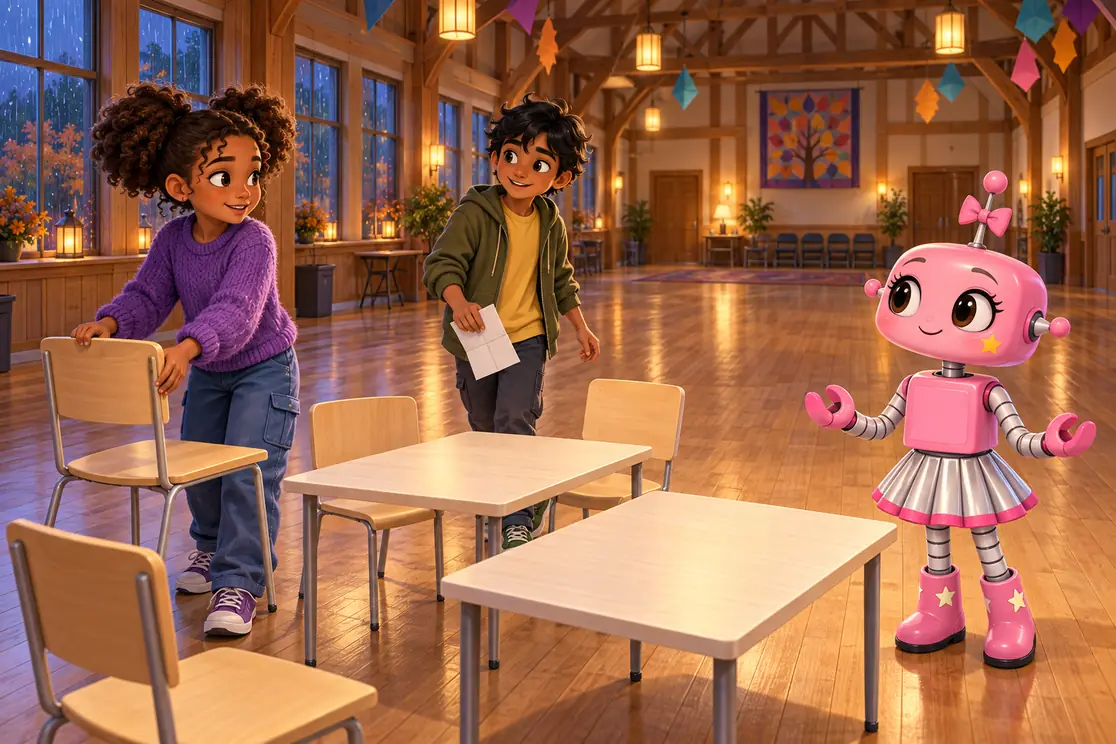
Rain taps on the windows. Inside, Amara and Arjun are preparing a community story night with coach CKRobi. Visitors can bring an imagined adventure, a family memory or something they love talking about.
There are chairs to place, edges to mark and volunteers to organise. The team does not have to solve the entire evening at once.
Amara “The empty hall looked easy. Now the plan feels enormous.”
CKRobi “Which decision do you need to make first?”
Arjun “How many chairs belong around the tables. Let's settle that before carrying them all.”
The layouts and working rates below are invented models. Each problem states its own rules.
CKSTEM Thinking CompassStuck? Find your next move.
You don’t need the whole route yet. Start with one useful move, then notice what it tells you.
What do you know for certain? What are you trying to find?
After checking your steps against every clue, choose your own check:
Ready to explore.
The direction reflects your self-check. Use the lesson’s answer and reasoning to check further when you are ready.
A long chain of tables
Join 18 identical square tables in one straight chain, with complete sides touching.
Put one chair beside every exposed table side. Put no chairs on either of two touching sides, and no extra chairs at corners.
How many chairs are needed? Explain how a smaller version could help you work it out without drawing all the chairs first.
18 tables · chair count unknown
Each small square is one table. Shared sides are inside the chain; the chairs have not been drawn.A question to help me begin
What could you make smaller while keeping the same joining and seating rules?
Try with the CKSTEM Thinking Compass
Interactive checking needs JavaScript. The complete question and worked answer remain available.
How many chairs are needed? Explain how a smaller version could help you work it out without drawing all the chairs first.
A long chain of tables
Join 18 identical square tables in one straight chain, with complete sides touching.
Put one chair beside every exposed table side. Put no chairs on either of two touching sides, and no extra chairs at corners.
18 tables · chair count unknown
Each small square is one table. Shared sides are inside the chain; the chairs have not been drawn.
Your answer
Enter the full count. Explain the preserved joining structure and why the small answer itself is not the large answer.
These quantities fit. Check the full count. Explain the preserved joining structure and why the small answer itself is not the large answer.
Break it into steps
Step 1 of 2
How many net chair places does adding one end table create?
Three new places minus one lost place is a net gain of two. Explain why the same end join occurs in the full chain.
Step 2 of 2
What is your answer for Chairs?
Chairs: 38. Compare this quantity with the complete worked reasoning; the number alone does not check your argument.
You have worked through these help steps. Return to Your answer when you are ready, and check every original clue.
Show the answer and reasoning: the long chain
Answer: The chain needs 38 chairs. A short chain helps us see what changes whenever a table is added at an end.
Try one table, then two, then three.
1 table
4 chairs
2 tables
6 chairs
3 tables
8 chairs
The small trials keep the straight-chain rule. Teal marks are chairs beside exposed sides; none sits on a join.
Arjun “A table has four sides. I nearly added four chairs for every table.”
CKRobi “How could you test that claim?”
Amara “Join just two. One old chair place disappears, and the new table brings three exposed sides. That is only two extra chairs.”
That change keeps happening when another table joins the end of a straight chain. Begin with four chairs, then add two for each of the other seventeen tables:
\[4+17\times2=38\]
18 along each long side + 2 ends
The completed chain has eighteen chair places on each long side and one at each end. Its diagram is reduced to fit; the count also follows from the joining rule.
Check another way: the two long sides each have 18 chair places, and the two ends have one each: \(18+18+2=38\). The short examples suggested a rule; the end-joining explanation is why it works for the full chain.
Solve a simpler problem
Make a difficult case easier to explore: use fewer objects, a smaller layout or friendlier numbers. Keep the relationship you need. Solve that easier case, explain what carries over, then return to the original question.
Ask: What am I changing? What must stay the same? What have I learned for the real problem?
Look for a pattern can notice the counts 4, 6, 8. Solve a simpler problem explains why the end-joining move creates the same change in the original chain. A sequence of numbers is a clue; the preserved joining structure makes the transfer valid.
A smaller answer is not usually the answer to the big problem. And several successful small tests do not prove that every larger case will work.
Use a related problem starts from a useful problem you have solved before. Here, you deliberately make an easier version of the current problem. Either way, explain why the borrowed idea fits.
Same tables, different arrangement
Compare four square tables in one straight chain with four square tables in a 2-by-2 block. Complete sides touch wherever the tables meet.
In both layouts, place one chair beside each exposed table side, none on touching sides and none at corners.
Do the layouts need the same number of chairs? Find both counts. Explain whether the chain's “two extra chairs” rule can be copied to the block.
Straight chain
2-by-2 block
The tables remain square and join along full sides. Only the table arrangements are given; compare the exposed sides.Try with the CKSTEM Thinking Compass
Interactive checking needs JavaScript. The complete question and worked answer remain available.
Do the layouts need the same number of chairs? Find both counts. Explain whether the chain's “two extra chairs” rule can be copied to the block.
Same tables, different arrangement
Compare four square tables in one straight chain with four square tables in a 2-by-2 block. Complete sides touch wherever the tables meet.
In both layouts, place one chair beside each exposed table side, none on touching sides and none at corners.
Straight chain
2-by-2 block
The tables remain square and join along full sides. Only the table arrangements are given; compare the exposed sides.
Your answer
Enter both counts. Explain why changing the joining structure changes the usable rule.
These quantities fit. Check both counts. Explain why changing the joining structure changes the usable rule.
Break it into steps
Step 1 of 3
How many full-side joins does the two-by-two block have?
There are four joins. Each removes two outside chair places from the sixteen available before joining.
Step 2 of 3
What is your answer for Straight-chain chairs?
Straight-chain chairs: 10. Compare this quantity with the complete worked reasoning; the number alone does not check your argument.
Step 3 of 3
What is your answer for Block chairs?
Block chairs: 8. Compare this quantity with the complete worked reasoning; the number alone does not check your argument.
You have worked through these help steps. Return to Your answer when you are ready, and check every original clue.
Show the answer and reasoning: the changed layout
Answer:No. The straight chain needs 10 chairs; the block needs 8. The end-joining rule cannot be copied unchanged.
Straight chain
10 chairs
2-by-2 block
8 chairs
The tables remain square and join along full sides. The block loses more outside places because it contains another shared side.
Amara “Four tables gave ten places in the chain. I thought four tables would always give ten.”
CKRobi “What did the first plan depend on?”
Arjun “Each new table joined just one end. The last table in the block touches two others, so a different number of sides disappears.”
Check: four separate tables offer sixteen places. The straight chain has three joins, removing two places per join: \(16-2\times3=10\). The block has four joins: \(16-2\times4=8\).
Keeping the number of tables is not enough. The small model must preserve the feature that makes its method work.
Friendlier numbers can reveal the operation
Arjun is marking an edge with a reusable strip.
In this model, Arjun lays \(\frac{3}{8}\) metre of strip each minute, at a constant rate. He needs to lay \(\frac{15}{4}\) metres. He takes no break.
Exactly how many minutes will it take? Check that your time gives the required length.
Try with the CKSTEM Thinking Compass
Interactive checking needs JavaScript. The complete question and worked answer remain available.
Exactly how many minutes will it take? Check that your time gives the required length.
Friendlier numbers can reveal the operation
Arjun is marking an edge with a reusable strip.
In this model, Arjun lays \(\frac{3}{8}\) metre of strip each minute, at a constant rate. He needs to lay \(\frac{15}{4}\) metres. He takes no break.
Your answer
Enter the original job’s time. Explain the relationship revealed by easier numbers and check the original fractions.
These quantities fit. Check the original job’s time. Explain the relationship revealed by easier numbers and check the original fractions.
Break it into steps
Step 1 of 2
How many eighth-metres make the original target length?
Fifteen fourths is thirty eighths. Each working minute lays three eighths.
Step 2 of 2
What is your answer for Working minutes?
Working minutes: 10. Compare this quantity with the complete worked reasoning; the number alone does not check your argument.
You have worked through these help steps. Return to Your answer when you are ready, and check every original clue.
Show the answer and reasoning: the strip
Answer: It takes 10 minutes.
If the fractions hide what to do, try easy numbers with the same meanings. Six metres at two metres each minute takes three minutes. We divide the required length by the length laid per minute.
Easier values
Minute 1
Minute 2
Minute 3
Each small bar = 1 metre
6 metres at 2 metres per minute
Original values
Minute 1
Minute 2
Minute 3
Minute 4
Minute 5
Minute 6
Minute 7
Minute 8
Minute 9
Minute 10
Each small bar = \(\frac18\) metre
30 eighths, 3 per minute
Each group records one working minute. The two models use explicitly different length units; transfer the relationship, then restore the original numbers.
Keep that relationship and restore the actual values:
\[\frac{15}{4}\div\frac{3}{8}=10\text{ minutes}\]
Arjun “The easy case took three minutes. Does that make three a good answer here?”
CKRobi “Which part of your easier case answers the original question?”
Amara “It shows which way to divide. We still need the real length and pace; its three minutes are not an estimate for this job.”
Check: \(10\times\frac{3}{8}=\frac{30}{8}=\frac{15}{4}\) metres. Direct reasoning with eighths works too: thirty eighths, at three eighths per minute, takes ten minutes.
Plan for the visitors
The team must seat at least 44 visitors around exactly two separate straight chains of square tables. Each chain must contain at least 3 whole tables. Within each chain, complete sides touch. The chains do not touch each other.
There is one chair per exposed table side, none on touching sides and none at corners. Every chair place can be used.
What is the fewest total number of tables needed? Give one working split between the chains and explain why fewer tables cannot work.
Visitors
At least 44 chair places
Layouts
Exactly 2 separate straight chains
Table counts
At least 3 whole tables per chain
Total unknown
Keep both separate chains and their minimum lengths when returning from a small trial to the final layout.Try with the CKSTEM Thinking Compass
Interactive checking needs JavaScript. The complete question and worked answer remain available.
What is the fewest total number of tables needed? Give one working split between the chains and explain why fewer tables cannot work.
Plan for the visitors
The team must seat at least 44 visitors around exactly two separate straight chains of square tables. Each chain must contain at least 3 whole tables. Within each chain, complete sides touch. The chains do not touch each other.
There is one chair per exposed table side, none on touching sides and none at corners. Every chair place can be used.
Visitors
At least 44 chair places
Layouts
Exactly 2 separate straight chains
Table counts
At least 3 whole tables per chain
Total unknown
Keep both separate chains and their minimum lengths when returning from a small trial to the final layout.
Your answer
Enter the least total. Give a split meeting both minimum chain lengths and prove that every smaller total fails.
These quantities fit. Check the least total. Give a split meeting both minimum chain lengths and prove that every smaller total fails.
Break it into steps
Step 1 of 2
How many end chair places do two separate chains keep?
Two chains keep four end places. The remaining forty target places must come from two places per table.
Step 2 of 2
What is your answer for Fewest total tables?
Fewest total tables: 20. Compare this quantity with the complete worked reasoning; the number alone does not check your argument.
You have worked through these help steps. Return to Your answer when you are ready, and check every original clue.
Show the answer and reasoning: two chains
Answer: They need at least 20 tables. Two chains of 10 tables each provide 44 places.
Using Solve a simpler problem, we learned to count two places per table, plus the two ends. Two separate chains have four ends altogether. So their seating count is twice the total number of tables, plus four.
Work backwards
Start from the required 44 places. Remove the four end places, then undo the two places per table:
\[(44-4)\div2=20\text{ tables}\]
44 required places
← Remove the 4 end places: 40 side places
← Undo 2 places per table: 20 tables
First chain
10 tables · 22 places
Second chain
10 tables · 22 places
Forward check: 20 tables → 22 + 22 = 44 places
Teal works back from the target; amber checks the actual layout. The two chains are separate, so each keeps both of its ends.
Amara “Twenty works. Have we shown it is the fewest?”
CKRobi “What would you need to know about every smaller total?”
Arjun “Nineteen tables give only forty-two places in two straight chains. Fewer give still less, however we split them.”
Full check: each ten-table chain has \(2\times10+2=22\) places. Both chains have at least three tables and together seat 44. With nineteen total tables, \(2\times19+4=42\), so no smaller total is enough.
How the tools fit: the simpler chain reveals the seating relationship; Work backwards recovers the table count from the target. The one- and two-table trials explain a local rule, but they are not proposed final chains.
The hall plan is settled. Now the organiser wants a fair choice of partners for future jobs.
There are 28 distinct volunteers, including Amara and Arjun. Make one digital planning card for every possible pair of two different volunteers.
A pair is counted once: Amara with Arjun is the same pair as Arjun with Amara. Nobody is paired with themselves.
How many cards are needed? Give a reusable counting rule for a different positive whole number of volunteers, explaining why every pair is counted exactly once.
People
28 distinct volunteers
One card
2 different people
Counting rule
One card per pair
Reversing names adds no new card
The total is unknown. A digital card records a possible partnership, rather than an ordered first-and-second assignment.Try with the CKSTEM Thinking Compass
Interactive checking needs JavaScript. The complete question and worked answer remain available.
How many cards are needed? Give a reusable counting rule for a different positive whole number of volunteers, explaining why every pair is counted exactly once.
Every possible helping pair
The hall plan is settled. Now the organiser wants a fair choice of partners for future jobs.
There are 28 distinct volunteers, including Amara and Arjun. Make one digital planning card for every possible pair of two different volunteers.
A pair is counted once: Amara with Arjun is the same pair as Arjun with Amara. Nobody is paired with themselves.
People
28 distinct volunteers
One card
2 different people
Counting rule
One card per pair
Reversing names adds no new card
The total is unknown. A digital card records a possible partnership, rather than an ordered first-and-second assignment.
Your answer
Enter the full count. Also give the general rule and explain the reversal, no-duplicate argument and one-volunteer boundary.
These quantities fit. Check the full count. Also give the general rule and explain the reversal, no-duplicate argument and one-volunteer boundary.
Break it into steps
Step 1 of 2
How many cards do four volunteers need in the smaller version?
The later-partner counts are three, two, one and zero: six. For the real count preserve this once-only attachment to the earlier person.
Step 2 of 2
What is your answer for Cards?
Cards: 378. Compare this quantity with the complete worked reasoning; the number alone does not check your argument.
You have worked through these help steps. Return to Your answer when you are ready, and check every original clue.
Show the answer and reasoning: helping pairs
Answer: They need 378 cards. With \(n\) volunteers, the count is \(\frac{n(n-1)}{2}\), for any positive whole \(n\). With just one volunteer, there are no pairs.
Try four people first. Number them 1 to 4. Count a person's partners only when the partner comes later in the list.
1 & 21 & 31 & 42 & 32 & 43 & 4
Person 1: 3 later partners
Person 2: 2 later partners
Person 3: 1 later partner
Person 4: 0 later partners
For four people, the six cards are different unordered pairs. Each is attached to its earlier person, so reversing it cannot add a second card.
Person 1 has three later partners, person 2 has two, person 3 has one, and person 4 has none. Every pair has exactly one earlier person, so it appears once. For 28 people, the same method gives \(27+26+\cdots+2+1\).
Use a variable
Let \(n\) be the positive whole number of volunteers and \(T\) the number of cards. The first person has \(n-1\) later partners; each person after that has one fewer. Add every whole number from 1 through \(n-1\). With two people, that sum has just one term, 1. For larger counts we can write:
\[T=1+2+\cdots+(n-1)\]
Amara “The small list shows what to add, but twenty-seven terms are still a lot.”
CKRobi “What could make that sum easier without losing any of its terms?”
Arjun “The small and large terms could help each other. I can try matching them from the two ends.”
Use symmetry
Reversal preserves all the terms and exchanges the outside positions. We can use that symmetry in two different ways. In one copy, pair outside terms inward; a middle term, if present, is left over and must be kept once. In two copies, write one above the reversal of the other; every column has the same total, including the middle column, and the result is twice the original sum.
Grouping terms
Choose convenient groups, add their subtotals, and keep every unused term exactly once. Here the outside pairs all make 28.
Pair every outside term inward
First term
Partner
Total
1
27
28
2
26
28
3
25
28
4
24
28
5
23
28
6
22
28
7
21
28
8
20
28
9
19
28
10
18
28
11
17
28
12
16
28
13
15
28
Unpaired middle term: 14
The first column uses 1–13 and the second uses 27–15. These thirteen pairs use twenty-six terms; fourteen is the one remaining term.
There are 13 pairs, plus the unpaired middle term 14:
\[13\times28+14=378\]
To get a reusable rule, write the sum above its reversal. This small example shows what happens:
Two copies of the four-person count
Row
1
2
3
Copy 1
3
2
1
Copy 2
1
2
3
Sum
4
4
4
The total row adds two copies, not one: three columns of four make twelve. Half of twelve is the six original cards.
For the general sum, each column makes \(n\), and there are \(n-1\) columns. We have added two copies of the card count:
\[2T=n(n-1)\]\[T=\frac{n(n-1)}{2}\]
Full check: \(\frac{28\times27}{2}=378\). Every pair is covered by its earlier person, and no self-pair or reversed duplicate is included. For one volunteer the count is 0, as the rule also gives.
A shorter direct route counts 27 possible partners for each of 28 people. That counts each pair from both ends, so divide \(28\times27\) by two. Our smaller four-person list led to the later-partner sum; we used reversal to finish that route and show how a second tool can help. Either complete method is valid.
How the tools fit:Solve a simpler problem exposes the later-partner method. Use a variable keeps it meaningful for a changing number of people. Use symmetry reverses the complete sum to create equal column totals, while keeping the middle term or accounting for both copies. Grouping terms is the supporting arithmetic move.
Revisit Use a variable when a quantity can change but its meaning must stay fixed.
Your turn
Try these changed problems before opening the answers. Decide what your easier model must keep—and what you must restore.
Keep one end clear
Join 12 square tables in one straight chain, with complete sides touching. One chair goes beside each exposed table side, none on touching sides and none at corners.
One end side is reserved for a story box, so that one place has no chair.
How many usable chair places remain? Explain how you accounted for the reserved end.
Try with the CKSTEM Thinking Compass
Interactive checking needs JavaScript. The complete question and worked answer remain available.
How many usable chair places remain? Explain how you accounted for the reserved end.
Keep one end clear
Join 12 square tables in one straight chain, with complete sides touching. One chair goes beside each exposed table side, none on touching sides and none at corners.
One end side is reserved for a story box, so that one place has no chair.
Your answer
Enter usable places. Explain how you restored the original reserved-end condition.
These quantities fit. Check usable places. Explain how you restored the original reserved-end condition.
Break it into steps
Step 1 of 2
How many chairs would the twelve-table chain have before reserving an end?
Two places per table plus two ends is twenty-six. Restore the reserved-end condition by removing one place.
Step 2 of 2
What is your answer for Usable chairs?
Usable chairs: 25. Compare this quantity with the complete worked reasoning; the number alone does not check your argument.
You have worked through these help steps. Return to Your answer when you are ready, and check every original clue.
Show the answer and reasoning: the reserved end
Answer:25 usable places remain.
The unblocked straight chain has \(2\times12+2=26\) places. Restore the extra condition: remove the one reserved end place, giving \(26-1=25\).
Crossed end: reserved · no chair
The crossed outline is not a chair. Twenty-four places remain along the long sides and one at the other end.
Check: twelve places along each long side plus the one usable end give \(12+12+1=25\). The simpler rule needs the reserved-end adjustment.
A pause in the job
A different job needs \(\frac{9}{2}\) metres of strip, laid at a constant \(\frac{3}{4}\) metre per working minute. After 2 working minutes, the worker pauses for 3 minutes, then resumes at the same rate until finished.
How many working minutes are needed, and how many elapsed minutes pass from the start to the finish?
Try with the CKSTEM Thinking Compass
Interactive checking needs JavaScript. The complete question and worked answer remain available.
How many working minutes are needed, and how many elapsed minutes pass from the start to the finish?
A pause in the job
A different job needs \(\frac{9}{2}\) metres of strip, laid at a constant \(\frac{3}{4}\) metre per working minute. After 2 working minutes, the worker pauses for 3 minutes, then resumes at the same rate until finished.
Your answer
Enter both times. Explain which time measure includes the pause and check the staged work.
These quantities fit. Check both times. Explain which time measure includes the pause and check the staged work.
Break it into steps
Step 1 of 3
How much strip is laid in the first two working minutes, in quarter-metres?
Two working minutes lay six quarters. The whole eighteen quarters require six working minutes in all; the three-minute pause is additional elapsed time.
Step 2 of 3
What is your answer for Working minutes?
Working minutes: 6. Compare this quantity with the complete worked reasoning; the number alone does not check your argument.
Step 3 of 3
What is your answer for Elapsed minutes?
Elapsed minutes: 9. Compare this quantity with the complete worked reasoning; the number alone does not check your argument.
You have worked through these help steps. Return to Your answer when you are ready, and check every original clue.
Show the answer and reasoning: the pause
Answer:6 working minutes and 9 elapsed minutes.
Length divided by working rate gives \(\frac{9}{2}\div\frac{3}{4}=6\). Add the three-minute pause once: \(6+3=9\).
Check in stages: the first two working minutes lay \(\frac{3}{2}\) metres. The remaining 3 metres take four more working minutes. No strip is laid during the pause.
Does a tiny success settle it?
A wall-puzzle board has 9 rows of 9 equal squares. Cover it completely with 1-by-2 rectangular tiles, each covering two adjacent squares. Tiles may be turned. No tile may be cut, overlap another, leave a gap or extend outside the board.
A smaller 2-by-2 board can be covered under the same tile rules.
Does that small success prove the 9-by-9 board can be covered? Decide whether the original board can be covered, and explain why.
CKSTEM Thinking CompassPlan and check your reasoning.
Does that small success prove the 9-by-9 board can be covered? Decide whether the original board can be covered, and explain why.
Does a tiny success settle it?
A wall-puzzle board has 9 rows of 9 equal squares. Cover it completely with 1-by-2 rectangular tiles, each covering two adjacent squares. Tiles may be turned. No tile may be cut, overlap another, leave a gap or extend outside the board.
A smaller 2-by-2 board can be covered under the same tile rules.
The original board has nine rows of nine squares. No covering has been supplied.
You don’t need the whole route yet. Start with one useful move, then notice what it tells you.
What do you know for certain? What are you trying to find?
After checking your steps against every clue, choose your own check:
Ready to explore.
The direction reflects your self-check. Use the lesson’s answer and reasoning to check further when you are ready.
The original board has nine rows of nine squares. No covering has been supplied.Show the answer and reasoning: the wall puzzle
Answer:No, the small success is not a proof; and no, the 9-by-9 board cannot be covered under these rules.
Each tile covers two squares, so any whole number of tiles covers an even number. The original board has \(9\times9=81\) squares, an odd number.
2-by-2 trial
AABB
Two complete tiles
3-by-3 trial
AACBBCDD
One square remains in this attempt
Matching letters mark one two-square tile. This unfinished trial can suggest the odd-area obstruction; the counting argument, not this attempt, rules out every covering of the original board.
A 3-by-3 trial keeps the odd-area difficulty and can help us notice it. But one unfinished trial alone is not a proof. The original total of 81 squares rules out every allowed tiling. We have not claimed that every even-sized shape can be tiled.
Does the simpler case solve the original problem?
The hall did not become smaller. The first useful decision did.
Choose an easier case for a reason. Keep track of what it reveals, explain why that idea applies, then restore the original size, values and restrictions. If the smaller case changes the feature that matters, choose a better one.
In the pair problem, Use symmetry makes the long sum manageable. Reversing a complete sum preserves its terms; it does not create another set of volunteer pairs.


 Amara “The empty hall looked easy. Now the plan feels enormous.”
 CKRobi “Which decision do you need to make first?”
 Arjun “How many chairs belong around the tables. Let's settle that before carrying them all.”