Historical contest guide
CIAC 2026 contest guide
Theme: Empathy
Explore material preserved from an earlier CKSTEM programme: its ideas, learning resources and original context.
This is a historical archive. Dates, awards, fees and registration instructions below describe that edition; its entry period has closed. See the current contest programme and calendar.
Original edition poster
CIAC · original 2026 contest details
Historical 2026 poster transcript. Where this poster and the old FAQ differ, both original versions are retained; these are not 2027 instructions.
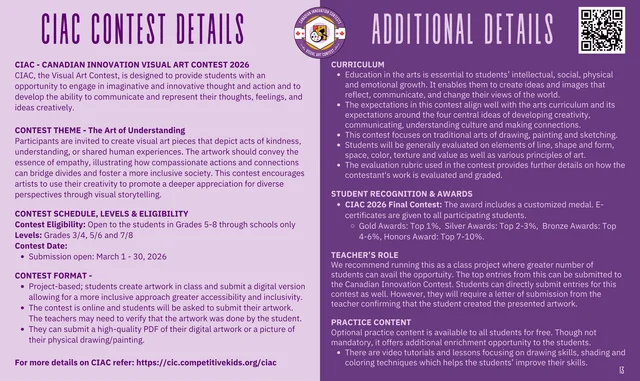
CIAC - CANADIAN INNOVATION VISUAL ART CONTEST 2026
CIAC, the Visual Art Contest, is designed to provide students with an opportunity to engage in imaginative and innovative thought and action and to develop the ability to communicate and represent their thoughts, feelings, and ideas creatively. CONTEST THEME - The Art of Understanding Participants are invited to create visual art pieces that depict acts of kindness, understanding, or shared human experiences. The artwork should convey the essence of empathy, illustrating how compassionate actions and connections can bridge divides and foster a more inclusive society. This contest encourages artists to use their creativity to promote a deeper appreciation for diverse perspectives through visual storytelling.
CONTEST SCHEDULE, LEVELS & ELIGIBILITY
Contest Eligibility: Open to the students in Grades 5-8 through schools only Levels: Grades 3/4, 5/6 and 7/8 Contest Date: • Submission open: March 1 - 30, 2026
CONTEST FORMAT -
• Project-based; students create artwork in class and submit a digital version allowing for a more inclusive approach greater accessibility and inclusivity. • The contest is online and students will be asked to submit their artwork. The teachers may need to verify that the artwork was doneby the student. • They can submit a high-quality PDF of their digital artwork or a picture of their physical drawing/painting.
CURRICULUM
• Education in the arts is essential to students' intellectual, social, physical and emotional growth. It enables them to create ideas and images that retlect, communicate, and change their views of the world. • The expectations in this contest align well with the arts curriculum and its expectations around the four central ideas of developing creativity, communicating, understanding culture and making connections. • This contest focuses on traditional arts of drawing, painting and sketching. • Students will be generally evaluated on elements of line, shape and form, space, color, texture and value as well as various principles of art. • The evaluation rubric used in the contest provides further details on how the contestant's work is evaluated and graded.
STUDENT RECOGNITION & AWARDS
• CIAC 2026 Final Contest: The award includes a customized medal. E- certificates are given to all participating students. • Gold Awards: Top 1%, Silver Awards: Top 2-3%, Bronze Awards: Top 4-6%, Honors Award: Top 7-10%.
TEACHER'S ROLE
We recommend running this as a class project where greater number of students can avail the opportuity. The top entries from this can be submitted to the Canadian Innovation Contest. Students can directly submit entries for this contest as well. However, they will require a letter of submission from the teacher confirming that the student created the presented artwork.
PRACTICE CONTENT
Optional practice content is available to all students for free. Though not mandatory, it offers additional enrichment opportunity to the students. • There are video tutorials and lessons focusing on drawing skills, shading and
2026 Visual Art theme
CIAC 2026 Theme
CIAC 2026 Contest FAQ
CIAC 2026 Contest FAQ
WHAT IS THE CANADIAN INNOVATION VISUAL ART CONTEST (CIAC)?
CIAC, the Visual Art Contest, is designed to provide students with an opportunity to engage in imaginative and innovative thought and action and to develop the ability to communicate and represent their thoughts, feelings, and ideas creatively.
CONTEST THEME
Theme: The Art of Understanding
Participants are invited to create visual art pieces that depict acts of kindness, understanding, or shared human experiences. The artwork should convey the essence of empathy, illustrating how compassionate actions and connections can bridge divides and foster a more inclusive society. This contest encourages artists to use their creativity to promote a deeper appreciation for diverse perspectives through visual storytelling.
CURRICULUM CONNECTION
- Education in the arts is essential to students’ intellectual, social, physical and emotional growth. It enables them to create ideas and images that reflect, communicate, and change their views of the world.
- The expectations in this contest align well with the arts curriculum and its expectations around the four central ideas of developing creativity, communicating, understanding culture and making connections.
- This contest focuses on traditional arts of drawing, painting and sketching.
- Students will be generally evaluated on elements of line, shape and form, space, color, texture and value as well as various principles of art.
- The evaluation rubric used in the contest provides further details on how the contestant's work is evaluated and graded.
CONTEST ELIGIBILITY & FORMAT: March 1-30, 2026
Contest Eligibility: Open to students in grades 3-8 (younger students are welcome to join. We will not hesitate to award exceptional talent).
Contest Levels: 3 levels based on the student’s current school grade
- Elementary Level: Grades 3 & 4
- Junior Level: Grades 5 & 6
- Middle Level: Grades 7 & 8
Contest Date:
- Submission open: March 1 - 30, 2026
CONTEST FORMAT
- The contest is online, and students will be asked to submit their artwork.
- They can submit a high-quality PDF of their digital artwork or a picture of their physical drawing/painting.
Originality: We are looking for original ideas in these contests. We will conduct checks for plagiarism. So, please be sure to trust yourself and be authentic. We want to see the world through your eyes. You may surprise the world through your insight. Please create something you will be proud of, regardless of the outcome of this contest.
STUDENT AWARDS
All contest participants are eligible for the following awards:
- Gold Awards: Top 1% of students for each contest level. The award includes a customized medal & e-certificate.
- Silver Awards: Top 2-3% of students for each contest level. The award includes a customized medal & e-certificate.
- Bronze Awards: Top 4-6% of students for each contest level. The award includes a customized medal & e-certificate.
- Honors Award: Top 7-10% of students for each contest level. The award includes a customized medal & e-certificate.
- Certificate of participation: Given to all participants.
* Because of the resources, CKSTEM will not pay for the international shipping to the schools. Awards will be sent to Canadian students, including schools and all other paid students. Students will also have an opportunity to join us in an award ceremony in the Greater Toronto Area (GTA).
REGISTRATION PROCESS
- If you are a school staff interested in participating, you can find the registration package View CIAC 2026 contest guide resource. You may also contact us at [email protected]. All contests are free for school registrations. We need a minimum of 5 students for school registrations.
- This contest is unavailable for individual registration as we can not verify the artwork.
CONTEST BROCHURE
You can download the Canadian Innovation Contests (CIC) brochure from View CIAC 2026 contest guide resource.
CIAC WINNING ENTRIES
Download Now
Evaluation Criteria
Visual Art · original 2023 evaluation rubric
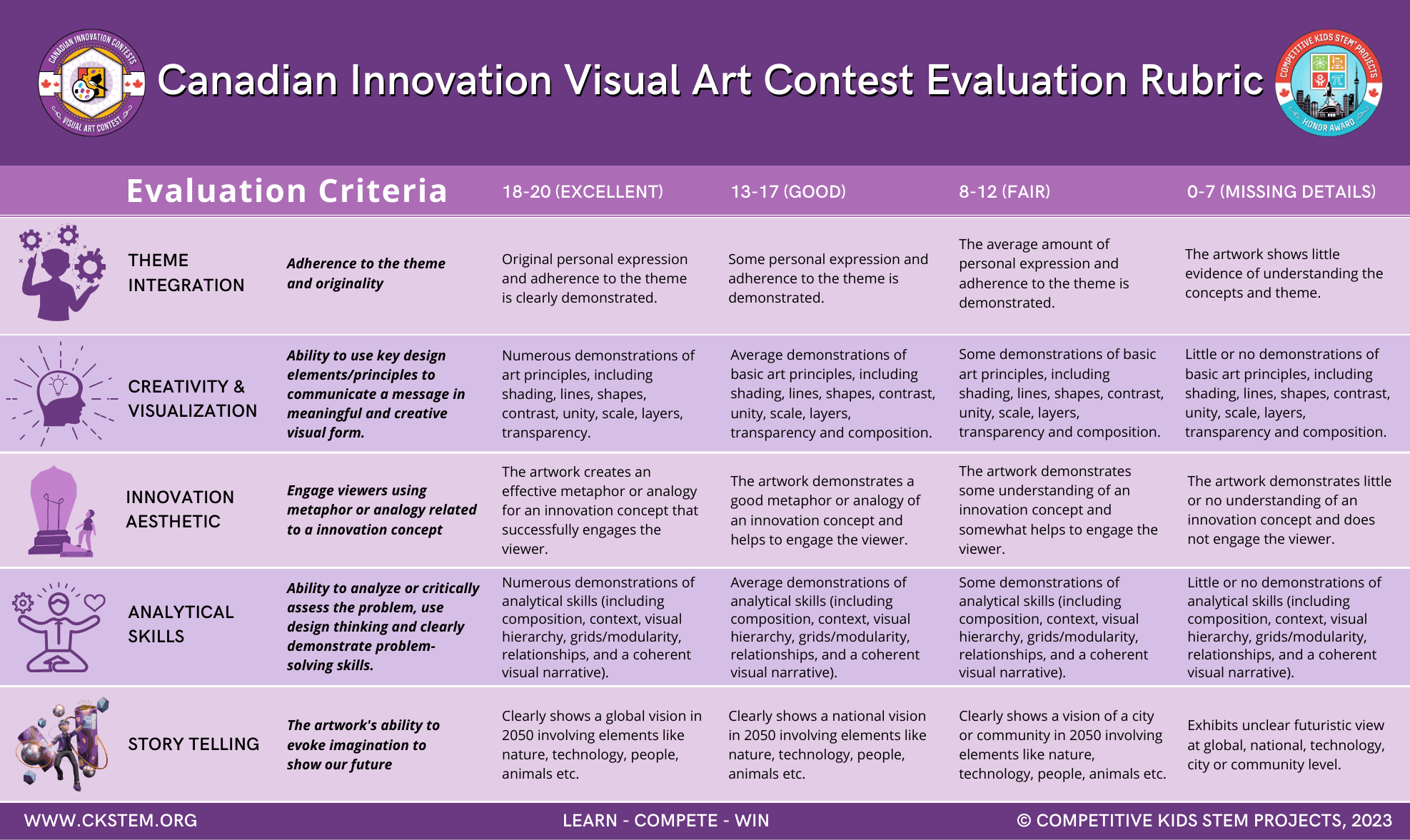
This is the historical rubric linked by the 2026 guide. Its original year and wording are retained. It is not a new Leadership rubric.
Theme Integration
Adherence to the theme and originality is clearly demonstrated.
- 18–20 · Excellent
- Original personal expression and adherence to the theme
- 13–17 · Good
- Some personal expression and adherence to the theme is demonstrated.
- 8–12 · Fair
- The average amount of personal expression and adherence to the theme is concepts and theme. demonstrated.
- 0–7 · Missing details
- The artwork shows little evidence of understanding the
Creativity & Visualization
Ability to use key design art principles, including elements/principles to communicate a message in meaningful and creative contrast, unity, scale, layers, visual form.
- 18–20 · Excellent
- Numerous demonstrations of shading, lines, shapes, transparency.
- 13–17 · Good
- Average demonstrations of basic art principles, including art principles, including shading, lines, shapes, contrast, shading, lines, shapes, contrast, unity, scale, layers, transparency and composition. transparency and composition.
- 8–12 · Fair
- Some demonstrations of basic basic art principles, including unity, scale, layers,
- 0–7 · Missing details
- Little or no demonstrations of shading, lines, shapes, contrast, unity, scale, layers, transparency and composition.
Innovation Aesthetic
The artwork creates an Engage viewers using for an innovation concept that metaphor or analogy related to a innovation concept
- 18–20 · Excellent
- effective metaphor or analogy successfully engages the viewer.
- 13–17 · Good
- The artwork demonstrates a some understanding of an good metaphor or analogy of innovation concept and an innovation concept and somewhat helps to engage the helps to engage the viewer.
- 8–12 · Fair
- The artwork demonstrates viewer.
- 0–7 · Missing details
- The artwork demonstrates little or no understanding of an innovation concept and does not engage the viewer.
Analytical Skills
Ability to analyze or critically analytical skills (including assess the problem, use composition, context, visual design thinking and clearly demonstrate problem- relationships, and a coherent solving skills. visual narrative).
- 18–20 · Excellent
- Numerous demonstrations of hierarchy, grids/modularity,
- 13–17 · Good
- Some demonstrations of Average demonstrations of analytical skills (including composition, context, visual composition, context, visual hierarchy, grids/modularity, relationships, and a coherent relationships, and a coherent visual narrative).
- 8–12 · Fair
- analytical skills (including hierarchy, grids/modularity, visual narrative).
- 0–7 · Missing details
- Little or no demonstrations of analytical skills (including composition, context, visual hierarchy, grids/modularity, relationships, and a coherent visual narrative).
Story Telling
The artwork's ability to evoke imagination to show our future animals etc.
- 18–20 · Excellent
- Clearly shows a global vision in 2050 involving elements like nature, technology, people,
- 13–17 · Good
- Clearly shows a national vision in 2050 involving elements like nature, technology, people, animals etc. technology, people, animals etc.
- 8–12 · Fair
- Clearly shows a vision of a city or community in 2050 involving elements like nature,
- 0–7 · Missing details
- Exhibits unclear futuristic view at global, national, technology, city or community level.
CIAC Winner's Artwork & Team Award
CIAC Winner's Artwork & Team Award
Design Inspiration and Ideas A Nineteenth-Century Vision of the Year 2000
Design Inspiration and Ideas
A Nineteenth-Century Vision of the Year 2000
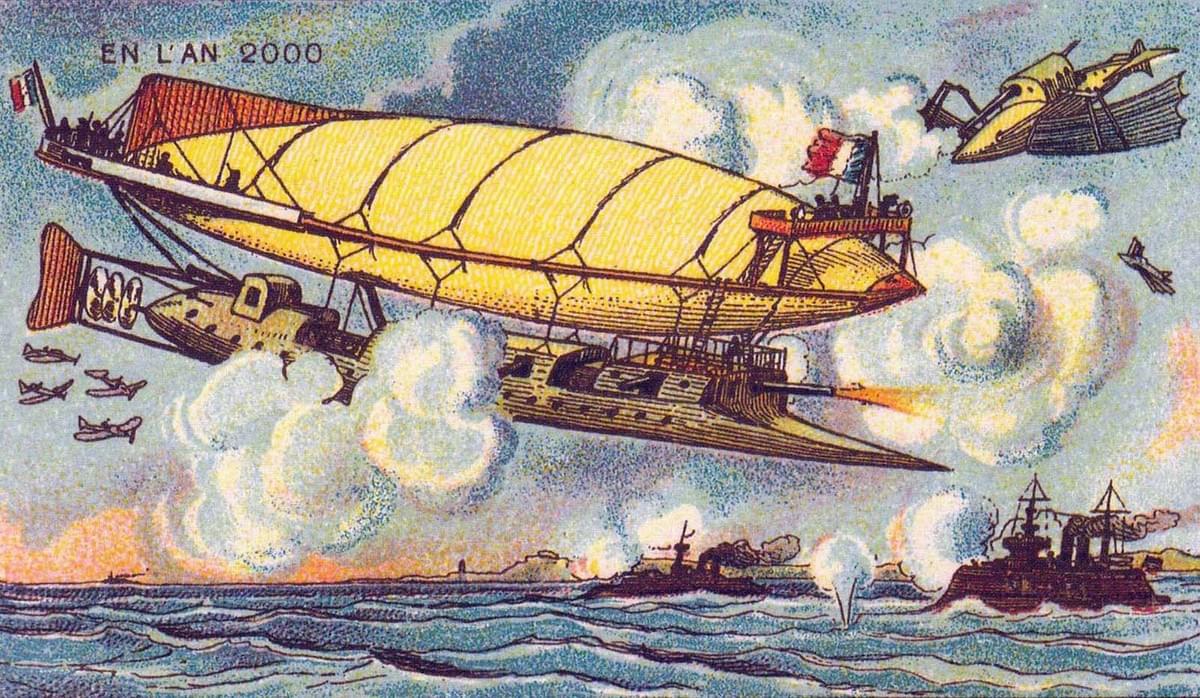
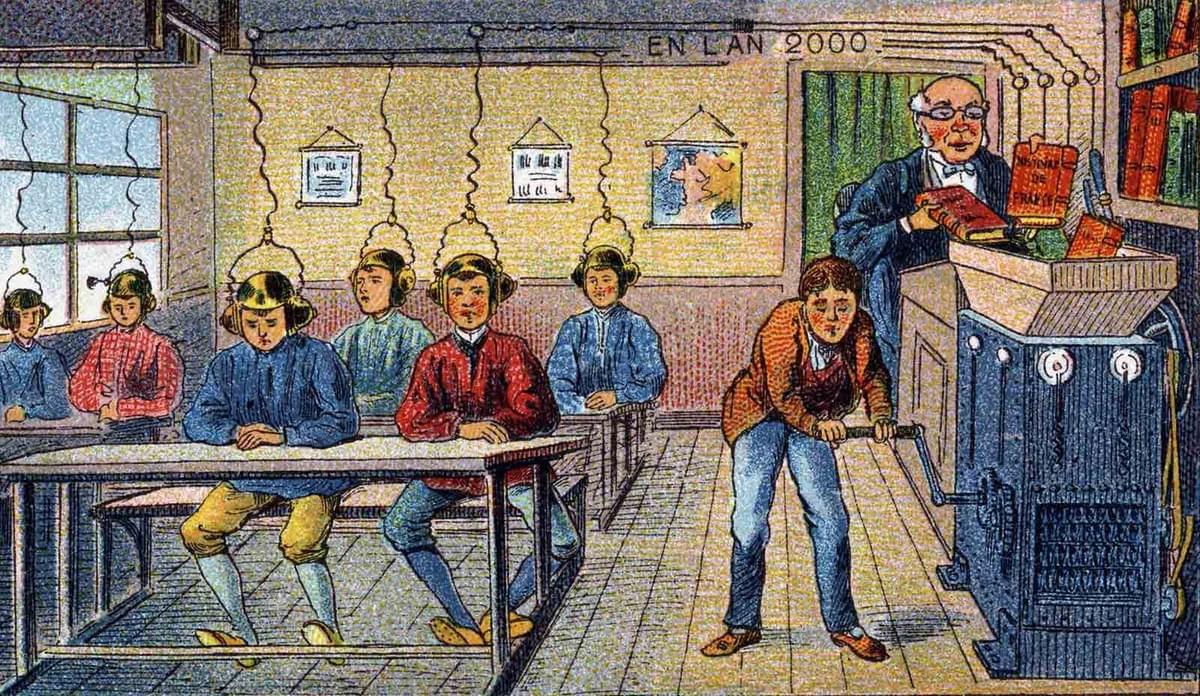
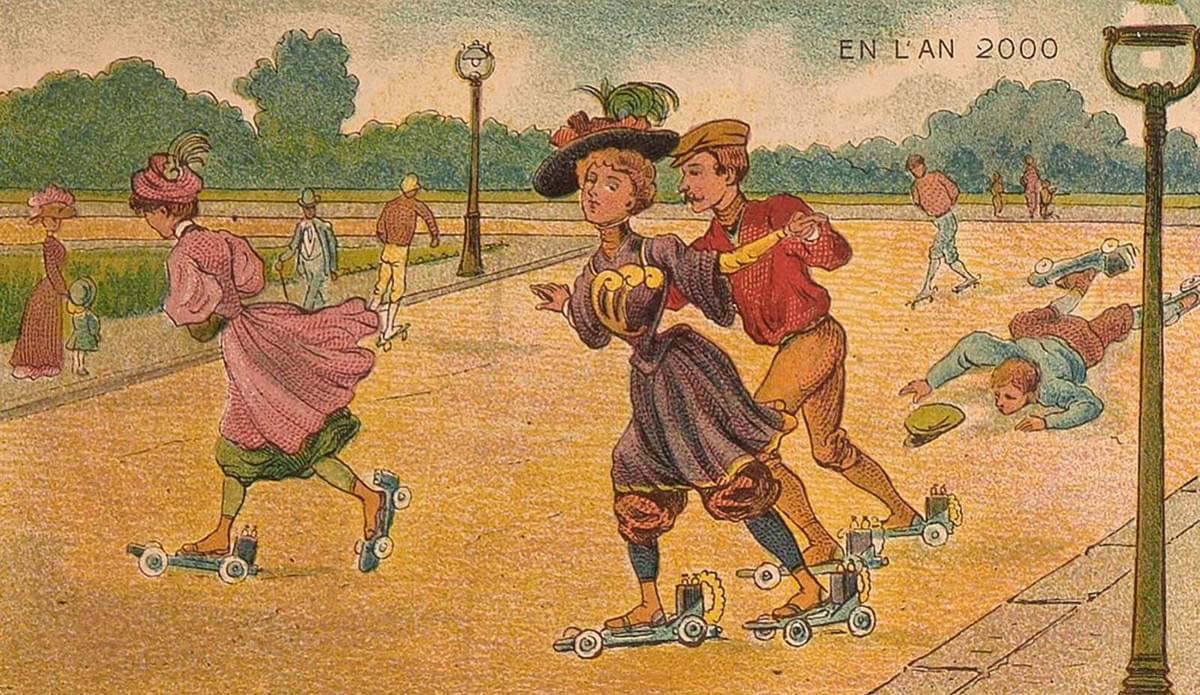
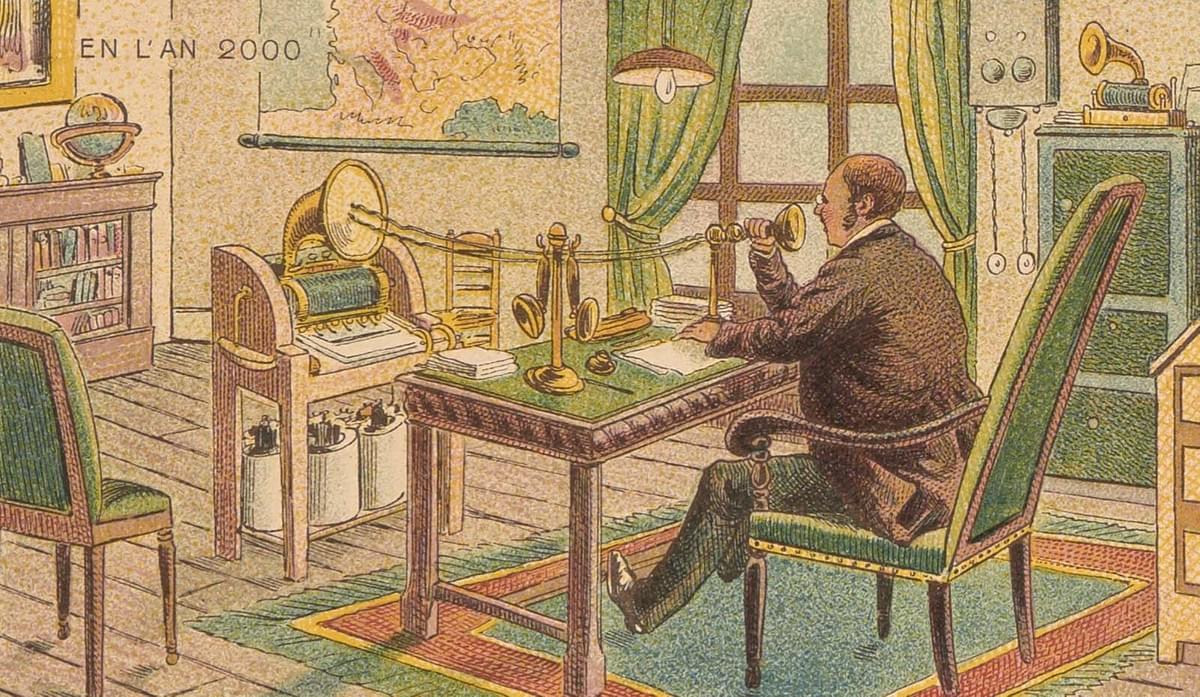
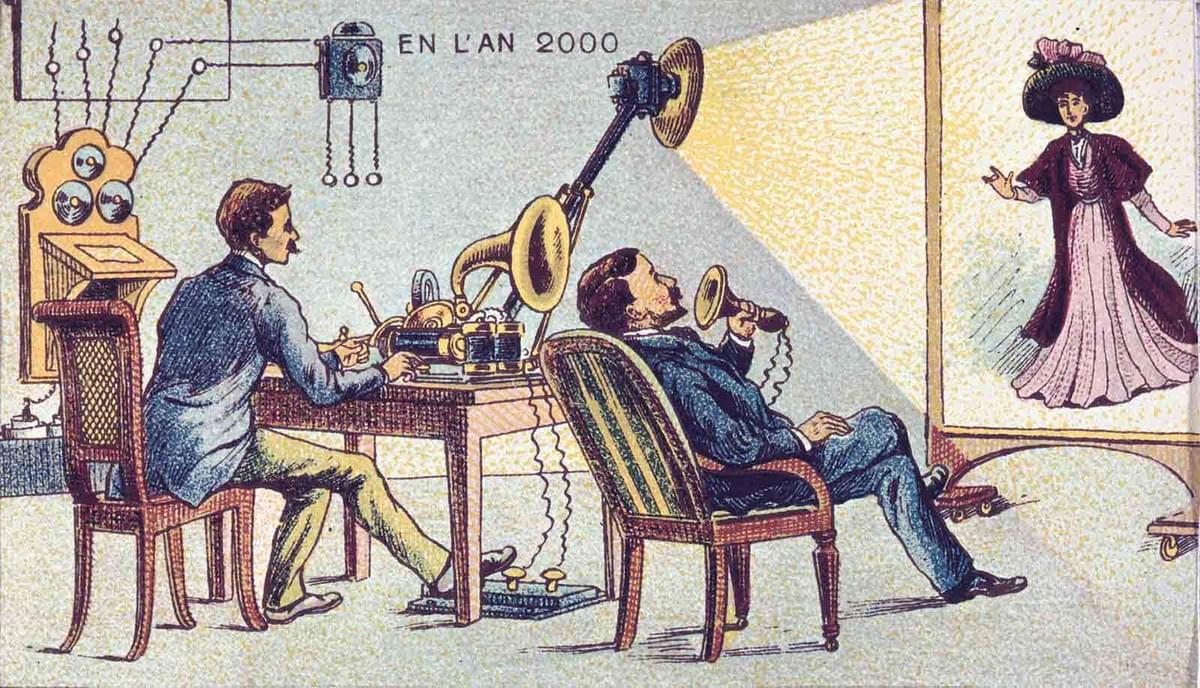
In 1899, a group of French illustrators led by Jean-Marc Côté was tasked with imagining what France would look like in the year 2000. Their ideas weren’t always on the money, but many have been realized, albeit not precisely according to the original drawings. These futuristic pictures were released in four installments in 1899, 1900, 1901, and 1910 and took the form of cigarette/cigar box inserts and, later, postcards.
Images below are shared to fuel your imagination. In 1899, People imagined what we could do in 2000. Can you share what we may do differently in 2050 using your imagination and artwork?
At School
At School
Moving using Rollers
Speaking Remotely
Video Telephone
An Aerial Battle