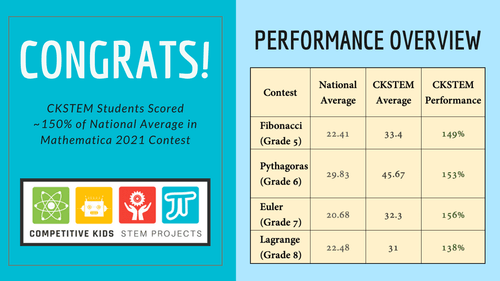
Free forever · made for Grade 2
Bloom Garden for Grade 2
A math course that feels like a garden game. Your child plays through picture puzzles across six worlds — 50+ lessons planned — and quietly learns the kind of math that wins contests. No leaderboards, no pressure — and nobody ever just tells them the answer. That’s the BLOOM way.
We intend to keep this course free forever · if your child can add and subtract, they’re ready
- Grade 2made for Grade 2 · a great review for Grades 3–4
- 50+ lessons plannedacross six worlds, growing all the time
- Free foreverthat’s our intention — and no payment details, ever
- One prerequisitebasic addition and subtraction — that’s it
Start here
Four minutes, and you’ll know exactly what to do.
You are your child’s best teacher — we just hand you the structure and the tools. This short guide shows how the Garden works, what your part is, and three tricks to use in the car, at the till and at the dinner table.
Your Job in the Garden
What a chapter looks like. What happens when your child gets one wrong. Why never reaching the top level isn’t failing. How to set a daily time — and then the part parents ask for most: three named tricks, and exactly where to use them.
- In the car — the pair that cancels
- At the till — take a round number, then give one back
- At the dinner table — one place setting, then skip-count
And here are real lessons, start to finish.
Sunny the sunflower teaches the trick with pictures, and Caw and Craw the crow twins turn up to test it. Watch one with your child and pause whenever they want to try.
-
Friendly Pairs
Two numbers that make a round ten are friends. Sunny shows your child how to spot a number’s friend, and a long slow sum turns into a quick one.
-
Chain Reactions
A long line of pluses and minuses becomes a chain of gives and takes. Your child finds the pairs that cancel each other out — and a scary-looking sum shrinks to almost nothing.
-
Repeated Blocks
The same little group, over and over. Your child learns to work out one group and then skip-count the rest, so eight additions turn into three.
-
Missing Digits
A sum with a smudge in it. Your child discovers that the columns still talk — so the hidden digit can be worked out rather than guessed.
More lesson videos land in the Grade 2 playlist as we record them, and anything new for parents goes in the parents’ playlist. The videos are a bonus — every chapter teaches the same trick inside the course itself.
The lesson plan
Six worlds. One growing garden.
The Garden has six worlds — the same six kinds of questions kids meet in real contests like TIMO and HKIMO. Each chapter teaches one big idea through pictures your child can touch, count and move. And every world has its own garden friend who cheers your child on and helps with hints.
-

Seed Works
Arithmetic
Adding and subtracting the clever way, with pairs and shortcuts.
with Sunny the sunflower
-
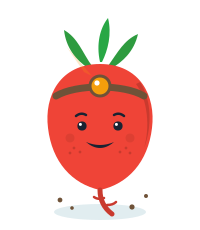
Root Cellar
Number Theory
Place value, odd and even, bigger and smaller. How numbers work.
with Rooty the radish
-

Lily Pond
Logical Thinking
Patterns, line-ups and little logic puzzles. Learning to think it through.
with Lily the water lily
-

Glass Greenhouse
Geometry
Counting squares, mirrors and building blocks. Playing with shapes.
with Vera the aloe
-
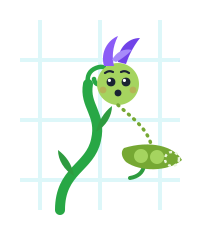
Trellis Maze
Combinatorics
How many ways can it be done? Paths, arrangements, careful counting.
with Twist the pea tendril
-
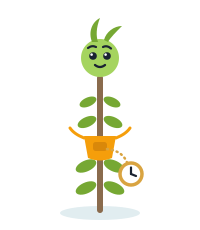
Market Garden
Measure, Time, Money & Data
Clocks, coins, rulers and simple graphs. Math from everyday life.
with Thyme the thyme sprig
And your child never gardens alone
-

Professor Bloom
The wise old tree of the Garden. He teaches every new idea in a few short, friendly lines — and never lectures.
-
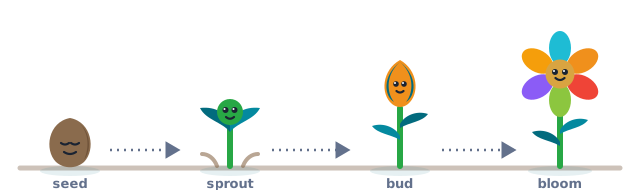
Your child’s own Sprout
On day one, your child plants a seed and gives it a name. It grows as they learn: seed, sprout, bud, and one day — full bloom.
-
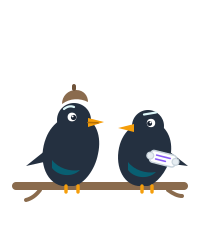
Caw & Craw, the Crow Twins
Two cheeky crows who bet your child can’t solve their puzzles. Smug, always fair — and never, ever mean about a miss.
Inside every chapter
Every chapter starts with a short lesson from Professor Bloom — a few simple lines and lots of pictures. Then your child learns by doing: dragging number chips, spotting the pattern, filling in the missing digit. The words stay simple, so most kids can do the whole thing on their own. No grown-up needed to read along.
Chapters your child will meet:
- Place Value Chips
- Pattern Chains
- Friendly Pairs
- Chain Reactions
- Repeated Blocks
- Missing Digits
- Stack It
- Cross-Sums
- Breaking Apart
- Look Before You Stack
- Balance Symbols
- Draw the Story
- The Odometer
- …and many more across the six worlds
Three ways to practice
Three kinds of quizzes, all through the Garden.
Steady practice, quick practice, and a taste of a real contest. All three adjust to your child — and none of them ever compare your child to anyone else.
-
Levels 1–4 · at your pace
Adaptive Quiz
Each chapter has four levels of questions. They get a little harder when your child is doing well, and a little gentler when they’re stuck — so it always feels just right. Every level climbed earns a star, and a star is never taken away.
Stuck? Their garden friend offers a hint — a nudge in the right direction, never the answer.
-
Quick timed rounds
Mental Math
Quick rounds, about twenty seconds a question. Bit by bit, the math facts become fast and automatic — and that frees your child’s head for the fun, tricky problems. Kids love beating their own best.
No racing other kids. The only score to beat is their own.
-
A mini contest
Crow Challenge
Every so often, Caw and Craw the Crow Twins turn up with a bet: “You can’t solve OUR puzzle!” Their challenge mixes questions from every world, just like a real contest. So when your child sits a real one someday, it already feels familiar.
The crows are smug but fair — and they never make fun of a miss.
Levels 1–4 · a promise to parents
Every kid is different — and that’s just fine.
Each chapter’s quiz climbs four levels. Level 1 builds the main skill. Levels 2 and 3 stretch it. Level 4 mixes ideas together, like a real contest. And here is the part we want every parent to hear: it is completely fine if your child doesn’t finish every level. The Garden is not a race to the top. It meets your child where they are.
The Level 1 questions alone will make your child perform better than most other kids in their classroom. Everything above that is a bonus.
Some kids fly to Level 4 in one world and stay at Level 1 in another. Both are doing it right. There are no leaderboards here, and your child is never compared to anyone else.
Honest work earns a daily scholarship.
Every day your child practices honestly, they earn a little scholarship credit — real credit, in their name, that they can put toward our Grade 3 and Grade 4 courses. There’s a small daily limit, so it stays fun instead of stressful, and the money never buys answers. It’s simply our way of showing your child that honest work is worth something real.
And the Garden keeps growing.
New chapters arrive regularly, and every one of the six worlds opens up over time — crow challenges along the way, and a friendly practice contest to finish the year. Start today and nothing is lost: the stars, the progress and the scholarship your child earns all stay with them as the Garden grows.
The parent’s role
A little help from you goes a long way.
Your child can work through a chapter on their own. But children do best when a parent sets the routine and carries the trick out of the room. Six small things that help a lot — and if you only do one thing, watch the four-minute guide.
-
Keep a small daily routine
15–20 minutes most days beats one long weekend session. Same time, same spot — after snack, before play — and the Garden becomes a happy habit.
-
Sit close for the first week
It’s always fine to help read a question. Just don’t give away the answer — the thinking is where the learning happens.
-
Praise the fix, not the score
In the Garden, wrong answers aren’t failures — they come back later so your child can fix them. Cheer “you fixed it!” as loudly as “you got it right!” and your child learns that trying matters most.
-
It’s okay to be stuck
Being stuck for a minute is not an emergency — that’s when the brain grows. The garden friends give hints, one step at a time. Your job is just calm company.
-
Ask about the garden every day
A simple “did you water your garden today?” goes a long way. Let your child show you what they earned — it’s a proud moment for a seven-year-old.
-
Take the weekly garden tour
Once a week, let your child walk you through their garden — what has bloomed, what’s still growing. They’ll love being the guide, and you’ll see their progress better than any report card could show it.
In Grade 3 or 4? The Garden is a great refresher.
Many older kids have small gaps in the basics — place value, quick adding and subtracting. Bloom Garden makes fixing those gaps feel like play. And strong basics make everything in Grades 3 and 4 (including our MPS courses) easier.
Plant the seed today.
Enrolling is free and takes a few minutes — no payment details, nothing to cancel. We intend to keep Bloom Garden for Grade 2 free forever. If your child can add and subtract, they’re ready. The Garden does the rest.