
Historical contest guide
CIMC 2026 contest guide
Theme: Empathy
Explore material preserved from an earlier CKSTEM programme: its ideas, learning resources and original context.
This is a historical archive. Dates, awards, fees and registration instructions below describe that edition; its entry period has closed. See the current contest programme and calendar.
Original edition poster
CIMC · original 2026 contest details
Historical 2026 poster transcript. Where this poster and the old FAQ differ, both original versions are retained; these are not 2027 instructions.
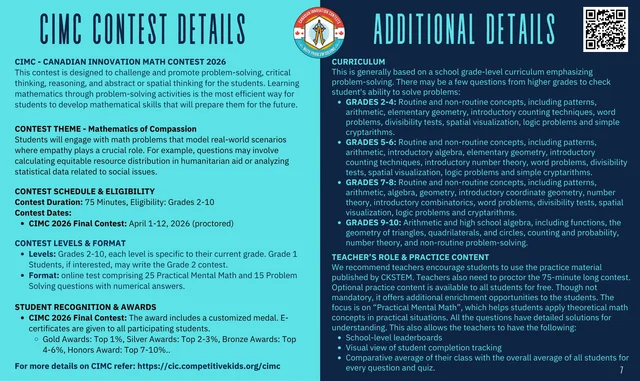
CIMC - CANADIAN INNOVATION MATH CONTEST 2026
This contest is designed to challenge and promote problem-solving, critical thinking, reasoning, and abstract or spatial thinking for the students. Learning mathematics through problem-solving activities is the most efficient way for students to develop mathematical skills that will prepare them for the future. CONTEST THEME - Mathematics of Compassion Students will engage with math problems that model real-world scenarios where empathy plays a crucial role. For example, questions may involve calculating equitable resource distribution in humanitarian aid or analyzing statistical data related to social issues.
CONTEST SCHEDULE & ELIGIBILITY
Contest Duration: 75 Minutes, Eligibility: Grades 2-10 Contest Dates: • CIMC 2026 Final Contest: April 1-12, 2026 (proctored)
CONTEST LEVELS & FORMAT
• Levels: Grades 2-10, each level is specific to their current grade. Grade 1 Students, if interested, may write the Grade 2 contest. • Format: online test comprising 25 Practical Mental Math and 15 Problem Solving questions with numerical answers.
STUDENT RECOGNITION & AWARDS
• CIMC 2026 Final Contest: The award includes a customized medal. E- certificates are given to all participating students. • Gold Awards: Top 1%, Silver Awards: Top 2-3%, Bronze Awards: Top 4-6%, Honors Award: Top 7-10%..
CURRICULUM
This is generally based on a school grade-level curriculum emphasizing problem-solving. There may be a few questions from higher grades to check student's ability to solve problems: • GRADES 2-4: Routine and non-routine concepts, including patterns, arithmetic, elementary geometry, introductory counting techniques, word problems, divisibility tests, spatial visualization, logic problems and simple cryptarithms. • GRADES 5-6: Routine and non-routine concepts, including patterns, arithmetic, introductory algebra, elementary geometry, introductory counting techniques, introductory number theory, word problems, divisibility tests, spatial visualization, logic problems and simple cryptarithms. • GRADES 7-8: Routine and non-routine concepts, including patterns, arithmetic, algebra, geometry, introductory coordinate geometry, number theory, introductory combinatorics, word problems, divisibility tests, spatial visualization, logic problems and cryptarithms. • GRADES 9-10: Arithmetic and high school algebra, including functions, the geometry of triangles, quadrilaterals, and circles, counting and probability, number theory, and non-routine problem-solving.
TEACHER'S ROLE & PRACTICE CONTENT
We recommend teachers encourage students to use the practice material published by CKSTEM. Teachers also need to proctor the 75-minute long contest. Optional practice content is available to all students for free. Though not mandatory, it offers additional enrichment opportunities to the students. The focus is on "Practical Mental Math" , which helps students apply theoretical math concepts in practical situations. All the questions have detailed solutions for understanding. This also allows the teachers to have the following: • School-level leaderboards • Visual view of student completion tracking • Comparative average of their class with the overall average of all students for
Learning Contest
CIMC Math Lab · 2026 learning content
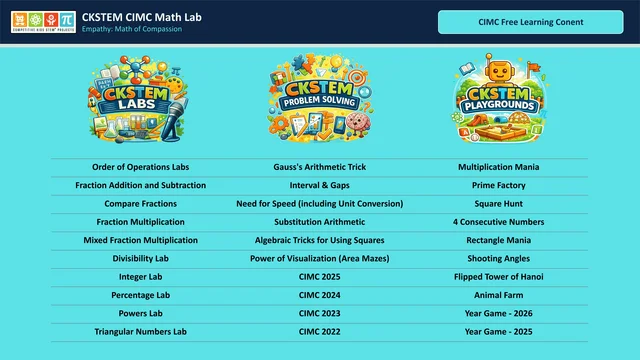
Original free learning-content list from the 2026 Empathy edition.
Labs
- Order of Operations Labs
- Fraction Addition and Subtraction
- Compare Fractions
- Fraction Multiplication
- Mixed Fraction Multiplication
- Divisibility Lab
- Integer Lab
- Percentage Lab
- Powers Lab
- Triangular Numbers Lab
Problem solving
- Gauss's Arithmetic Trick
- Interval & Gaps
- Need for Speed (including Unit Conversion)
- Substitution Arithmetic
- Algebraic Tricks for Using Squares
- Power of Visualization (Area Mazes)
- CIMC 2025
- CIMC 2024
- CIMC 2023
- CIMC 2022
Playgrounds
- Multiplication Mania
- Prime Factory
- Square Hunt
- 4 Consecutive Numbers
- Rectangle Mania
- Shooting Angles
- Flipped Tower of Hanoi
- Animal Farm
- Year Game - 2026
- Year Game - 2025
CIMC 2026 CONTEST FAQ
CIMC 2026 CONTEST FAQ
WHAT IS THE CANADIAN INNOVATION MATH CONTEST (CIMC)?
The Canadian Innovation Math Contest, popularly known as CIMC, is an initiative by Competitive Kids STEM to provide students across the globe with an opportunity to showcase their talent and develop their skills. The contest is designed to challenge and promote problem-solving, critical thinking, reasoning, and abstract or spatial thinking for the students.
Learning mathematics through problem-solving activities is the most efficient way for students to develop mathematical skills that will prepare them for future challenges. This contest is designed to challenge and promote problem-solving, critical thinking, reasoning, and abstract or spatial thinking for the students. Learning mathematics through problem-solving activities is the most efficient way for students to develop mathematical skills that will prepare them for the future.
CONTEST SCHEDULE & ELIGIBILITY: APRIL 1-12, 2026
- Contest Duration: 75 Minutes
- Eligibility: Grades 2-10 (Grade 1 students, if interested, may write the Grade 2 contest.)
- Contest Dates: April 1-12, 2026
CONTEST FORMAT
- Format: Online
- Proctoring: Proctored by teachers. The same grade contest in a school must be conducted on the same day and preferably at the same time for all students. Teachers may split students into reasonable batches if a school grade has many students. However, the contest for all students should be done on the same day
- Contest Levels - Nine levels, Grades 2-10, each level is specific to a grade.
- Contest Duration - 75 Minutes
- Calculators - No one should use a calculator in this contest.
- Contest Format (one unified test):
- Part A - Mental Math (100 points): 15-25 questions focused on "Practical Mental Math." Students may use our online drills to practice questions in this section to improve their accuracy and speed.
- Part B - Problem-Solving (100 points): 15-25 questions as per the syllabus for the appropriate grade level. The last few problems will require a deeper understanding of the topics.
- Logistics: The test will be taken online. Once you start the test, you will have the time specified above to complete it.
- Practice tests are also available before the competition for further preparation.
CURRICULUM CONNECTION
The curriculum is generally based on a school grade-level curriculum emphasizing problem-solving. As this is a contest, you can expect a few questions from higher grades to check student's understanding of advanced concepts.
GRADES 2-4
- Routine and non-routine concepts, including patterns, arithmetic, elementary geometry, introductory counting techniques, word problems, divisibility tests, spatial visualization, logic problems and simple cryptarithms
GRADES 5-6
- Routine and non-routine concepts, including patterns, arithmetic, introductory algebra, elementary geometry, introductory counting techniques, introductory number theory, word problems, divisibility tests, spatial visualization, logic problems and simple cryptarithms
GRADES 7-8
- Routine and non-routine concepts, including patterns, arithmetic, algebra, geometry, introductory coordinate geometry, number theory, introductory combinatorics, word problems, divisibility tests, spatial visualization, logic problems and cryptarithms
Grade 9-10
- Arithmetic and high school algebra, including functions, Geometry of triangles, quadrilaterals, and circles, Counting and Probability, Number Theory, Non-routine problem-solving
STUDENT AWARDS
All contest participants are eligible for the following awards:
- Gold Awards: Top 1% of students for each contest level. The award includes a customized medal & e-certificate.
- Silver Awards: Top 2-3% of students for each contest level. The award includes a customized medal & e-certificate.
- Bronze Awards: Top 4-6% of students for each contest level. The award includes a customized medal & e-certificate.
- Honors Award: Top 7-10% of students for each contest level. The award includes a customized medal & e-certificate.
- Certificate of participation: Given to all participants.
* Because of the resources, CKSTEM will not pay for the international shipping to the schools. Awards will be sent to Canadian students, including schools and all other paid students. Students will also have an opportunity to join us in an award ceremony in the Greater Toronto Area (GTA).
HOW TO DECIDE YOUR CONTEST GRADE?
Please use the school grade you attended/will attend in January 2026 as your contest grade. You will be disqualified if you use the wrong contest grade.
REGISTRATION PROCESS
- If you are a school staff interested in participating, you can find the registration package View CIMC 2026 contest guide resource. You may also contact us at [email protected]. All contests are free for school registrations. We need a minimum of 5 students for school registrations.
- If you are an individual participant, you can enroll View CIMC 2026 contest guide resource. You must first create an account if you don't have it at our contest portal already. You can find instructions on how to create your account at https://www.competitivekids.org/blog/registration. There is a fee of 20 CAD for individual students.
PROCTORING
School Registrations: School teachers are responsible for proctoring students in school. Contest for a school grade must be proctored at the same time. If students take the contest at different times, only the first set of students will be considered for the awards. Up to 15 minutes of variation in start time is acceptable.
Individual Registrations: CKSTEM will proctor students who enroll for the contests directly with CKSTEM. Students are expected to use two devices with working cameras. Students must take the contest on a laptop and share the camera from this device on Zoom. The Second device is required to show the room from a different angle on Zoom. Honesty is the best policy. CKSTEM will provide multiple slots for the students to choose from during the contest period.
CONTEST BROCHURE
You can download the Canadian Innovation Contests (CIC) brochure from View CIMC 2026 contest guide resource.
CIMC 2023, 2024, & 2025 PRACTICE QUESTIONS
Download Now
CIMC ADVISORS
CIMC ADVISORS

Cerasela Tesleanu
CIMC Advisory Board Member
Cerasela Tesleanu is a math professor at Collège Stanislas Montreal, Canada, specializing in various Math and Algorithmics courses. As a mathematics coach, she has successfully trained gifted students for national and international competitions. She is passionate about the STREAM teaching approach by using math in conjunction with programming and robotics.
As an Advisory Board Member, Cerasela's contributions include designing CIMC contests and preparing training programs and resources.

Ansh Agarwal
CIMC Student Advisor
Ansh Agarwal is a grade 12 student who excels in math problem solving. Ansh was a bronze medalist in the Canadian Math Olympiad (CMO) and the Asian Pacific Math Olympiad (APMO) in 2025. He is also actively engaged in teaching with CKSTEM and AwesomeMath.
As a member of the CIMC Advisory Committee, Ansh has contributed significantly to designing the contest and creating problems over the last few years.
HELP US TO HELP OTHERS
HELP US TO HELP OTHERS
SPREAD AWARENESS AND DONATE

We want to help students all across the globe. Please help us spread the word. We are confident that the participants will have fun solving some of the coolest math problems with our unique approach, allowing them to try each problem more than once.
We also need funds to run this program, especially for specific tool licensing costs. The anticipated cost to facilitate this is over $25000. We are relying on the generosity of our donors to help meet this cost, as we will not be charging the students any contest fees. Therefore, we will greatly appreciate your support and donation.