
Historical contest guide
CIPC 2026 contest guide
Theme: Empathy
Explore material preserved from an earlier CKSTEM programme: its ideas, learning resources and original context.
This is a historical archive. Dates, awards, fees and registration instructions below describe that edition; its entry period has closed. See the current contest programme and calendar.
Debate contest poster
CIPC · original 2026 contest details
Historical 2026 poster transcript. Where this poster and the old FAQ differ, both original versions are retained; these are not 2027 instructions.
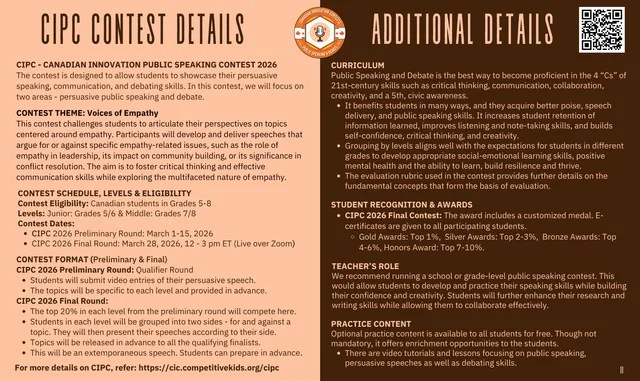
CIPC - CANADIAN INNOVATION PUBLIC SPEAKING CONTEST 2026
The contest is designed to allow students to showcase their persuasive speaking, communication, and debating skills. In this contest, we will focus on two areas - persuasive public speaking and debate. CONTEST THEME: Voices of Empathy This contest challenges students to articulate their perspectives on topics centered around empathy. Participants will develop and deliver speeches that argue for or against specific empathy-related issues, such as the role of empathy in leadership, its impact on community building, or its significance in conflict resolution. The aim is to foster critical thinking and effective communication skills while exploring the multifaceted nature of empathy.
CONTEST SCHEDULE, LEVELS & ELIGIBILITY
Contest Eligibility: Canadian students in Grades 5-8 Levels: Junior: Grades 5/6 & Middle: Grades 7/8 Contest Dates: • CIPC 2026 Preliminary Round: March 1-15, 2026 • CIPC 2026 Final Round: March 28, 2026, 12 - 3 pm ET (Live over Zoom) CONTEST FORMAT (Preliminary & Final) CIPC 2026 Preliminary Round: Qualifier Round • Students will submit video entries of their persuasive speech. • The topics will be specific to each level and provided in advance. CIPC 2026 Final Round: • The top 20% in each level from the preliminary round will compete here. • Students in each level will be grouped into two sides - for and against a topic. They will then present their speeches according to their side. • Topics will be released in advance to all the qualifying finalists. • This will be an extemporaneous speech. Students can prepare in advance.
CURRICULUM
Public Speaking and Debate is the best way to become proficient in the 4 "Cs" of 21st-century skills such as critical thinking, communication, collaboration, creativity, and a 5th, civic awareness. • It benefits students in many ways, and they acquire better poise, speech delivery, and public speaking skills. It increases student retention of information learned, improves listening and note-taking skills, and builds self-confidence, critical thinking, and creativity. • Grouping by levels aligns well with the expectations for students in different grades to develop appropriate social-emotional learning skills, positive mental health and the ability to learn, build resilience and thrive. • The evaluation rubric used in the contest provides further details on the fundamental concepts that form the basis of evaluation.
STUDENT RECOGNITION & AWARDS
• CIPC 2026 Final Contest: The award includes a customized medal. E- certificates are given to all participating students. • Gold Awards: Top 1%, Silver Awards: Top 2-3%, Bronze Awards: Top 4-6%, Honors Award: Top 7-10%.
TEACHER'S ROLE
We recommend running a school or grade-level public speaking contest. This would allow students to develop and practice their speaking skills while building their confidence and creativity. Students will further enhance their research and writing skills while allowing them to collaborate effectively.
PRACTICE CONTENT
Optional practice content is available to all students for free. Though not mandatory, it offers enrichment opportunities to the students. • There are video tutorials and lessons focusing on public speaking,
CIPC 2026 Theme
CIPC 2026 Theme
CIDC 2026 Contest FAQ
CIDC 2026 Contest FAQ
WHAT IS THE CANADIAN INNOVATION DEBATING CONTEST (CIPC)?
The contest is designed to allow students to showcase their persuasive speaking, communication, and debating skills. In this contest, we will focus on two areas - persuasive public speaking and debate.
CONTEST THEME
THEME: Voices of Empathy
This contest challenges students to articulate their perspectives on topics centered around empathy. Participants will develop and deliver speeches that argue for or against specific empathy-related issues, such as the role of empathy in leadership, its impact on community building, or its significance in conflict resolution. The aim is to foster critical thinking and effective communication skills while exploring the multifaceted nature of empathy.
CURRICULUM CONNECTION
Public Speaking is the best way to become proficient in the 4 “Cs” of 21st-century skills such as critical thinking, communication, collaboration, creativity, and a 5th, civic awareness.
- It benefits students in many ways, and they acquire better poise, speech delivery, and public speaking skills. It increases student retention of information learned, improves listening and note-taking skills, and builds self-confidence, critical thinking, and creativity.
- Grouping by levels aligns well with the expectations for students in different grades to develop appropriate social-emotional learning skills, positive mental health and the ability to learn, build resilience and thrive.
- The evaluation rubric used in the contest provides further details on the fundamental concepts that form the basis of evaluation.
CONTEST LEVELS & ELIGIBILITY
Contest Eligibility: Open to students in Grades 5-8
Contest Levels: 3 levels based on the student’s current school grade
- Junior Level: Grades 5 & 6
- Middle Level: Grades 7 & 8
PRELIMINARY ROUND (QUALIFIER): March 1 - 15, 2026
Preliminary Round: focuses on persuasive public speaking.
- This is a qualifier round; students will be scored on their speeches.
- Students will submit video entries of their persuasive speech.
- The topics will be specific to each level and provided in advance.
FINAL ROUND: MARCH 28, 2026, 12 - 3 PM ET
Final Round: this will be a debating contest
- Students who score up to the top 20% in each level during the preliminary round will be qualified to compete in the final round.
- This will be a live contest over Zoom.
- Students in each level will be grouped into two sides - for and against a topic. They will then present their speeches according to their side.
- Topics will be released in advance to all the qualifying finalists.
- This will be an extemporaneous speech. Students can prepare in advance.
STUDENT AWARDS
All contest participants are eligible for the following awards:
- Gold Awards: Top 1% of students for each contest level. The award includes a customized medal & e-certificate.
- Silver Awards: Top 2-3% of students for each contest level. The award includes a customized medal & e-certificate.
- Bronze Awards: Top 4-6% of students for each contest level. The award includes a customized medal & e-certificate.
- Honors Award: Top 7-10% of students for each contest level. The award includes a customized medal & e-certificate.
- Certificate of participation: Given to all participants.
* Because of the resources, CKSTEM will not pay for the international shipping to the schools. Awards will be sent to Canadian students, including schools and all other paid students. Students will also have an opportunity to join us in an award ceremony in the Greater Toronto Area (GTA).
REGISTRATION STEPS
- If you are a school staff interested in participating, you can find the registration package View CIPC 2026 contest guide resource. You may also contact us at [email protected]. All contests are free for school registrations. We need a minimum of 5 students for school registrations.
- If you are an individual participant, you can enroll View CIPC 2026 contest guide resource. You must first create an account if you don't have it at our contest portal already. You can find instructions on how to create your account at https://www.competitivekids.org/blog/registration. There is a fee of 20 CAD for individual students.
CONTEST BROCHURE
You can download the Canadian Innovation Contests (CIC) brochure from View CIPC 2026 contest guide resource.
CIPC 2024 TOPICS
You can review the CIPC topics View CIPC 2026 contest guide resource.
Download Now
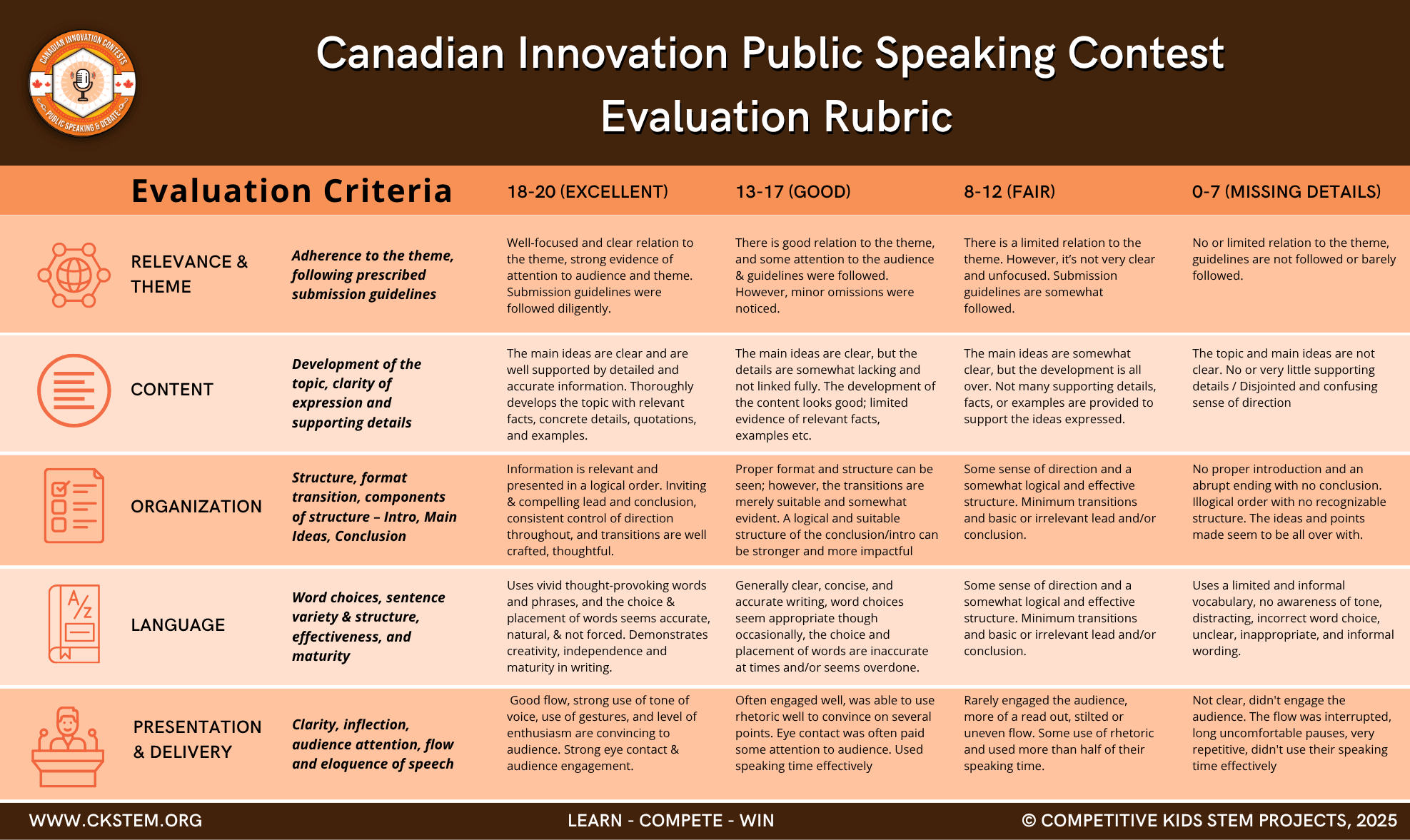
Evaluation Criteria
Public Speaking · original 2025 evaluation rubric
This is the historical rubric linked by the 2026 guide. Its original year and wording are retained. It is not a new Leadership rubric.
Relevance & Theme
Adherence to the theme, following prescribed submission guidelines
- 18–20 · Excellent
- Well-focused and clear relation to the theme, strong evidence of attention to audience and theme. Submission guidelines were followed diligently.
- 13–17 · Good
- There is good relation to the theme, and some attention to the audience & guidelines were followed. However, minor omissions were noticed.
- 8–12 · Fair
- There is a limited relation to the theme. However, it's not very clear and unfocused. Submission guidelines are somewhat followed.
- 0–7 · Missing details
- No or limited relation to the theme, guidelines are not followed or barely followed.
Content
Development of the topic, clarity of expression and supporting details
- 18–20 · Excellent
- The main ideas are clear and are well supported by detailed and accurate information. Thoroughly develops the topic with relevant facts, concrete details, quotations, and examples.
- 13–17 · Good
- The main ideas are clear, but the details are somewhat lacking and not linked fully. The development of the content looks good; limited evidence of relevant facts, examples etc.
- 8–12 · Fair
- The main ideas are somewhat clear, but the development is all over. Not many supporting details, facts, or examples are provided to support the ideas expressed.
- 0–7 · Missing details
- The topic and main ideas are not clear. No or very little supporting details / Disjointed and confusing sense of direction
Organization
Structure, format transition, components of structure - Intro, Main Ideas, Conclusion
- 18–20 · Excellent
- Information is relevant and presented in a logical order. Inviting & compelling lead and conclusion, consistent control of direction throughout, and transitions are well crafted, thoughtful.
- 13–17 · Good
- Proper format and structure can be seen; however, the transitions are merely suitable and somewhat evident. A logical and suitable structure of the conclusion/intro can be stronger and more impactful
- 8–12 · Fair
- Some sense of direction and a somewhat logical and effective structure. Minimum transitions and basic or irrelevant lead and/or conclusion.
- 0–7 · Missing details
- No proper introduction and an abrupt ending with no conclusion. Illogical order with no recognizable structure. The ideas and points made seem to be all over with.
Language
Word choices, sentence variety & structure, effectiveness, and maturity
- 18–20 · Excellent
- Uses vivid thought-provoking words and phrases, and the choice & placement of words seems accurate, natural, & not forced. Demonstrates creativity, independence and maturity in writing.
- 13–17 · Good
- Generally clear, concise, and accurate writing, word choices seem appropriate though occasionally, the choice and placement of words are inaccurate at times and/or seems overdone.
- 8–12 · Fair
- Some sense of direction and a somewhat logical and effective structure. Minimum transitions and basic or irrelevant lead and/or conclusion.
- 0–7 · Missing details
- Uses a limited and informal vocabulary, no awareness of tone, distracting, incorrect word choice, unclear, inappropriate, and informal wording.
Presentation & Delivery
Clarity, inflection, audience attention, flow and eloquence of speech
- 18–20 · Excellent
- Good flow, strong use of tone of voice, use of gestures, and level of enthusiasm are convincing to audience. Strong eye contact & audience engagement.
- 13–17 · Good
- Often engaged well, was able to use rhetoric well to convince on several points. Eye contact was often paid some attention to audience. Used speaking time effectively
- 8–12 · Fair
- Rarely engaged the audience, more of a read out, stilted or uneven flow. Some use of rhetoric and used more than half of their speaking time.
- 0–7 · Missing details
- Not clear, didn't engage the audience. The flow was interrupted, long uncomfortable pauses, very repetitive, didn't use their speaking time effectively
Public Speaking Anthem
Public Speaking Anthem
Debra Miko

Debra Miko
CIPC Advisory Board Member
Debra Miko is the executive director of The Speech and Debate Canada Foundation. During her impressive tenure at the CSDF, she rebuilt the organization to become accountable to its members and focus on our youth first, all while growing the nationwide debate activity. She has worked with hundreds of students across Canada and internationally as a judge and supervisor for the Canadian National Team.