
Historical contest guide
CISC 2026 contest guide
Theme: Empathy
Explore material preserved from an earlier CKSTEM programme: its ideas, learning resources and original context.
This is a historical archive. Dates, awards, fees and registration instructions below describe that edition; its entry period has closed. See the current contest programme and calendar.
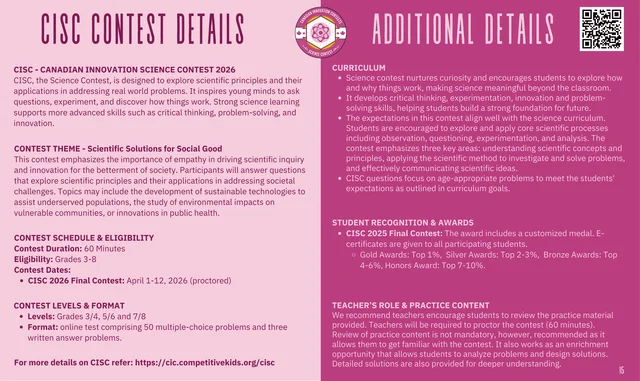
Original edition poster
CISC · original 2026 contest details
Historical 2026 poster transcript. Where this poster and the old FAQ differ, both original versions are retained; these are not 2027 instructions.
SCIENCE CONTEST*
CISC - CANADIAN INNOVATION SCIENCE CONTEST 2026
CISC, the Science Contest, is designed to explore scientific principles and their applications in addressing real world problems. It inspires young minds to ask questions, experiment, and discover how things work. Strong science learning supports more advanced skills such as critical thinking, problem-solving, and innovation. CONTEST THEME - Scientific Solutions for Social Good This contest emphasizes the importance of empathy in driving scientific inquiry and innovation for the betterment of society. Participants will answer questions that explore scientific principles and their applications in addressing societal challenges. Topics may include the development of sustainable technologies to assist underserved populations, the study of environmental impacts on vulnerable communities, or innovations in public health.
CONTEST SCHEDULE & ELIGIBILITY
Contest Duration: 60 Minutes Eligibility: Grades 3-8 Contest Dates: • CISC 2026 Final Contest: April 1-12, 2026 (proctored)
CONTEST LEVELS & FORMAT
• Levels: Grades 3/4, 5/6 and 7/8 • Format: online test comprising 50 multiple-choice problems and three written answer problems.
CURRICULUM
• Science contest nurtures curiosity and encourages students to explore how and why things work, making science meaningful beyond the classroom. • It develops critical thinking, experimentation, innovation and problem- solving skills, helping students build a strong toundation for future. • The expectations in this contest align well with the science curriculum. Students are encouraged to explore and apply core scientific processes including observation, questioning, experimentation, and analysis. The contest emphasizes three key areas: understanding scientific concepts and principles, applying the scientitic method to investigate and solve problems, and effectively communicating scientific ideas. • CISC questions focus on age-appropriate problems to meet the students' expectations as outlined in curriculum goals.
STUDENT RECOGNITION & AWARDS
• CISC 2025 Final Contest: The award includes a customized medal. E- certificates are given to all participating students. • Gold Awards: Top 1%, Silver Awards: Top 2-3%, Bronze Awards: Top 4-6%, Honors Award: Top 7-10%.
TEACHER'S ROLE & PRACTICE CONTENT
We recommend teachers encourage students to review the practice material provided. Teachers will be required to proctor the contest (60 minutes). Review of practice content is not mandatory, however, recommended as it allows them to get familiar with the contest. It also works as an enrichment opportunity that allows students to analyze problems and design solutions.
CISC 2026 Theme
CISC 2026 Theme
Learning Contest
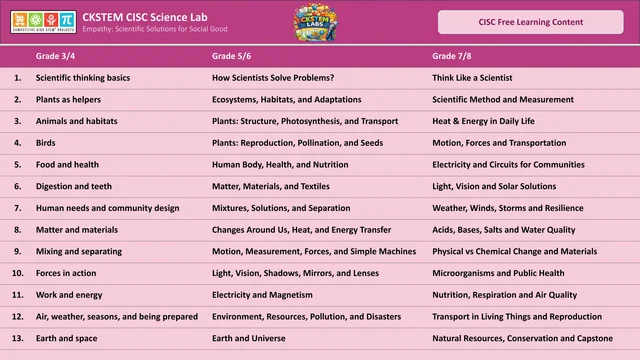
CISC Science Lab · 2026 learning content
Original free learning-content list from the 2026 Empathy edition.
Grades 3/4
- How Scientists Solve Problems?
- Scientific thinking basics
- Plants as helpers
- Ecosystems, Habitats, and Adaptations
- Plants: Structure, Photosynthesis, and Transport
- Plants: Reproduction, Pollination, and Seeds
- Human Body, Health, and Nutrition
- Matter, Materials, and Textiles
- Human needs and community design
- Mixtures, Solutions, and Separation
- Matter and materials
- Changes Around Us, Heat, and Energy Transfer
- Mixing and separating
- Motion, Measurement, Forces, and Simple Machines
- Forces in action
- Light, Vision, Shadows, Mirrors, and Lenses
- Electricity and Magnetism
- Environment, Resources, Pollution, and Disasters
- Earth and Universe
- Earth and space
Grades 5/6
Grades 7/8
- Think Like a Scientist
- Scientific Method and Measurement
- Heat & Energy in Daily Life
- Motion, Forces and Transportation
- Electricity and Circuits for Communities
- Light, Vision and Solar Solutions
- Weather, Winds, Storms and Resilience
- Acids, Bases, Salts and Water Quality
- Physical vs Chemical Change and Materials
- Microorganisms and Public Health
- Nutrition, Respiration and Air Quality
- Transport in Living Things and Reproduction
- Natural Resources, Conservation and Capstone
CISC 2026 Contest FAQ
CISC 2026 Contest FAQ
WHAT IS THE CANADIAN INNOVATION SCIENCE CONTEST (CISC)?
CISC, the Science Contest, is designed to explore scientific principles and their applications in addressing real-world problems. It inspires young minds to ask questions, experiment, and discover how things work. Strong science learning supports more advanced skills such as critical thinking, problem-solving, and innovation.
CURRICULUM CONNECTION
- Science contest nurtures curiosity and encourages students to explore how and why things work, making science meaningful beyond the classroom.
- It develops critical thinking, experimentation, innovation and problem-solving skills, helping students build a strong foundation for future.
- The expectations in this contest align well with the science curriculum. Students are encouraged to explore and apply core scientific processes including observation, questioning, experimentation, and analysis. The contest emphasizes three key areas: understanding scientific concepts and principles, applying the scientific method to investigate and solve problems, and effectively communicating scientific ideas.
- CISC questions focus on age-appropriate problems to meet the students' expectations as outlined in curriculum goals.
CONTEST ELIGIBILITY & FORMAT: APRIL 1-12, 2026
- Eligibility: Grades 3-8
- Contest Dates: April 1-12, 2026
- 2 Contest Levels - Grades 3/4, 5/6, and 7/8
- Online Test Format: 50 multiple-choice problems and a written-answer problem within 60 minutes.
- Logistics: The contest will be held online.
- Practice Content: Optional practice content is available to all students for free. Though not mandatory, it offers additional enrichment opportunities to the students. The focus is on solving questions that allow students to analyze problems & design solutions.
- Practice tests are available for students to attempt similar problems
STUDENT AWARDS
All contest participants are eligible for the following awards:
- Gold Awards: Top 1% of students for each contest level. The award includes a customized medal & e-certificate.
- Silver Awards: Top 2-3% of students for each contest level. The award includes a customized medal & e-certificate.
- Bronze Awards: Top 4-6% of students for each contest level. The award includes a customized medal & e-certificate.
- Honors Award: Top 7-10% of students for each contest level. The award includes a customized medal & e-certificate.
- Certificate of participation: Given to all participants.
* Because of the resources, CKSTEM will not pay for the international shipping to the schools. Awards will be sent to Canadian students, including schools and all other paid students. Students will also have an opportunity to join us in an award ceremony in the Greater Toronto Area (GTA).
PROCTORING
School Registrations: School teachers are responsible for proctoring students in school. Contest for a school grade must be proctored at the same time. If students take the contest at different times, only the first set of students will be considered for the awards. Up to 15 minutes of variation in start time is acceptable.
Individual Registrations: CKSTEM will proctor students who enroll for the contests directly with CKSTEM. Students are expected to use two devices with working cameras. Students must take the contest on a laptop and share the camera from this device on Zoom. The Second device is required to show the room from a different angle on Zoom. Honesty is the best policy. CKSTEM will provide multiple slots for the students to choose from during the contest period.
REGISTRATION PROCESS
- If you are a school staff interested in participating, you can find the registration package View CISC 2026 contest guide resource. You may also contact us at [email protected]. All contests are free for school registrations. We need a minimum of 5 students for school registrations. We need a minimum of 5 students for school registrations.
- If you are an individual participant, you can enroll View CISC 2026 contest guide resource. You must first create an account if you don't have it at our contest portal already. You can find instructions on how to create your account at https://www.competitivekids.org/blog/registration. There is a fee of 20 CAD for individual students.
CONTEST BROCHURE
You can download the Canadian Innovation Contests (CIC) brochure from View CISC 2026 contest guide resource.
Download Now
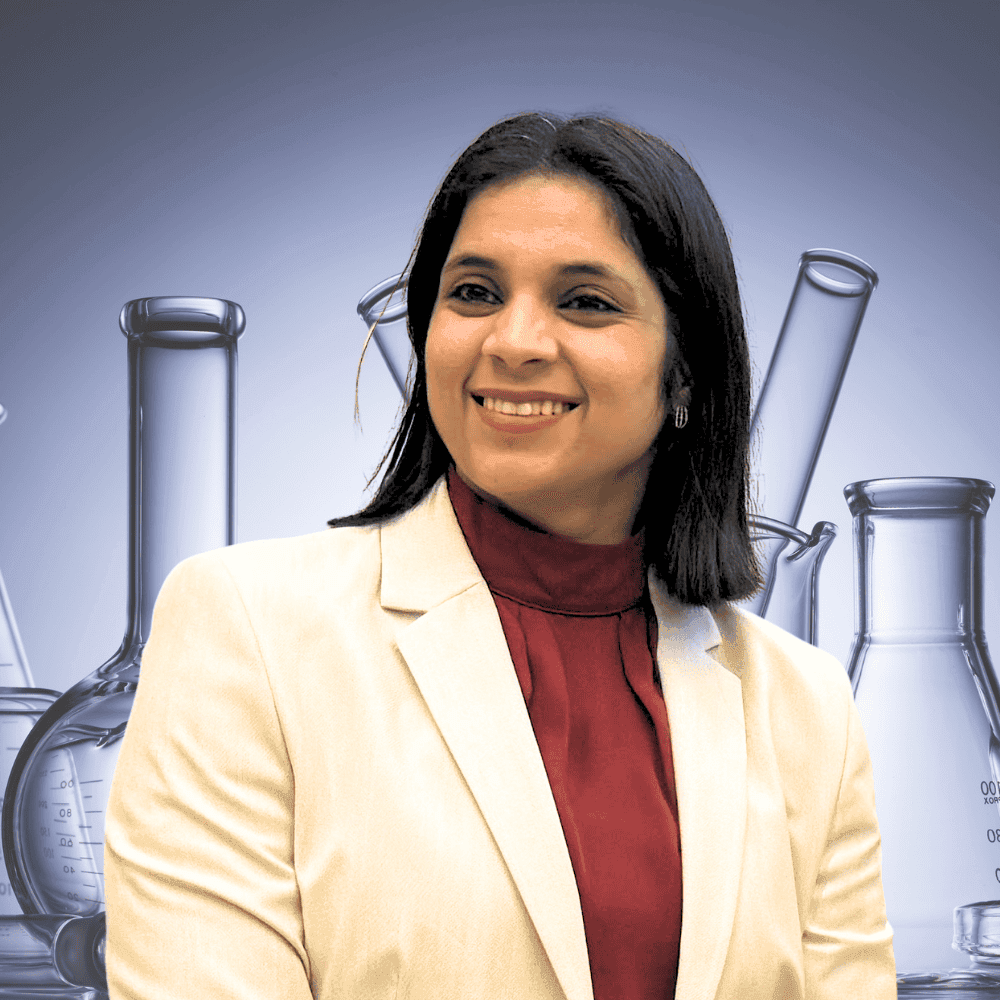
Navya Tekwani
Navya Tekwani
CISC Advisory Board Member
Navya Tekwani is a dedicated and experienced science educator who is passionate about helping students connect scientific concepts to the real world. I encourage curiosity, critical thinking, and problem-solving, with the goal of inspiring students to see science not just as a subject, but as a tool for innovation, creative thinking, and meaningful solutions to global challenges.
HELP US TO HELP OTHERS
HELP US TO HELP OTHERS
SPREAD AWARENESS AND DONATE

We want to help students all across the globe. Please help us spread the word. We are confident that the participants will have fun solving some of the coolest problems with our unique approach, allowing them to try each problem more than once.
We also need funds to run this program, especially for licensing costs involving specific tools. The anticipated cost to facilitate this is over $15000. We are relying on the generosity of our donors to help meet this cost, as we will not be charging the students any contest fees. Therefore, we will greatly appreciate your support and donation.