Historical contest guide
CIWC 2026 contest guide
Theme: Empathy
Explore material preserved from an earlier CKSTEM programme: its ideas, learning resources and original context.
This is a historical archive. Dates, awards, fees and registration instructions below describe that edition; its entry period has closed. See the current contest programme and calendar.
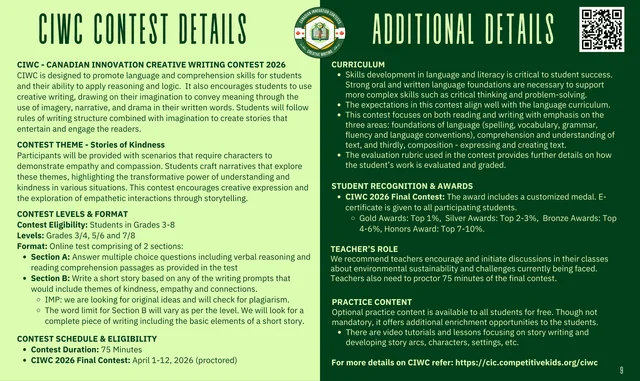
Original edition poster
CIWC · original 2026 contest details
Historical 2026 poster transcript. Where this poster and the old FAQ differ, both original versions are retained; these are not 2027 instructions.
CIWC - CANADIAN INNOVATION CREATIVE WRITING CONTEST 2026
CIWC is designed to promote language and comprehension skills for students and their ability to apply reasoning and logic. It also encourages students to use creative writing, drawing on their imagination to convey meaning through the use of imagery, narrative, and drama in their written words. Students will follow rules of writing structure combined with imagination to create stories that entertain and engage the readers. CONTEST THEME - Stories of Kindness Participants will be provided with scenarios that require characters to demonstrate empathy and compassion. Students craft narratives that explore these themes, highlighting the transformative power of understanding and kindness in various situations. This contest encourages creative expression and the exploration of empathetic interactions through storytelling.
CONTEST LEVELS & FORMAT
Contest Eligibility: Students in Grades 3-8 Levels: Grades 3/4, 5/6 and 7/8 Format: Online test comprising of 2 sections: • Section A: Answer multiple choice questions including verbal reasoning and reading comprehension passages as provided in the test • Section B: Write a short story based on any of the writing prompts that would include themes of kindness, empathy and connections. • IMP: we are looking for original ideas and will check for plagiarism. • The word limit for Section B will vary as per the level. We will look for a complete piece of writing including the basic elements of a short story.
CONTEST SCHEDULE & ELIGIBILITY
• Contest Duration: 75 Minutes • CIWC 2026 Final Contest: April 1-12, 2026 (proctored)
CURRICULUM
• Skills development in language and literacy is critical to student success. Strong oral and written language foundations are necessary to support more complex skills such as critical thinking and problem-solving. • The expectations in this contest align well with the language curriculum. • This contest focuses on both reading and writing with emphasis on the three areas: foundations of language (spelling, vocabulary, grammar, fluency and language conventions), comprehension and understanding of text, and thirdly, composition - expressing and creating text. • The evaluation rubric used in the contest provides further details on how the student's work is evaluated and graded.
STUDENT RECOGNITION & AWARDS
• CIWC 2026 Final Contest: The award includes a customized medal. E- certificate is given to all participating students. • Gold Awards: Top 1%, Silver Awards: Top 2-3%, Bronze Awards: Top 4-6%, Honors Award: Top 7-10%.
TEACHER'S ROLE
We recommend teachers encourage and initiate discussions in their classes about environmental sustainability and challenges currently being faced. Teachers also need to proctor 75 minutes of the final contest.
PRACTICE CONTENT
Optional practice content is available to all students for free. Though not mandatory, it offers additional enrichment opportunities to the students. • There are video tutorials and lessons focusing on story writing and developing story arcs, characters, settings, etc.
CIWC 2026 Theme
CIWC 2026 Theme
CIWC 2026 Contest FAQ
CIWC 2026 Contest FAQ
WHAT IS THE CANADIAN INNOVATION CREATIVE WRITING CONTEST (CIWC)?
CIWC is designed to promote students' language and comprehension skills and their ability to apply reasoning and logic. It also encourages students to use creative writing, drawing on their imagination to convey meaning through imagery, narrative, and drama in their written words. Students will follow rules of writing structure combined with imagination to create stories that entertain and engage readers.
CONTEST THEME
Theme - Stories of Kindness
Participants will be provided with scenarios that require characters to demonstrate empathy and compassion. Students craft narratives that explore these themes, highlighting the transformative power of understanding and kindness in various situations. This contest encourages creative expression and the exploration of empathetic interactions through storytelling.
CURRICULUM CONNECTION
- Skills development in language and literacy is critical to student success. Strong oral and written language foundations are necessary to support more complex skills such as critical thinking and problem-solving.
- The expectations in this contest align well with the language curriculum.
- This contest focuses on both reading and writing with emphasis on the three areas: foundations of language (spelling, vocabulary, grammar, fluency and language conventions), comprehension and understanding of text, and thirdly, composition - expressing and creating text.
- The evaluation rubric used in the contest provides further details on how the student’s work is evaluated and graded.
CONTEST ELIGIBILITY & FORMAT: APRIL 1-12, 2026
CONTEST SCHEDULE & ELIGIBILITY
- Contest Duration: 75 Minutes
- Eligibility: Grades 3-8
- Contest Dates: April 1-12, 2026
CONTEST LEVELS & FORMAT
- Three levels - Grades 3/4, 5/6 and 7/8
- Format: Online test comprising of 2 sections:
- Section A: Answer multiple choice questions related to 2 short comprehension passages as provided in the test
- Section B: Rewrite a given historical event, assuming robots were present at that event and advanced technology was used.
- IMP: we are looking for original ideas and will check for plagiarism.
- The word limit for Section B and the difficulty level of the comprehension passages in Section A will vary as per the contest level.
STUDENT AWARDS
All contest participants are eligible for the following awards:
- Gold Awards: Top 1% of students for each contest level. The award includes a customized medal & e-certificate.
- Silver Awards: Top 2-3% of students for each contest level. The award includes a customized medal & e-certificate.
- Bronze Awards: Top 4-6% of students for each contest level. The award includes a customized medal & e-certificate.
- Honors Award: Top 7-10% of students for each contest level. The award includes a customized medal & e-certificate.
- Certificate of participation: Given to all participants.
* Because of the resources, CKSTEM will not pay for the international shipping to the schools. Awards will be sent to Canadian students, including schools and all other paid students. Students will also have an opportunity to join us in an award ceremony in the Greater Toronto Area (GTA).
PROCTORING
School Registrations: School teachers are responsible for proctoring students in school. Contest for a school grade must be proctored at the same time. If students take the contest at different times, only the first set of students will be considered for the awards. Up to 15 minutes of variation in start time is acceptable.
Individual Registrations: CKSTEM will proctor students who enroll for the contests directly with CKSTEM. Students are expected to use two devices with working cameras. Students must take the contest on a laptop and share the camera from this device on Zoom. The Second device is required to show the room from a different angle on Zoom. Honesty is the best policy. CKSTEM will provide multiple slots for the students to choose from during the contest period.
REGISTRATION PROCESS
- If you are a school staff interested in participating, you can find the registration package View CIWC 2026 contest guide resource. You may also contact us at [email protected]. All contests are free for school registrations. We need a minimum of 5 students for school registrations.
- If you are an individual participant, you can enroll View CIWC 2026 contest guide resource. You must first create an account if you don't have it at our contest portal already. You can find instructions on how to create your account at https://www.competitivekids.org/blog/registration. There is a fee of 20 CAD for individual students.
CONTEST BROCHURE
You can download the Canadian Innovation Contests (CIC) brochure from View CIWC 2026 contest guide resource.
CIWC PRACTICE QUESTIONS
You can download the CIWC practice questions from View CIWC 2026 contest guide resource.
Download Now
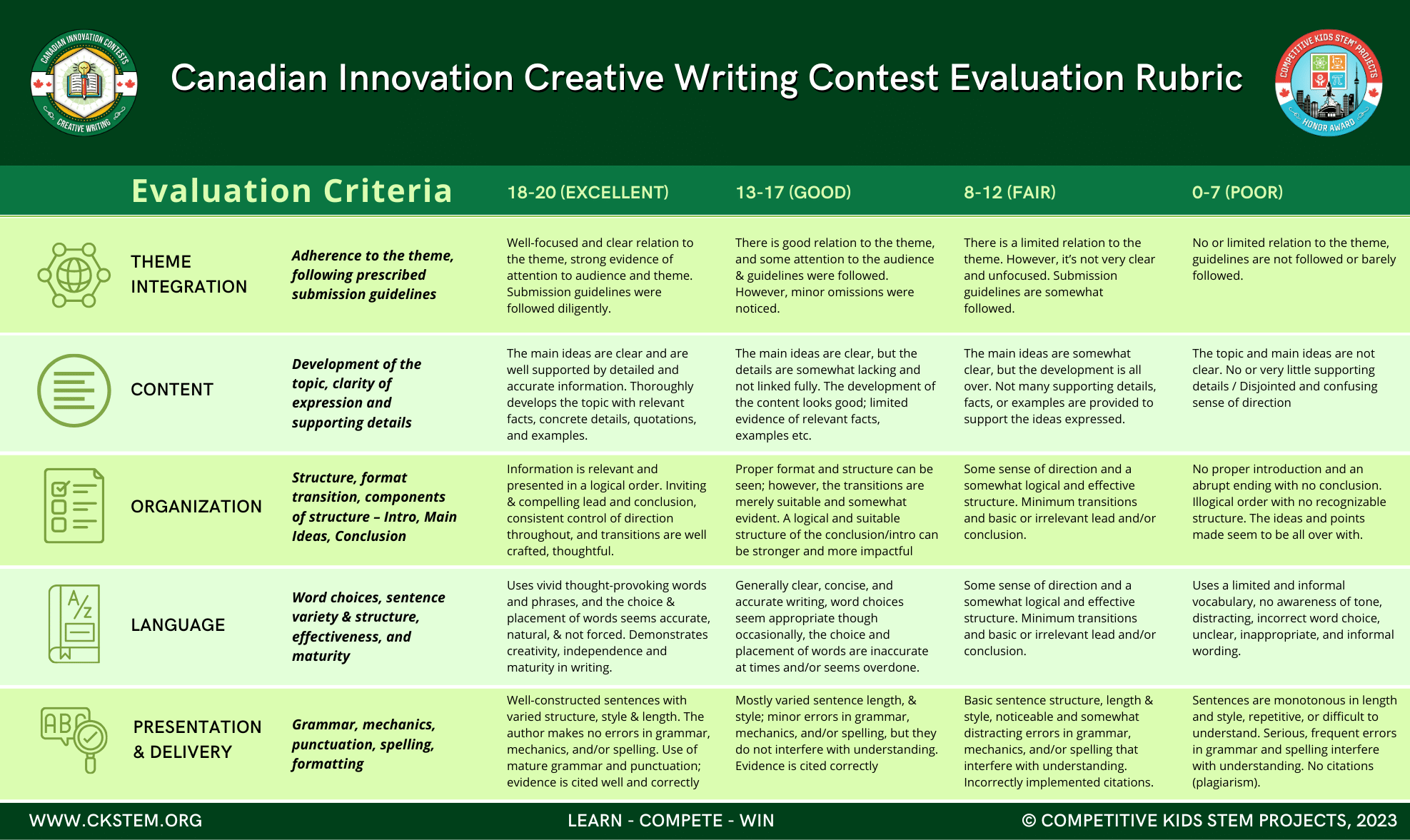
Evaluation Criteria
Creative Writing · original 2023 evaluation rubric
This is the historical rubric linked by the 2026 guide. Its original year and wording are retained. It is not a new Leadership rubric.
Theme Integration
Adherence to the theme, following prescribed submission guidelines
- 18–20 · Excellent
- Well-focused and clear relation to the theme, strong evidence of attention to audience and theme. Submission guidelines were followed diligently.
- 13–17 · Good
- There is good relation to the theme, and some attention to the audience & guidelines were followed. However, minor omissions were noticed.
- 8–12 · Fair
- There is a limited relation to the theme. However, it's not very clear and unfocused. Submission guidelines are somewhat followed.
- 0–7 · Poor
- No or limited relation to the theme, guidelines are not followed or barely followed.
Content
Development of the topic, clarity of expression and supporting details
- 18–20 · Excellent
- The main ideas are clear and are well supported by detailed and accurate information. Thoroughly develops the topic with relevant facts, concrete details, quotations, and examples.
- 13–17 · Good
- The main ideas are clear, but the details are somewhat lacking and not linked fully. The development of the content looks good; limited evidence of relevant facts, examples etc.
- 8–12 · Fair
- The main ideas are somewhat clear, but the development is all over. Not many supporting details, facts, or examples are provided to support the ideas expressed.
- 0–7 · Poor
- The topic and main ideas are not clear. No or very little supporting details / Disjointed and confusing sense of direction
Organization
Structure, format transition, components of structure - Intro, Main Ideas, Conclusion
- 18–20 · Excellent
- Information is relevant and presented in a logical order. Inviting & compelling lead and conclusion, consistent control of direction throughout, and transitions are well crafted, thoughtful.
- 13–17 · Good
- Proper format and structure can be seen; however, the transitions are merely suitable and somewhat evident. A logical and suitable structure of the conclusion/intro can be stronger and more impactful
- 8–12 · Fair
- Some sense of direction and a somewhat logical and effective structure. Minimum transitions and basic or irrelevant lead and/or conclusion.
- 0–7 · Poor
- No proper introduction and an abrupt ending with no conclusion. Illogical order with no recognizable structure. The ideas and points made seem to be all over with.
Language
Word choices, sentence variety & structure, effectiveness, and maturity
- 18–20 · Excellent
- Uses vivid thought-provoking words and phrases, and the choice & placement of words seems accurate, natural, & not forced. Demonstrates creativity, independence and maturity in writing
- 13–17 · Good
- Generally clear, concise, and accurate writing, word choices seem appropriate though occasionally, the choice and placement of words are inaccurate at times and/or seems overdone.
- 8–12 · Fair
- Some sense of direction and a somewhat logical and effective structure. Minimum transitions and basic or irrelevant lead and/or conclusion.
- 0–7 · Poor
- Uses a limited and informal vocabulary, no awareness of tone, distracting, incorrect word choice, unclear, inappropriate, and informal wording.
Presentation & Delivery
Grammar, mechanics, punctuation, spelling, formatting
- 18–20 · Excellent
- Well-constructed sentences with varied structure, style & length. The author makes no errors in grammar, mechanics, and/or spelling. Use of mature grammar and punctuation; evidence is cited well and correctly
- 13–17 · Good
- Mostly varied sentence length, & style; minor errors in grammar, mechanics, and/or spelling, but they do not interfere with understanding. Evidence is cited correctly
- 8–12 · Fair
- Basic sentence structure, length & style, noticeable and somewhat distracting errors in grammar, mechanics, and/or spelling that interfere with understanding. Incorrectly implemented citations.
- 0–7 · Poor
- Sentences are monotonous in length and style, repetitive, or difficult to understand. Serious, frequent errors in grammar and spelling interfere with understanding. No citations (plagiarism).