Historical contest guide
Canadian Innovation Photography Contest 2025
Theme: Environmental sustainability
Explore material preserved from an earlier CKSTEM programme: its ideas, learning resources and original context.
This is a historical archive. Dates, awards, fees and registration instructions below describe that edition; its entry period has closed. See the current contest programme and calendar.
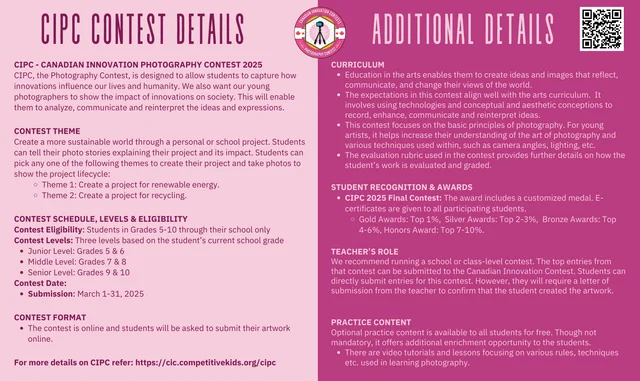
Original edition poster
Photography Contest 2025 · contest details
The Canadian Innovation Photography Contest invited students to capture how innovations influence lives, humanity and society, and to analyse, communicate and reinterpret ideas through photography.
Theme and project
Create a more sustainable world through a personal or school project. Tell a photo story explaining the project, its impact and its lifecycle. The two project themes were renewable energy and recycling.
Eligibility, levels and submission
Grades 5–10, through school only. Junior: Grades 5–6; Middle: Grades 7–8; Senior: Grades 9–10. Online submissions ran March 1–31, 2025. Students submitted their artwork online.
Curriculum and practice
The arts curriculum connection involved creating ideas and images that reflect, communicate and change views of the world; using technologies and conceptual and aesthetic approaches to record, enhance, communicate and reinterpret ideas. Photography principles included camera angles and lighting. The evaluation rubric explained grading. Optional free practice included video tutorials and lessons on photography rules and techniques.
Student recognition
The final contest offered a customized medal and e-certificates for all participants. Published award bands: Gold top 1%; Silver top 2–3%; Bronze top 4–6%; Honors top 7–10%.
Teacher’s role
The poster recommended a school or class contest, with top entries submitted to CIC. It also said students could submit directly with a teacher’s letter confirming that the student created the artwork.
Published awards and qualifier information
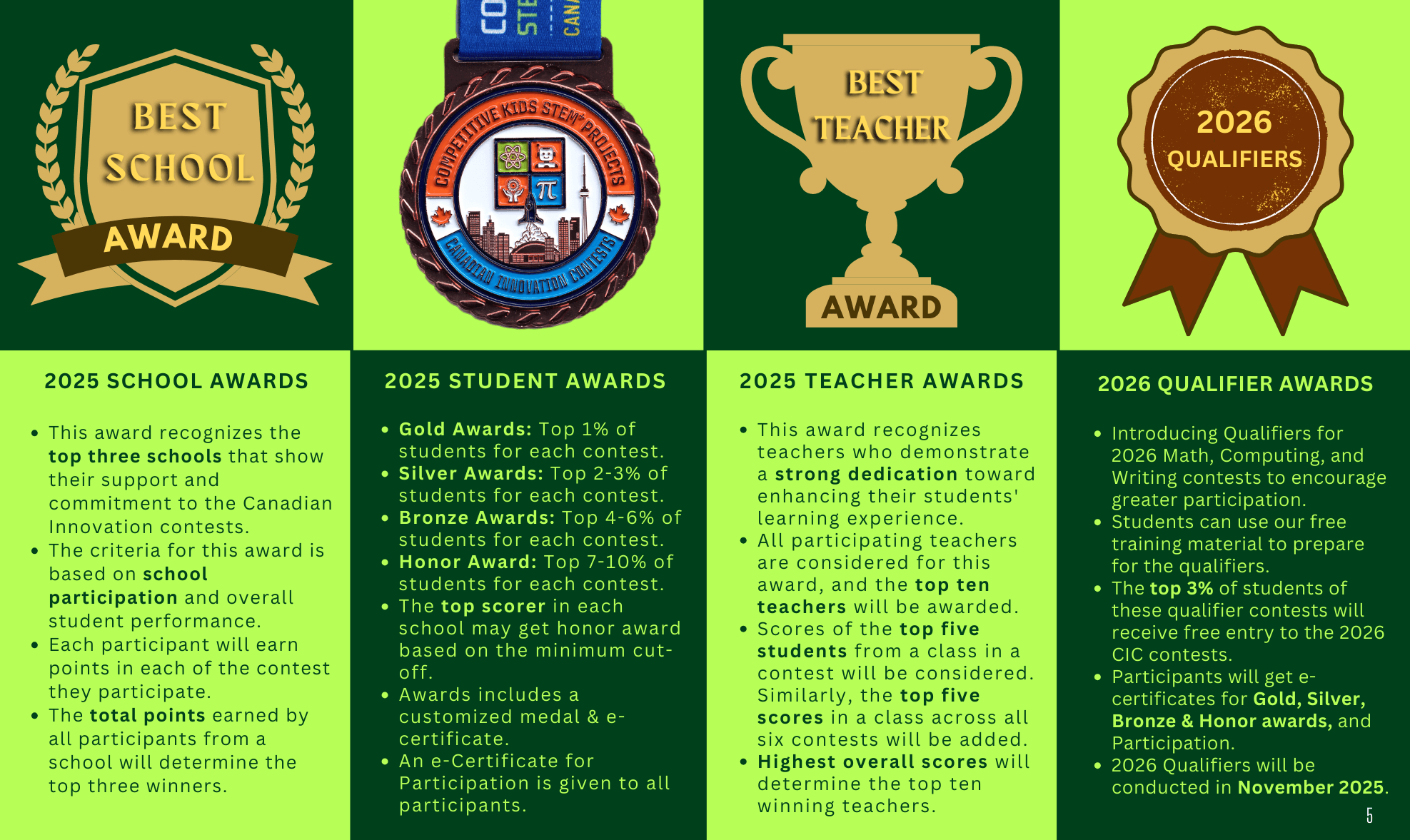
Published 2025 awards and 2026 qualifier information
2025 school awards
The top three schools were recognized for support and commitment to CIC, based on participation and overall performance. Each participant earned points in each contest entered; the school’s total points determined the top three winners.
2025 student awards
Gold: top 1%; Silver: top 2–3%; Bronze: top 4–6%; Honor: top 7–10%, for each contest. A school’s top scorer could receive an Honor award subject to a minimum cut-off. Awards included a customized medal and e-certificate. All participants received a participation e-certificate.
2025 teacher awards
All participating teachers were considered, with the top ten recognized for dedication to student learning. Scores of the top five students in a class for a contest were considered; the top five scores in a class across all six contests were added. The highest overall scores determined the winning teachers.
2026 qualifiers, held in November 2025
The poster introduced Math, Computing and Writing qualifiers. Free training material was available. The top 3% received free entry to the 2026 CIC contests. E-certificates recognized Gold, Silver, Bronze, Honor and participation. These are historical arrangements, not the 2027 entry rules.
2025 photography contest details
CIAC 2026 Theme
CIPC 2025 Contest FAQ
CIPC 2025 Contest FAQ
WHAT IS THE CANADIAN INNOVATION PHOTOGRAPHY CONTEST (CIPC)?
Last year, CKSTEM introduced three new contests in the areas of Visual Arts, Creative Writing, and Photography. We believe that these contests allow for students' holistic development and success in today’s world.
CIPC, the Photography Contest, is designed to allow students to capture how innovations influence our lives and humanity. We also want our young photographers to show the impact of innovations on society. This will enable them to analyze, communicate and reinterpret the ideas and expressions.
CONTEST THEME
Create a more sustainable world through a personal or school project. Students can tell their photo stories explaining their project and its impact. Students can pick any one of the following themes to create their project and take photos to show the project lifecycle:
- Theme 1: Create a project for renewable energy.
- Theme 2: Create a project for recycling.
CURRICULUM CONNECTION
- Education in the arts enables students to create ideas and images that reflect, communicate, and change their views of the world.
- The expectations in this contest align well with the arts curriculum. It involves using technologies and conceptual and aesthetic conceptions to record, enhance, communicate and reinterpret ideas.
- This contest focuses on the basic principles of photography. For young artists, it helps increase their understanding of the art of photography and various techniques used within, such as camera angles, lighting, etc.
- The evaluation rubric used in the contest provides further details on how the student’s work is evaluated and graded.
CONTEST ELIGIBILITY & FORMAT: MARCH 1-31, 2025
Contest Eligibility: Open to students in Grades 5-10
Contest Levels: Three levels based on the student’s current school grade
- Junior Level: Grades 5 & 6
- Middle Level: Grades 7 & 8
- Senior Level: Grades 9 & 10
Contest Date:
- Submission open: March 1 - 31, 2025
Contest Format: The contest is online, and students will be asked to submit their artwork.
Originality: We are looking for original ideas in these contests. We will conduct checks for plagiarism. So, please be sure to trust yourself and be authentic. We want to see the world through your eyes. You may surprise the world through your insight. Please create something you will be proud of, regardless of the outcome of this contest.
STUDENT AWARDS
All contest participants are eligible for the following awards:
- Gold Awards: Top 1% of students for each contest level. The award includes a customized medal & e-certificate.
- Silver Awards: Top 2-3% of students for each contest level. The award includes a customized medal & e-certificate.
- Bronze Awards: Top 4-6% of students for each contest level. The award includes a customized medal & e-certificate.
- Honors Award: Top 7-10% of students for each contest level. The award includes a customized medal & e-certificate.
- Certificate of participation: Given to all participants.
* Because of the resources, CKSTEM will not pay for the international shipping to the schools. Awards will be sent to Canadian students, including schools and all other paid students. Students will also have an opportunity to join us in an award ceremony in the Greater Toronto Area (GTA).
REGISTRATION PROCESS
- If you are a school staff interested in participating, you can find the registration package View Canadian Innovation Photography Contest 2025 resource. You may also contact us at [email protected]. All contests are free for school registrations.
- This contest is not available for individual registration as we can not verify the work.
TEST YOUR PHOTO COMPOSITION SKILLS
This composition quiz aims to help you check your knowledge of photo composition. You can access the quiz View Canadian Innovation Photography Contest 2025 resource.
CONTEST BROCHURE
You can download the Canadian Innovation Contests (CIC) brochure from View Canadian Innovation Photography Contest 2025 resource.
CIPC 2024 WINNING ENTRIES
You can review the CIPC winning entries View Canadian Innovation Photography Contest 2025 resource.
Download Now
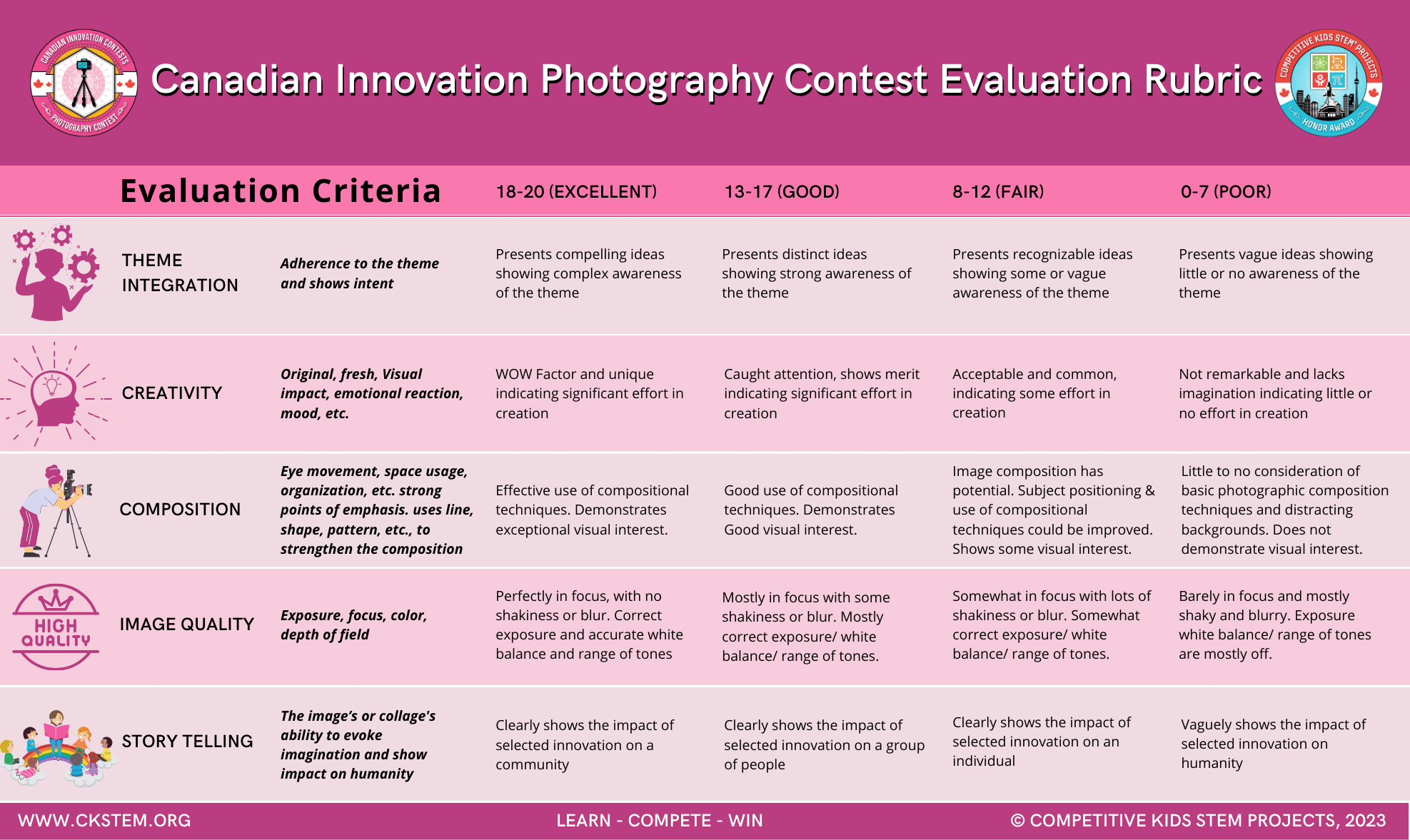
Evaluation Criteria
Photography Contest · published evaluation rubric
Original historical rubric. Each criterion uses the published bands: 18–20 Excellent, 13–17 Good, 8–12 Fair and 0–7 Poor.
Theme Integration
Adherence to the theme and shows intent
- 18–20 · Excellent
- Presents compelling ideas showing complex awareness of the theme
- 13–17 · Good
- Presents distinct ideas showing strong awareness of the theme
- 8–12 · Fair
- Presents recognizable ideas showing some or vague awareness of the theme
- 0–7 · Poor
- Presents vague ideas showing little or no awareness of the theme
Creativity
Original, fresh, Visual impact, emotional reaction, mood, etc.
- 18–20 · Excellent
- WOW Factor and unique indicating significant effort in creation
- 13–17 · Good
- Caught attention, shows merit indicating significant effort in creation
- 8–12 · Fair
- Acceptable and common, indicating some effort in creation
- 0–7 · Poor
- Not remarkable and lacks imagination indicating little or no effort in creation
Composition
Eye movement, space usage, organization, etc. strong points of emphasis. uses line, shape, pattern, etc., to strengthen the composition
- 18–20 · Excellent
- Effective use of compositional techniques. Demonstrates exceptional visual interest.
- 13–17 · Good
- Good use of compositional techniques. Demonstrates Good visual interest.
- 8–12 · Fair
- Image composition has potential. Subject positioning & use of compositional techniques could be improved. Shows some visual interest.
- 0–7 · Poor
- Little to no consideration of basic photographic composition techniques and distracting backgrounds. Does not demonstrate visual interest.
Image Quality
Exposure, focus, color, depth of field
- 18–20 · Excellent
- Perfectly in focus, with no shakiness or blur. Correct exposure and accurate white balance and range of tones
- 13–17 · Good
- Mostly in focus with some shakiness or blur. Mostly correct exposure/ white balance/ range of tones.
- 8–12 · Fair
- Somewhat in focus with lots of shakiness or blur. Somewhat correct exposure/ white balance/ range of tones.
- 0–7 · Poor
- Barely in focus and mostly shaky and blurry. Exposure white balance/ range of tones are mostly off.
Story Telling
The image's or collage's ability to evoke imagination and show impact on humanity
- 18–20 · Excellent
- Clearly shows the impact of selected innovation on a community
- 13–17 · Good
- Clearly shows the impact of selected innovation on a group of people
- 8–12 · Fair
- Clearly shows the impact of selected innovation on an individual
- 0–7 · Poor
- Vaguely shows the impact of selected innovation on humanity