Mathematical typesetting is unavailable. Reload this page to try again.
The parade of shadows
Draw a diagram
Give a difficult relationship somewhere to live.
A small rehearsal model helps Mina and Rowan plan the paper bird's journey through the Glow Garden.
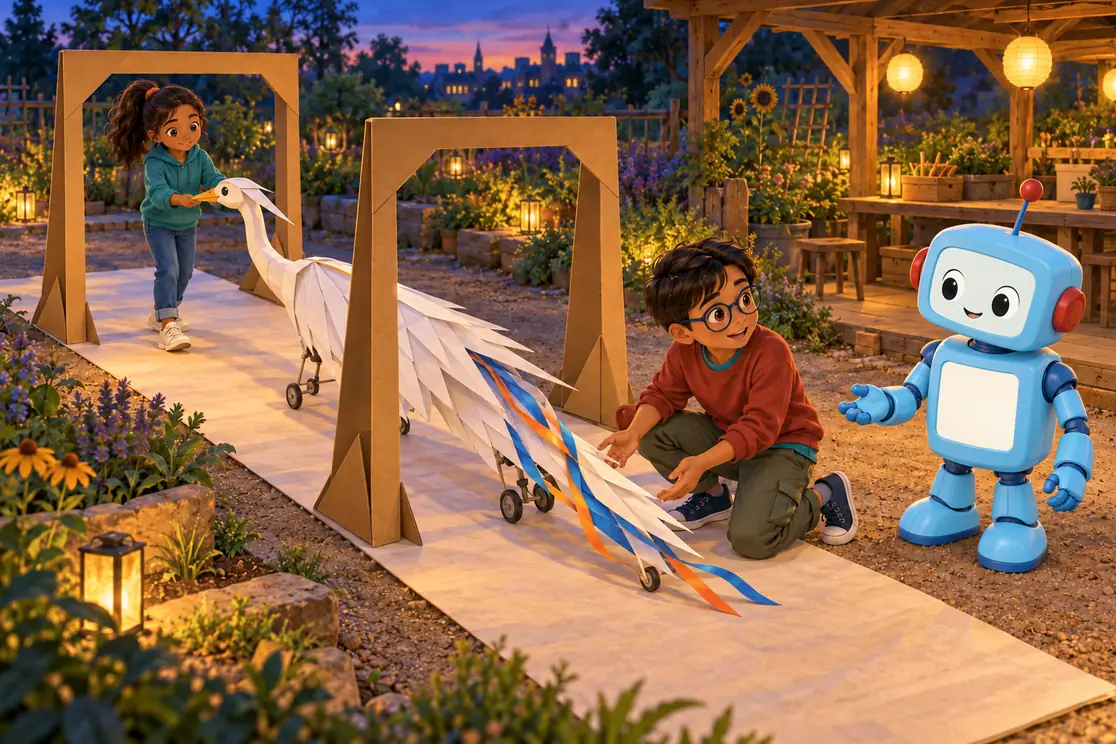
The Glow Garden is preparing an evening procession: paper creatures, changing shadows and a story told along the path. Mina and Rowan are helping plan a long paper bird. CKRobo is their coach.
Mina “The wings look wonderful. We still need the whole bird to get through the walkways on time.”
CKRobo “What could help you keep the important details in view?”
Rowan “I will sketch the parts that matter and keep them where we can compare them.”
A bird’s full length runs from its front tip to the very last trailing decoration. Each problem gives the lengths and timing rules to use.
CKSTEM Thinking CompassStuck? Find your next move.
You don’t need the whole route yet. Start with one useful move, then notice what it tells you.
What do you know for certain? What are you trying to find?
After checking your steps against every clue, choose your own check:
Ready to explore.
The direction reflects your self-check. Use the lesson’s answer and reasoning to check further when you are ready.
When is the bird really through?
A rigid paper bird is 6 metres long in all, from its front tip to its very last trailing decoration. It moves straight through a 12-metre covered walkway at a constant half a metre per second, without stopping. All its other dimensions fit through the opening.
Start the clock when the front reaches the entrance. Stop it when the rear reaches the far exit; that counts as fully clear.
Rowan proposes 24 seconds, the time to travel 12 metres.
Does that allow the whole bird to clear the walkway? Find the correct clearing time.
Full bird length: 6 m · walkway: 12 m · speed: ½ m/s
The grey region is the walkway. The bird and clock positions are described in the question.A question to help me begin
Which positions would you want your drawing to remember?
Try with the CKSTEM Thinking Compass
Interactive checking needs JavaScript. The complete question and worked answer remain available.
Does that allow the whole bird to clear the walkway? Find the correct clearing time.
When is the bird really through?
A rigid paper bird is 6 metres long in all, from its front tip to its very last trailing decoration. It moves straight through a 12-metre covered walkway at a constant half a metre per second, without stopping. All its other dimensions fit through the opening.
Start the clock when the front reaches the entrance. Stop it when the rear reaches the far exit; that counts as fully clear.
Rowan proposes 24 seconds, the time to travel 12 metres.
Full bird length: 6 m · walkway: 12 m · speed: ½ m/s
The grey region is the walkway. The bird and clock positions are described in the question.
Your answer
Enter full clearing time. Explain why the front reaching the exit does not clear the whole bird.
These quantities fit. Check full clearing time. Explain why the front reaching the exit does not clear the whole bird.
Break it into steps
Step 1 of 2
How far does the front move before the rear clears?
The front must travel twelve walkway metres plus six bird metres: eighteen in all.
Step 2 of 2
What is your answer for Clearing seconds?
Clearing seconds: 36. Compare this quantity with the complete worked reasoning; the number alone does not check your argument.
You have worked through these help steps. Return to Your answer when you are ready, and check every original clue.
Show the answer and reasoning: the whole bird
Answer:No. The whole bird needs 36 seconds to clear the walkway.
Rowan “After twenty-four seconds, the front is at the exit.”
CKRobo “How does that position compare with the question's finishing condition?”
Mina “The rear is still six metres behind it. We need a second picture with the rear at the exit.”
Clock starts
Front: entrance Rear: 6 m before entrance
Clock stops
Rear: far exit Front: 6 m beyond exit
Markers: vertical teal bar = rear; amber triangle = front. Travel is to the right.
Both pictures use the same metric scale. Compare the same point across the two positions; its complete travel is eighteen metres.
In the finishing picture, the front is six metres beyond the exit. It has travelled the walkway's length plus the bird's length:
\[12+6=18\]
At this speed, one metre takes two seconds. Eighteen metres take eighteen lots of two seconds. Equivalently, divide the distance by the speed:
\[18\div\tfrac12=36\]
Check: after 36 seconds, the front has moved 18 metres and the rear has moved from 6 metres before the entrance to the exit. After 24 seconds the rear is only halfway through.
Draw a diagram
Turn the important information into marks you can compare: positions on a line, people as dots, or quantities as bars. Say what each mark means. Keep the given relationships and use the picture to reason.
A picture of feathers would not settle the clearing time. Two simple rectangles did: they kept the front and rear visible together.
Act it out helps you follow what happens through movement. A diagram keeps chosen relationships still so you can examine them. You can move between the two.
The light-collection line
Before the rehearsal, the helpers form one line to collect their lights.
Mina is seventh from the front.Rowan is sixth from the back. There are exactly three other people strictly between them. These are all the clues.
Find every possible number of people in the whole line, including Mina and Rowan. Explain how you know none is missing.
Mina
7th from the front
Strictly between
3 other people
Rowan
6th from the back
Three clues about the same line of helpers.Try with the CKSTEM Thinking Compass
Interactive checking needs JavaScript. The complete question and worked answer remain available.
Find every possible number of people in the whole line, including Mina and Rowan. Explain how you know none is missing.
The light-collection line
Before the rehearsal, the helpers form one line to collect their lights.
Mina is seventh from the front.Rowan is sixth from the back. There are exactly three other people strictly between them. These are all the clues.
Mina
7th from the front
Strictly between
3 other people
Rowan
6th from the back
Three clues about the same line of helpers.
Your answer
Enter every possible whole-line size. Add a row for another size. Explain how your diagrams meet every clue and why no size is missing.
The listed sizes fit. Check every original clue in your diagrams and explain why your list is complete.
Break it into steps
Help step 1
How many places apart are Mina and Rowan?
The three people between them make four position changes from one named person to the other.
You have worked through these help steps. Return to Your answer when you are ready, and check every original clue.
Show the answer and reasoning: the possible lines
Answer: The line can contain 8 people or 16 people. Both totals fit all the clues.
Mina “I added seven, three and six. That gives sixteen.”
CKRobo “Which arrangements still fit all the clues?”
Rowan “Your sum puts Mina first. The clues do not say that. I will also draw a line with me nearer the front.”
Mina nearer the front
Front at left · back at right
Count each person once
Group
People
Before Mina
6
Mina
1
Strictly between
3
Rowan
1
After Rowan
5
Rowan nearer the front
Front at left · back at right
Count each person once
Group
People
Before Rowan
2
Rowan
1
Strictly between
3
Mina
1
After Mina
1
Every dot is one person. Mina is the teal square and Rowan the amber diamond. Each picture keeps all three clues, with a different order of the two names.
If Mina comes first, she is person 7 and Rowan is person 11. There are five more people behind Rowan:
\[6+1+3+1+5=16\]
If Rowan comes first, he is person 3 and Mina is person 7. One more person stands behind Mina:
\[2+1+3+1+1=8\]
Check: in the 16-person line, persons 8, 9 and 10 are between them. In the 8-person line, persons 4, 5 and 6 are between them; Rowan at position 3 is sixth from the back. Mina is seventh from the front in both pictures.
Why this is complete: one of the two children must be nearer the front. Each order fixes their positions and the total. The pictures show those two possibilities without counting anyone twice. The first calculation was valid for one order, but did not find every answer.
The pavilion banners
The children prepare two banner strips for the pavilion. They want to shorten them while keeping a particular relationship.
The blue strip is 220 centimetres long and the orange strip is 140 centimetres long.
Cut off the same length from each strip. Both remaining lengths must be positive. The remaining blue strip must be three times as long as the remaining orange strip.
How much should be cut from each strip? How long will each remaining strip be?
Blue: 220 centimetres
Orange: 140 centimetres
The original banner-strip lengths share one scale. No cuts or remaining lengths are marked.Try with the CKSTEM Thinking Compass
Interactive checking needs JavaScript. The complete question and worked answer remain available.
How much should be cut from each strip? How long will each remaining strip be?
The pavilion banners
The children prepare two banner strips for the pavilion. They want to shorten them while keeping a particular relationship.
The blue strip is 220 centimetres long and the orange strip is 140 centimetres long.
Cut off the same length from each strip. Both remaining lengths must be positive. The remaining blue strip must be three times as long as the remaining orange strip.
Blue: 220 centimetres
Orange: 140 centimetres
The original banner-strip lengths share one scale. No cuts or remaining lengths are marked.
Your answer
Enter the cut and both remaining lengths. Explain the bars and check equal cuts, positivity and the three-to-one relationship.
These quantities fit. Check the cut and both remaining lengths. Explain the bars and check equal cuts, positivity and the three-to-one relationship.
Break it into steps
Step 1 of 4
What difference survives the equal cuts?
Two hundred and twenty minus one hundred and forty is eighty. That difference is two orange-sized parts in the remaining bars.
Step 2 of 4
What is your answer for Cut from each (cm)?
Cut from each (cm): 100. Compare this quantity with the complete worked reasoning; the number alone does not check your argument.
Step 3 of 4
What is your answer for Blue left (cm)?
Blue left (cm): 120. Compare this quantity with the complete worked reasoning; the number alone does not check your argument.
Step 4 of 4
What is your answer for Orange left (cm)?
Orange left (cm): 40. Compare this quantity with the complete worked reasoning; the number alone does not check your argument.
You have worked through these help steps. Return to Your answer when you are ready, and check every original clue.
Show the answer and reasoning: equal cuts
Answer: Cut 100 centimetres from each. The blue strip will be 120 centimetres and the orange strip 40 centimetres. This is the only cut that meets the conditions.
Mina “I cannot compare the strips easily when I draw them curling.”
CKRobo “What would a simpler drawing need to preserve?”
Rowan “Equal cut-off pieces, then three equal parts left in blue and one in orange. I can draw those as straight bars.”
Lengths in centimetres · hatched pieces are removed
Blue
cutpartpartpart
Orange
cutpart
Equal hatched cuts and the three-parts-to-one-part remainders share a common scale.
Rowan “The hatched pieces are the same length.”
CKRobo “What can you work out from that?”
Mina “Blue started eighty centimetres longer. Equal cuts leave that difference. The two extra blue parts must share those eighty centimetres.”
Each remaining orange-sized part is \(80\div2=40\) centimetres. Orange therefore has 40 centimetres left, so the cut is \(140-40=100\) centimetres. Blue has three parts: \(3\times40=120\) centimetres.
Check: \(220-100=120\) and \(140-100=40\). Both lengths are positive, the cuts match, and 120 is three times 40. The difference fixes the size of a part, so another cut cannot meet the same conditions.
The bars represent quantities and their relationship. The same kind of drawing can compare amounts of water or lengths of time.
Ready for the first shadow
The crew has a second time to protect as well as the end of the procession.
A straight route has a 12-metre first walkway, then an 8-metre open gap, then a 10-metre second walkway.
The rigid bird’s full length is 6 metres, including all trailing decorations. It moves at half a metre per second, except for one 12-second pause immediately after its rear reaches the first exit. The whole bird fits in the open gap. All its other dimensions fit through both openings.
Time starts when the front reaches the first entrance and ends when the rear reaches the second far exit. There are no other pauses. Use constant speed while moving and ignore acceleration here.
The crew needs the rear clear of the first walkway by 19:59:10. The rear must clear the final exit by 20:00:00. Both deadlines are on the same evening; reaching an exit at its deadline is allowed.
What is the latest starting time, and which deadline controls it? Check that the complete journey meets both deadlines.
The route in order
Part
Metres
First walkway
12
Open gap
8
Second walkway
10
The route is straight. Grey regions are covered and the pale amber region is open.
Try with the CKSTEM Thinking Compass
Interactive checking needs JavaScript. The complete question and worked answer remain available.
What is the latest starting time, and which deadline controls it? Check that the complete journey meets both deadlines.
Ready for the first shadow
The crew has a second time to protect as well as the end of the procession.
A straight route has a 12-metre first walkway, then an 8-metre open gap, then a 10-metre second walkway.
The rigid bird’s full length is 6 metres, including all trailing decorations. It moves at half a metre per second, except for one 12-second pause immediately after its rear reaches the first exit. The whole bird fits in the open gap. All its other dimensions fit through both openings.
Time starts when the front reaches the first entrance and ends when the rear reaches the second far exit. There are no other pauses. Use constant speed while moving and ignore acceleration here.
The crew needs the rear clear of the first walkway by 19:59:10. The rear must clear the final exit by 20:00:00. Both deadlines are on the same evening; reaching an exit at its deadline is allowed.
The route in order
Part
Metres
First walkway
12
Open gap
8
Second walkway
10
The route is straight. Grey regions are covered and the pale amber region is open.
Your answer
Enter the latest starting time in separate hours, minutes and seconds fields, using a 24-hour clock. Also identify the controlling deadline and check both exit times.
The start time fits. Explain which deadline controls it and check both clearances against their deadlines.
Break it into steps
Step 1 of 7
How far must the front move before the rear clears the first walkway?
At first clearance, the rear is 12 metres from the entrance and the front is another 6 metres ahead: 18 metres in all.
Step 2 of 7
How many moving seconds does that first clearance take?
At half a metre each second, 18 metres takes 36 seconds. The pause starts after the rear reaches this exit.
Step 3 of 7
How many seconds does the complete journey take, including the pause?
The front travels 36 metres, taking 72 moving seconds. The one 12-second pause makes 84 seconds in all; do not add the bird’s length again.
Step 4 of 7
How many seconds before 20:00:00 must the bird start to meet the first deadline?
The first deadline requires 50 + 36 = 86 seconds of lead time. The final deadline requires only 84 seconds. Use the earlier start, with 86 seconds of lead time.
Step 5 of 7
What is the hours part of that latest start, on a 24-hour clock?
Working back from 20:00:00 crosses into the 19th hour. Continue the subtraction for the minute and second parts.
Step 6 of 7
What is the minutes part of that same latest start?
One minute back reaches 19:59:00; another 26 seconds reaches the preceding minute. Its minute part is 58.
Step 7 of 7
What is the seconds part of that same latest start?
The latest start is 19:58:34. First clearance is at 19:59:10, the pause ends at 19:59:22 and final clearance is at 19:59:58. The first deadline controls the start; explain the checks against both deadlines.
You have worked through these help steps. Return to Your answer when you are ready, and check every original clue.
Show the answer and reasoning: the latest start
Answer: Start no later than 19:58:34. The first-walkway deadline controls the start. The bird’s rear clears at 19:59:10, and the complete 84-second journey finishes at 19:59:58, two seconds before the final deadline.
Rowan “I added six metres for each covered walkway. Did I need both?”
CKRobo “Where is the front when the first pause begins?”
Mina “Six metres into the open gap already. I will draw the same front point through the whole journey, so I do not count that travel twice.”
Draw a diagram to record the first entrance, pause and final clearing position. Keep the same front point in every picture; a pause changes time but adds no travel.
Start
Front: 0 m
Pause
Rear: 12 m · front: 18 m Pause: 12 seconds
Finish
Rear: 30 m · front: 36 m
Markers: vertical teal bar = rear; amber triangle = front. Travel is to the right.
Every position is measured from the first entrance on the same metric scale. Following one front point avoids adding its length twice.
The first entrance is position 0 and the last exit is at \(12+8+10=30\) metres. At the pause, the front is at 18 metres. At the finish it is at 36 metres. Each moving stage is therefore 18 metres, taking 36 seconds. The complete time is \(36+12+36=84\) seconds.
Work backwards
Mina “I can go back from the final deadline through the last moving stage, the pause and the first moving stage.”
CKRobo “What starting time survives both deadlines?”
Rowan “The final deadline allows 19:58:36. But going back thirty-six seconds from the first deadline gives 19:58:34. We have to use the earlier limit.”
Work back through the required stages from each deadline. The final deadline gives the latest restart, then pause-beginning and start times. The first deadline gives a second start limit. Compare those limits; a plan must satisfy both.
Reasoning backwards · recover the latest times
From the final deadline
Known deadlineFinal clear by 20:00:00
Go back 36 secondsRestart by 19:59:24
Go back 12 secondsFirst clear by 19:59:12
Go back 36 secondsStart by 19:58:36
From the first deadline
Known deadlineFirst clear by 19:59:10
Go back 36 secondsStart by 19:58:34
The two deadlines impose different start limits. The earlier limit is required for a plan that meets both.
Checking forwards · replay the chosen plan
Start19:58:34
First clears19:59:10
Restart19:59:22
Last clears19:59:58
This forward replay includes two moving stages and exactly one twelve-second pause.
Check forwards: start at 19:58:34, clear the first walkway 36 seconds later at 19:59:10, pause until 19:59:22, then travel for 36 seconds to finish at 19:59:58. Starting one second later would still meet the final deadline, but miss the first one. Any later start fails that first deadline.
How the tools fit: the diagram establishes where each moving stage begins and ends, without counting the bird twice. Work backwards recovers two necessary start limits from the known deadlines and identifies the one that controls.
Choose the bird that can actually make the journey
The crew can choose a longer bird and one motor kit. Use the following space, elapsed-time and building-cost rules.
The straight route has a 12-metre first walkway, an 8-metre open gap, and a 10-metre second walkway. Choose a full bird length of a positive whole number of metres and exactly one motor kit. The full length includes every part of the bird, from its front tip to its last trailing decoration.
Kit S: 4 credits, speed half a metre per second. Kit F: 10 credits, speed 1 metre per second.
Building the bird costs 2 credits per metre. The total budget for bird and motor is 24 credits; there are no other costs.
The bird must pause for 12 seconds immediately after its rear reaches the first exit. During that pause, the whole bird must fit inside the 8-metre open gap. It may touch either end of the gap. All other dimensions fit through the openings.
Allow at most 84 seconds, from the front reaching the first entrance to the rear reaching the second far exit. There are no other pauses. Use the chosen kit’s constant speed while moving and ignore acceleration here.
Find the greatest possible full bird length. State the motor, total cost and full journey time. Explain what stops a longer bird with each kit, so no allowed longer design is missed.
Available motor kits
Kit
Credits
Metres per second
S
4
½
F
10
1
Full bird length
2 credits per metre Positive whole metres
Total limits
24 credits 84 seconds including pause
Available kits, building cost and the total budget and time limits.
Try with the CKSTEM Thinking Compass
Interactive checking needs JavaScript. The complete question and worked answer remain available.
Find the greatest possible full bird length. State the motor, total cost and full journey time. Explain what stops a longer bird with each kit, so no allowed longer design is missed.
Choose the bird that can actually make the journey
The crew can choose a longer bird and one motor kit. Use the following space, elapsed-time and building-cost rules.
The straight route has a 12-metre first walkway, an 8-metre open gap, and a 10-metre second walkway. Choose a full bird length of a positive whole number of metres and exactly one motor kit. The full length includes every part of the bird, from its front tip to its last trailing decoration.
Kit S: 4 credits, speed half a metre per second. Kit F: 10 credits, speed 1 metre per second.
Building the bird costs 2 credits per metre. The total budget for bird and motor is 24 credits; there are no other costs.
The bird must pause for 12 seconds immediately after its rear reaches the first exit. During that pause, the whole bird must fit inside the 8-metre open gap. It may touch either end of the gap. All other dimensions fit through the openings.
Allow at most 84 seconds, from the front reaching the first entrance to the rear reaching the second far exit. There are no other pauses. Use the chosen kit’s constant speed while moving and ignore acceleration here.
Available motor kits
Kit
Credits
Metres per second
S
4
½
F
10
1
Full bird length
2 credits per metre Positive whole metres
Total limits
24 credits 84 seconds including pause
Available kits, building cost and the total budget and time limits.
Your answer
Enter length, cost and time. Also name the motor, explain which condition stops each kit and check the full bird’s parked position.
These quantities fit. Check length, cost and time. Also name the motor, explain which condition stops each kit and check the full bird’s parked position.
Break it into steps
Step 1 of 4
What length limit does parking in the open gap impose?
The front cannot pass twenty, giving a maximum length of eight before the kit-specific time and cost checks.
Step 2 of 4
What is your answer for Greatest length (m)?
Greatest length (m): 7. Compare this quantity with the complete worked reasoning; the number alone does not check your argument.
Step 3 of 4
What is your answer for Total cost (credits)?
Total cost (credits): 24. Compare this quantity with the complete worked reasoning; the number alone does not check your argument.
Step 4 of 4
What is your answer for Elapsed seconds?
Elapsed seconds: 49. Compare this quantity with the complete worked reasoning; the number alone does not check your argument.
You have worked through these help steps. Return to Your answer when you are ready, and check every original clue.
Show the answer and reasoning: the longest allowed design
Answer: A 7-metre bird with Kit F. It costs 24 credits and completes the journey in 49 seconds. Kit S is limited by time to 6 metres; Kit F is limited by cost to 7 metres. A 7-metre bird requires Kit F because Kit S stops at 6 metres. No longer allowed design works.
Mina “One unknown length has to pass the space, time and cost checks.”
CKRobo “How could you keep those quantities clear while you compare designs?”
Mina “I will call the full bird length \(x\) metres and work through each kit separately.”
Use a variable
The same \(x\) is the full bird length in metres in every condition. It is a positive whole number. Naming it lets us find what limits each kit, rather than start a fresh calculation for every proposed length.
Draw a diagram of the pause and the finish with that same unknown length. These are labelled schematics; do not measure \(x\) from their drawn widths.
During the pause
Rear: 12 m Front: \(12+x\) m Gap ends: 12 m and 20 m
At the finish
Rear: 30 m Front: \(30+x\) m Front began at 0 m
Markers: vertical teal bar = rear; amber triangle = front. Travel is to the right.
These are labelled schematics, not a numerical measurement of x. The same full length starts at the specified rear boundary in each state; touching the gap’s far end is allowed.
Rowan “The rear is at twelve when we stop. The front is at twelve plus \(x\), and must not pass twenty.”
CKRobo “What does the finishing picture tell you?”
Mina “The rear has to reach thirty. So the front reaches thirty plus \(x\). That is its whole travel from zero.”
The pause picture puts the rear at the gap's left boundary, 12 metres, and the front at \(12+x\). Keeping it no farther than the right boundary, 20 metres, gives \(x\le8\). The finish picture puts the rear at 30 and the front at \(30+x\), so the front’s complete moving distance is \(30+x\) metres.
Casework
There are exactly two motor choices. Keep each kit’s own cost and speed together. For each case, find all three length bounds; the smallest controls that kit. Comparing the two feasible case winners then settles the greatest full length.
Case S. Moving time is \((30+x)\div\tfrac12=60+2x\) seconds. Including the pause gives \(72+2x\) seconds. The 84-second limit forces \(x\le6\). The budget gives \(4+2x\le24\), or \(x\le10\), and the gap gives \(x\le8\). All three must hold, so this kit permits at most 6 metres.
Case F. At one metre per second, divide the \(30+x\) metre distance by 1 to get the moving time in seconds. Add the pause: \((30+x)\div1+12=42+x\) seconds, giving \(x\le42\). The budget is tighter: \(10+2x\le24\), so \(x\le7\). The gap gives \(x\le8\). This kit permits at most 7 metres.
Separate upper bounds on full bird length, in metres
Kit
Space
Budget
Time
Greatest allowed
S
8
10
6
6
F
8
7
42
7
Kit S
Space bound
8 m
Budget bound
10 m
Time bound
6 m
Greatest allowed
6 m
Kit F
Space bound
8 m
Budget bound
7 m
Time bound
42 m
Greatest allowed
7 m
A design must meet all three bounds in its kit’s row. Their minimum controls that kit; its feasible winner can then be compared with the other case.
Check the winner: Kit F and a 7-metre bird cost \(10+2\times7=24\) credits. The front travels \(30+7=37\) metres in 37 seconds, and the pause adds 12 seconds: \(37+12=49\). During the pause, the bird occupies positions 12 through 19, all inside the gap from 12 to 20. Every condition holds.
Why it is greatest: Kit S cannot exceed 6 metres because of time. Kit F cannot exceed 7 metres because of cost. These are the only kits, and the 7-metre design works.
A shorter check of the greatest length
The gap allows at most 8 whole metres. At 8 metres, Kit S would take 88 seconds and Kit F would cost 26 credits, so neither works. A 7-metre bird with Kit F does work. That is another complete proof. The variable-and-case analysis also explains which condition stops each kit and can be reused if a budget or time limit changes.
How the tools fit: the diagram reveals complete travel and parking space. Use a variable keeps one changing length consistent across those relationships. Casework compares the two actual kits and explains their different limits.
Your turn
Decide what the question asks and what you can find from the given information. Try each question mentally before opening its answer.
A miniature train
A miniature train is 3 metres long. It moves straight through a 7-metre tunnel at 2 metres per second, without pausing; all its other dimensions fit through the opening.
How many seconds pass from the front reaching the entrance to the rear reaching the far exit?
Try with the CKSTEM Thinking Compass
Interactive checking needs JavaScript. The complete question and worked answer remain available.
How many seconds pass from the front reaching the entrance to the rear reaching the far exit?
A miniature train
A miniature train is 3 metres long. It moves straight through a 7-metre tunnel at 2 metres per second, without pausing; all its other dimensions fit through the opening.
Your answer
Enter complete clearing time. Explain front and rear positions, not only the distance to the front exit.
These quantities fit. Check complete clearing time. Explain front and rear positions, not only the distance to the front exit.
Break it into steps
Step 1 of 2
How far does the train’s front move before the rear clears?
Seven plus three is ten metres. Divide by the speed of two metres per second.
Step 2 of 2
What is your answer for Clearing seconds?
Clearing seconds: 5. Compare this quantity with the complete worked reasoning; the number alone does not check your argument.
You have worked through these help steps. Return to Your answer when you are ready, and check every original clue.
Show the answer and reasoning: the miniature train
Answer:5 seconds.
Start
Finish
The front moves ten metres while the rear moves from three metres before the entrance to the seven-metre exit.
The front travels \(7+3=10\) metres. At 2 metres per second, \(10\div2=5\) seconds. Check: the front is then 10 metres beyond its start; the rear, 3 metres behind it, has reached the exit 7 metres from the entrance.
The two jugs
Two jugs contain 18 cups and 10 cups of water. Pour the same amount from each. Both must retain a positive amount. The larger remaining amount must be twice the smaller.
How many cups should be poured from each? How much remains in each jug?
Try with the CKSTEM Thinking Compass
Interactive checking needs JavaScript. The complete question and worked answer remain available.
How many cups should be poured from each? How much remains in each jug?
The two jugs
Two jugs contain 18 cups and 10 cups of water. Pour the same amount from each. Both must retain a positive amount. The larger remaining amount must be twice the smaller.
Your answer
Enter removal and both leftovers. Explain why the bar relationship forces one answer and check every condition.
These quantities fit. Check removal and both leftovers. Explain why the bar relationship forces one answer and check every condition.
Break it into steps
Step 1 of 4
What difference remains after equal pours?
Eighteen minus ten is eight. In the two-to-one remainder model, that is one smaller-jug part.
Step 2 of 4
What is your answer for Poured from each?
Poured from each: 2. Compare this quantity with the complete worked reasoning; the number alone does not check your argument.
Step 3 of 4
What is your answer for Larger left?
Larger left: 16. Compare this quantity with the complete worked reasoning; the number alone does not check your argument.
Step 4 of 4
What is your answer for Smaller left?
Smaller left: 8. Compare this quantity with the complete worked reasoning; the number alone does not check your argument.
You have worked through these help steps. Return to Your answer when you are ready, and check every original clue.
Show the answer and reasoning: the two jugs
Answer: Pour 2 cups from each. The jugs then contain 16 cups and 8 cups.
Amounts in cups · hatched pieces are poured out
Originally 18 cups
288
Originally 10 cups
28
Equal removal preserves the eight-cup difference. The remaining two-parts-to-one-part relationship fixes the smaller amount.
The difference remains \(18-10=8\) cups. In a two-parts-to-one-part model, that difference is one part, so the smaller remaining amount is 8 cups. It loses \(10-8=2\) cups. Check: \(18-2=16\), \(10-2=8\), and sixteen is twice eight; both amounts are positive. The fixed difference forces the smaller remaining amount to be 8 cups, so no other equal removal works.
What can the map tell you?
An artist's map shows a river path and a hill path between the same two places. It is not to scale and gives no actual path lengths. The river path looks shorter on the drawing.
Can the drawing alone prove that the real river path is shorter?
CKSTEM Thinking CompassPlan and check your reasoning.
Can the drawing alone prove that the real river path is shorter?
What can the map tell you?
An artist's map shows a river path and a hill path between the same two places. It is not to scale and gives no actual path lengths. The river path looks shorter on the drawing.
You don’t need the whole route yet. Start with one useful move, then notice what it tells you.
What do you know for certain? What are you trying to find?
After checking your steps against every clue, choose your own check:
Ready to explore.
The direction reflects your self-check. Use the lesson’s answer and reasoning to check further when you are ready.
Show the answer and reasoning: the artist's map
Answer:No. The actual shorter route cannot be determined from this drawing alone.
The river path could be 2 kilometres and the hill path 3 kilometres. It could instead be 4 kilometres while the hill path is 3 kilometres. Both fit a map with no scale or stated lengths, but they give opposite answers.
Check: appearance on this schematic is not a measurement of either real path. We need actual lengths or other information that justifies the comparison.
What should your diagram show?
A useful diagram remembers what your mind might lose: a rear end, a named person, an equal part or a condition shared by several calculations.
Choose the marks for the job. Name what they represent, keep every given relationship and explain the step the picture makes possible. Let the labels and reasoning justify your conclusion.


 Mina “The wings look wonderful. We still need the whole bird to get through the walkways on time.”
 CKRobo “What could help you keep the important details in view?”
 Rowan “I will sketch the parts that matter and keep them where we can compare them.”